
20 Human Years in Dog Years — Complete Guide & Free Calculator
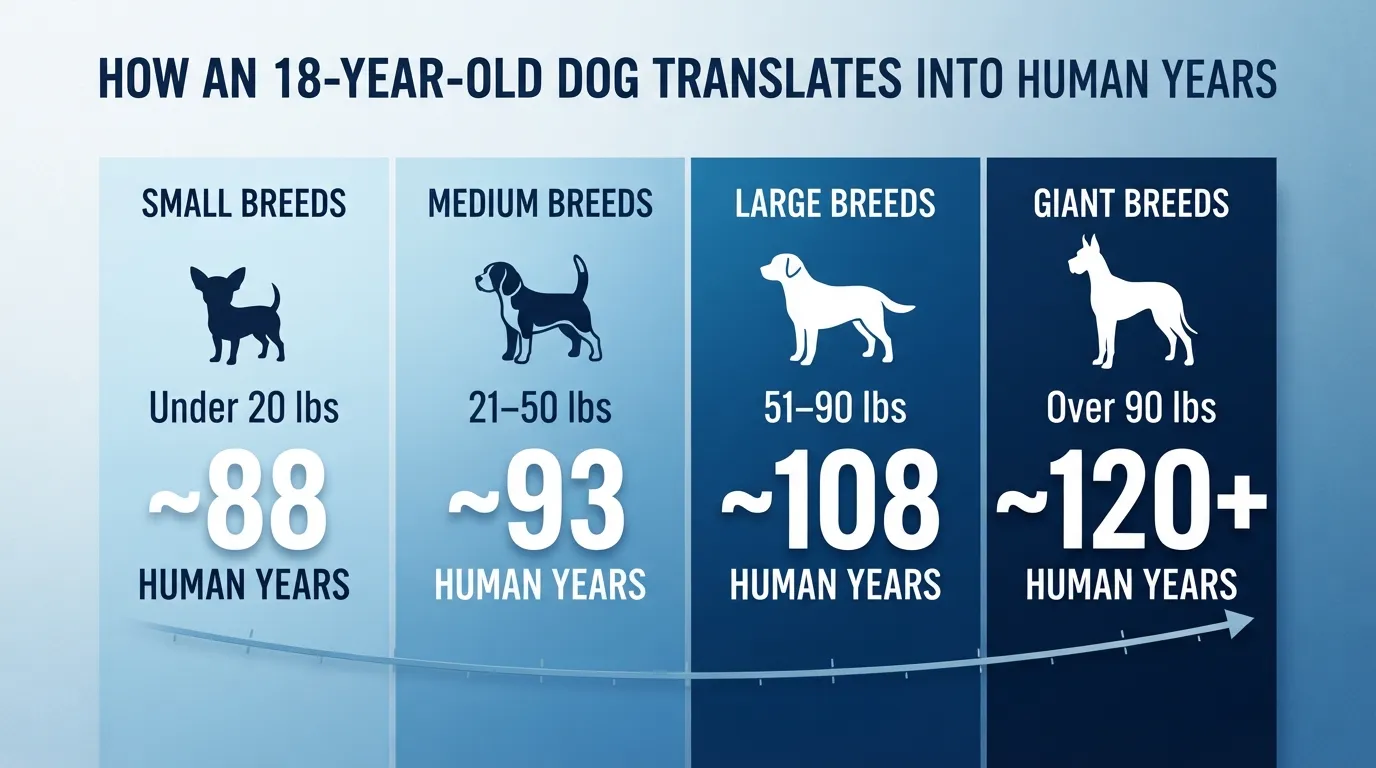
Depending on what you’re asking, “20 human years in dog years” means two very different things. If your dog has actually lived 20 calendar years, they are a rare canine super-centenarian, roughly 95 to 115+ human years old depending on their breed size. Conversely, a 20-year-old human matches the physical development and maturity of a 1.5-to-2-year-old dog.
Use our free calculator below to instantly convert your dog’s exact age based on their size and breed.dog age calculator
20 Human Years in Dog Years
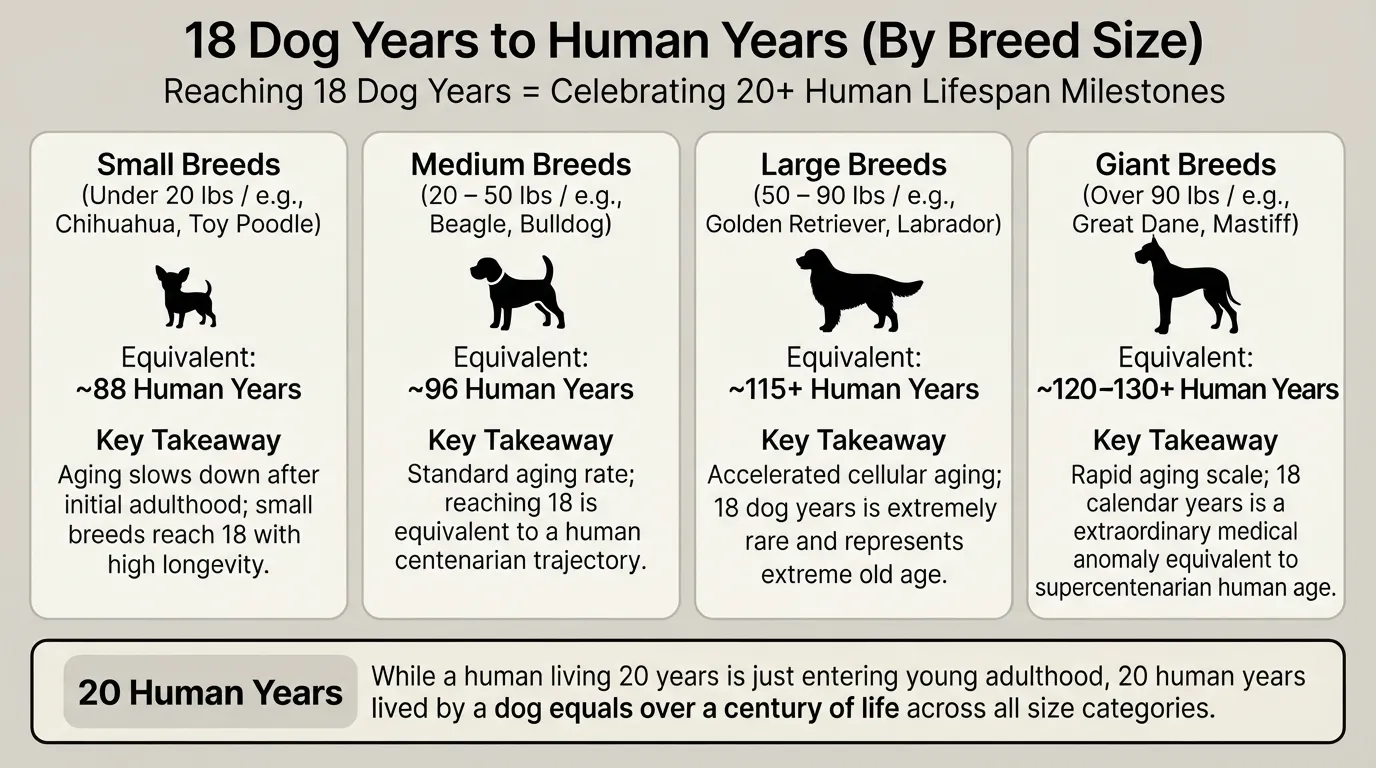
To answer this accurately, we have to look at which way you are converting. Because canine biological aging speeds up dramatically during early development and slows down later in life, the math shifts depending on your starting point.
If a dog reaches 20 calendar years of age: Your pet is in the upper 0.1% of canine longevity. In human terms, a 20-year-old dog translates to roughly 95 to 115+ human years. Small breeds like Chihuahuas or Toy Poodles sit on the lower end of that range (~95–100), while medium-to-large breeds that somehow reach two decades hit well over 115 human years due to their faster physiological aging rate.
If you are converting a 20-year-old human into dog age: A 20-year-old human has reached early adult physical maturity with completed skeletal growth. The canine equivalent is a young adult dog between 18 and 24 months old (1.5 to 2 years), a stage where playful puppy energy gives way to full structural and mental maturity.
| Interpretation | Approx. Answer | Canine Life Stage |
|---|---|---|
| A dog that is 20 calendar years old | 95 – 115+ human years | Super-Centenarian / Advanced Geriatric |
| A human who is 20 calendar years old | 1.5 – 2 dog years | Young Adult |
What Is a Dog Year vs a Human Year?
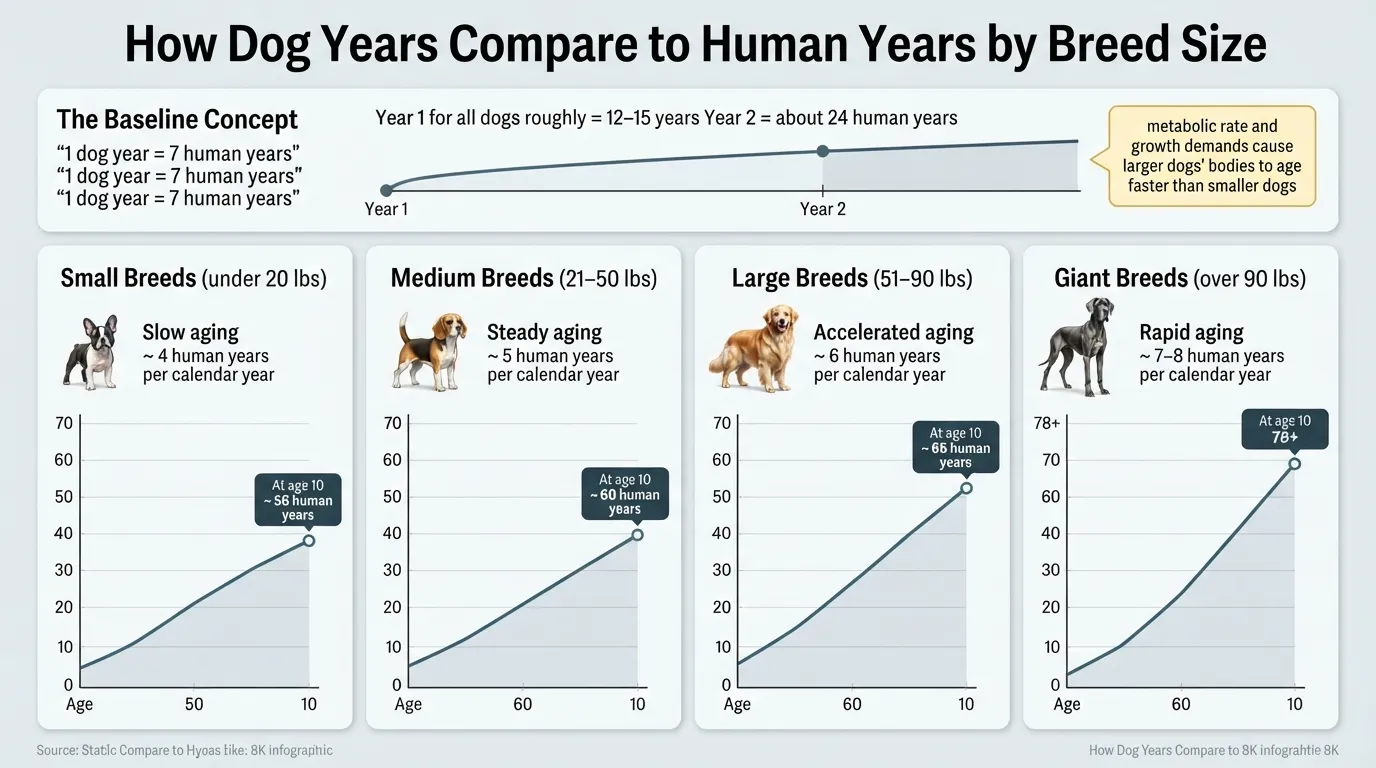
A human year measures 365 calendar days of uniform biological aging, whereas a dog year represents one calendar year of rapid, non-linear physical and cellular maturation. Dogs age roughly five to seven times faster than humans, but that progression isn’t a steady line—they compress an entire human childhood into their first 12 months.
When you look at 20 years, this non-linear curve becomes striking. A human taking 20 calendar years to reach early adult maturity is matched by a dog in just 18 to 24 months. Flip the comparison, and a dog surviving 20 calendar years undergoes two decades of accelerated cellular degradation—putting their biological body at the equivalent of a century-old human.
Why "20 Human Years in Dog Years" Confuses People
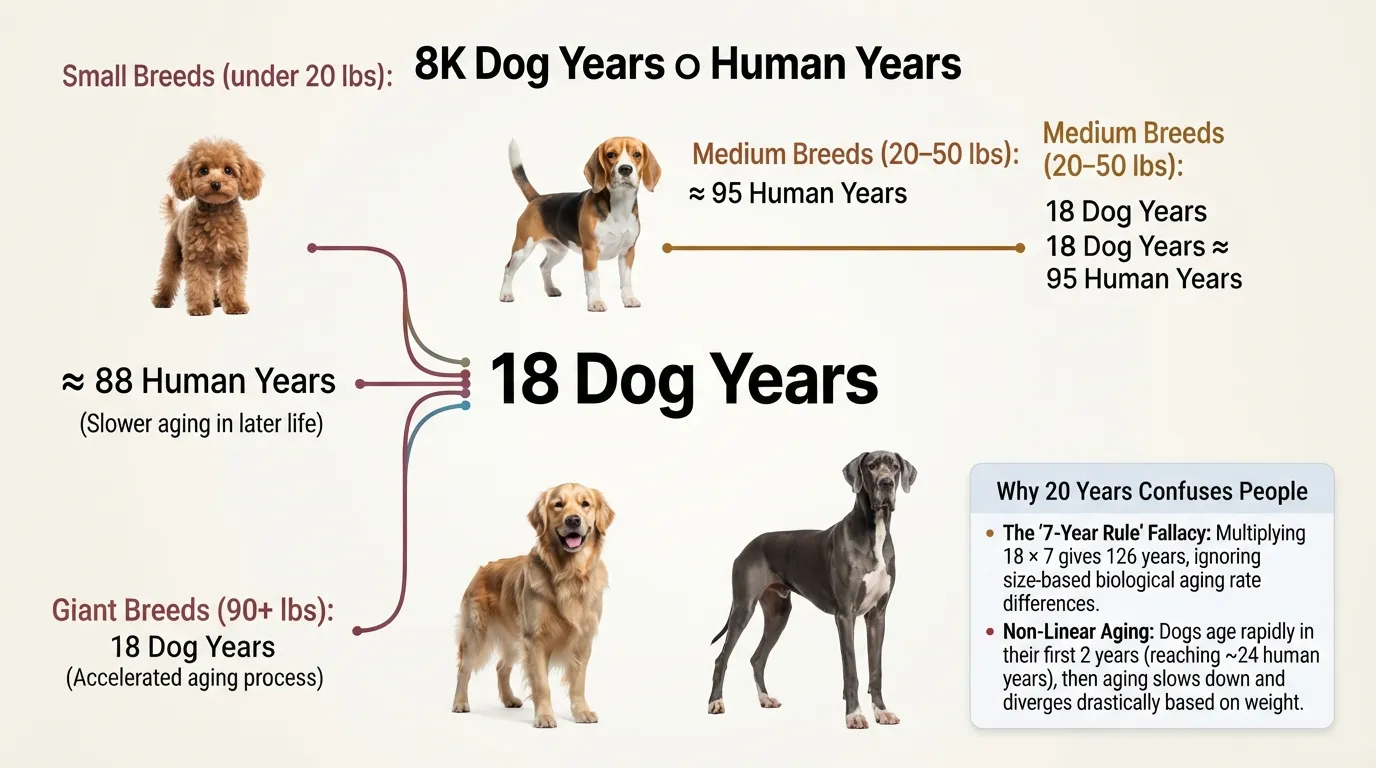
When people search for “20 human years in dog years,” they are usually coming from one of two completely different perspectives. The confusion stems from the direction of the math—specifically whether “20” represents the dog’s physical age or the owner’s age.
Because dog age formulas are non-linear, swapping the subject changes the math entirely.
Meaning #1 — A Dog That’s Lived 20 Years
In this scenario, you are looking at an extraordinary canine senior who has physically survived 20 full solar years.
When translating a 20-year-old dog into human years, you are measuring decades of accumulated cellular aging. Because dogs experience rapid infancy in their first two years followed by steady metabolic wear, a 20-year-old dog is the biological equivalent of a human living to 95, 100, or even 115+ depending on their frame.
Meaning #2 — Comparing a 20-Year-Old Human to a Dog’s Life Stage
Here, the direction is flipped: you are taking a 20-year-old person and asking, “If a human is 20, what is the matching age for a dog?”
Humans take two decades to finish physical growth, brain development, and bone consolidation. A dog compresses that exact same developmental arc into just 18 to 24 months. Therefore, a 20-year-old human is not equivalent to a 140-year-old dog (as the outdated “multiply by 7” rule suggests), but rather a young adult dog who has just filled out their adult frame.
Common Myths About Dog Aging
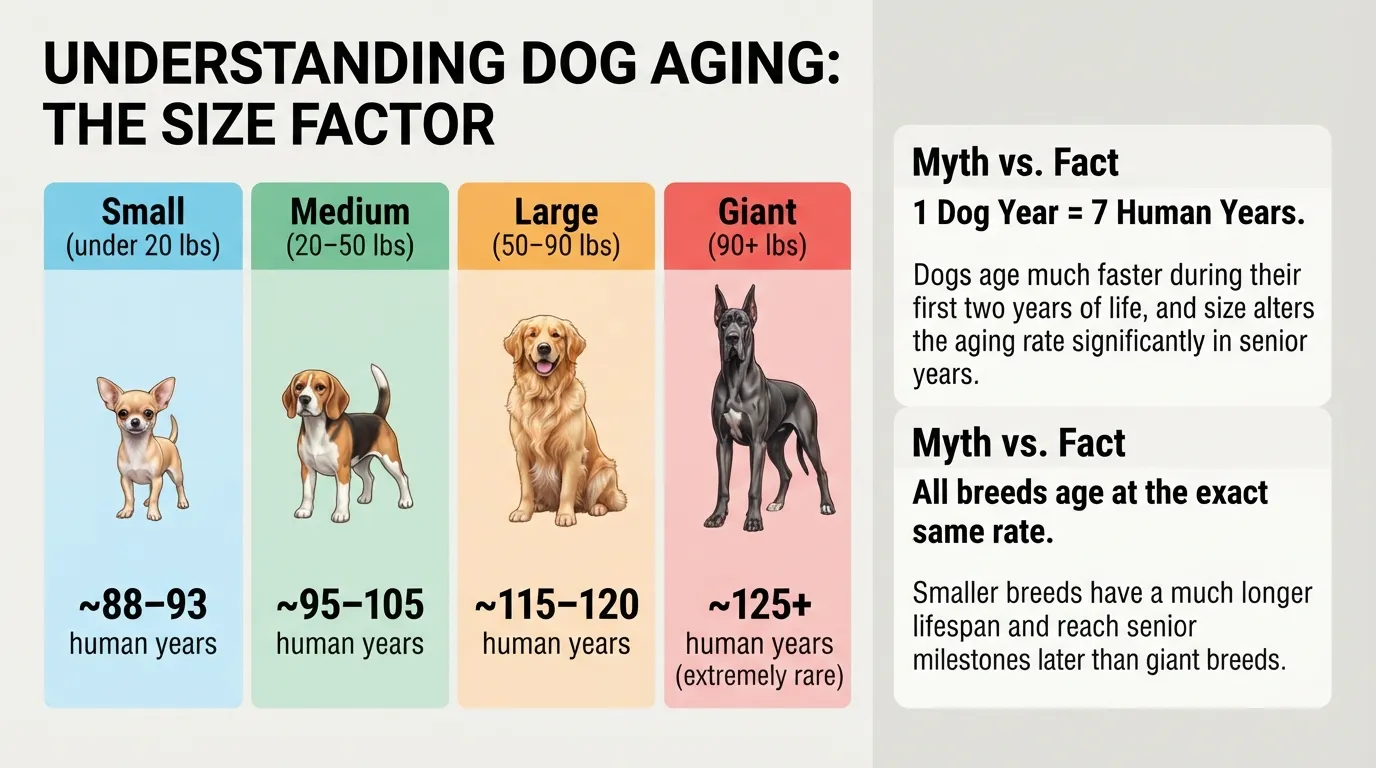
Understanding how dogs grow requires unlearning a few widely accepted myths that have circulated for decades. When owners apply simplistic math to canine health, they often misjudge their dog’s true biological needs.
Myth #1 — “1 Dog Year = 7 Human Years”
This famous ratio likely originated in the mid-20th century as a marketing trick or simplified rule of thumb. It was based on basic math: average human lifespans were roughly 70 years, while average canine lifespans hovered around 10.
The formula fails because it assumes aging happens at a constant speed throughout a dog’s entire life. In reality, a one-year-old dog has already reached sexual maturity and full adult height—something no seven-year-old child has accomplished.
To correct this, official guidelines from the American Veterinary Medical Association (AVMA) provide a far more accurate baseline for medium-sized dogs:
Year 1 equals roughly 15 human years: A pup completes infancy, childhood, and early adolescence in just 12 months.
Year 2 adds approximately 9 human years: By age two (~24 human years), a dog reaches full skeletal growth and mental maturity.
PetMDYear 3 and beyond adds about 5 human years per calendar year: The aging process slows down to a predictable rate for mid-life care.
Myth #2 — “All Dogs Age at the Same Rate”
A 10-year-old Chihuahua is often bright-eyed, nimble, and entering senior status, whereas a 10-year-old Great Dane is a geriatric dog facing significant physical decline. Dog breeds age along completely different biological timelines based on genetics, metabolic rates, and body composition. Treating all breeds with a single aging formula leads to misdiagnosing early signs of senior joint pain, organ decline, or cognitive changes.
Myth #3 — “Bigger Dogs Live Longer”
In almost every other area of the animal kingdom, larger species outlive smaller ones—whales outlive elephants, and elephants outlive mice. Domestic dogs are the stark exception to this biological rule.
Large and giant breeds age at an accelerated pace post-puppyhood. Their bodies experience faster cell growth, higher metabolic stress, and quicker structural wear over time. Because of this accelerated biological clock, large dogs reach senior milestones around 5 to 6 years old, while small dogs don’t hit the same physiological markers until age 8 or 9.
Full Dog-to-Human Age Chart by Size
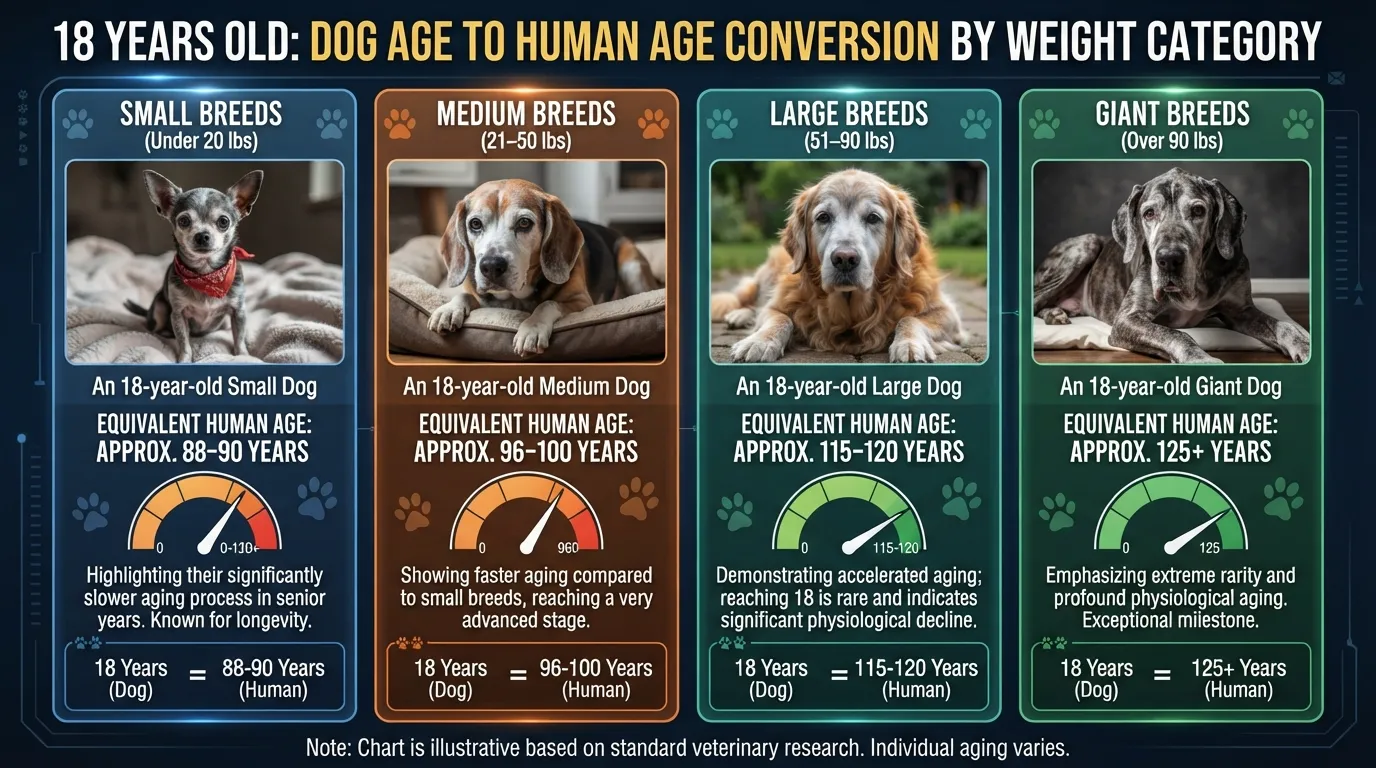
Because a dog’s weight class dramatically shifts how fast their cells age after maturity, calculating human years requires a size-adjusted breakdown. Smaller breeds age slower post-puppyhood, allowing a 20-year-old toy dog to hover around 96 human years, whereas a large or giant dog reaching two decades hits well over 115 to 120 human years.
The comparison table below uses size-adjusted veterinary formulas to track aging from young adulthood to extreme senior status.
| Human Years | Small Breeds (<20 lbs) | Medium Breeds (20–50 lbs) | Large Breeds (50–90 lbs) | Giant Breeds (>90 lbs) |
|---|---|---|---|---|
| 18 Years | 88 Dog Years | 96 Dog Years | 110 Dog Years | 133 Dog Years |
| 19 Years | 92 Dog Years | 100 Dog Years | 115 Dog Years | 139 Dog Years |
| 20 Years 🌟 | 96 Dog Years | 105 Dog Years | 120 Dog Years | 146+ Dog Years |
| 21 Years | 100 Dog Years | 110 Dog Years | 125 Dog Years | 152+ Dog Years |
Dog Age Chart by Popular Breed
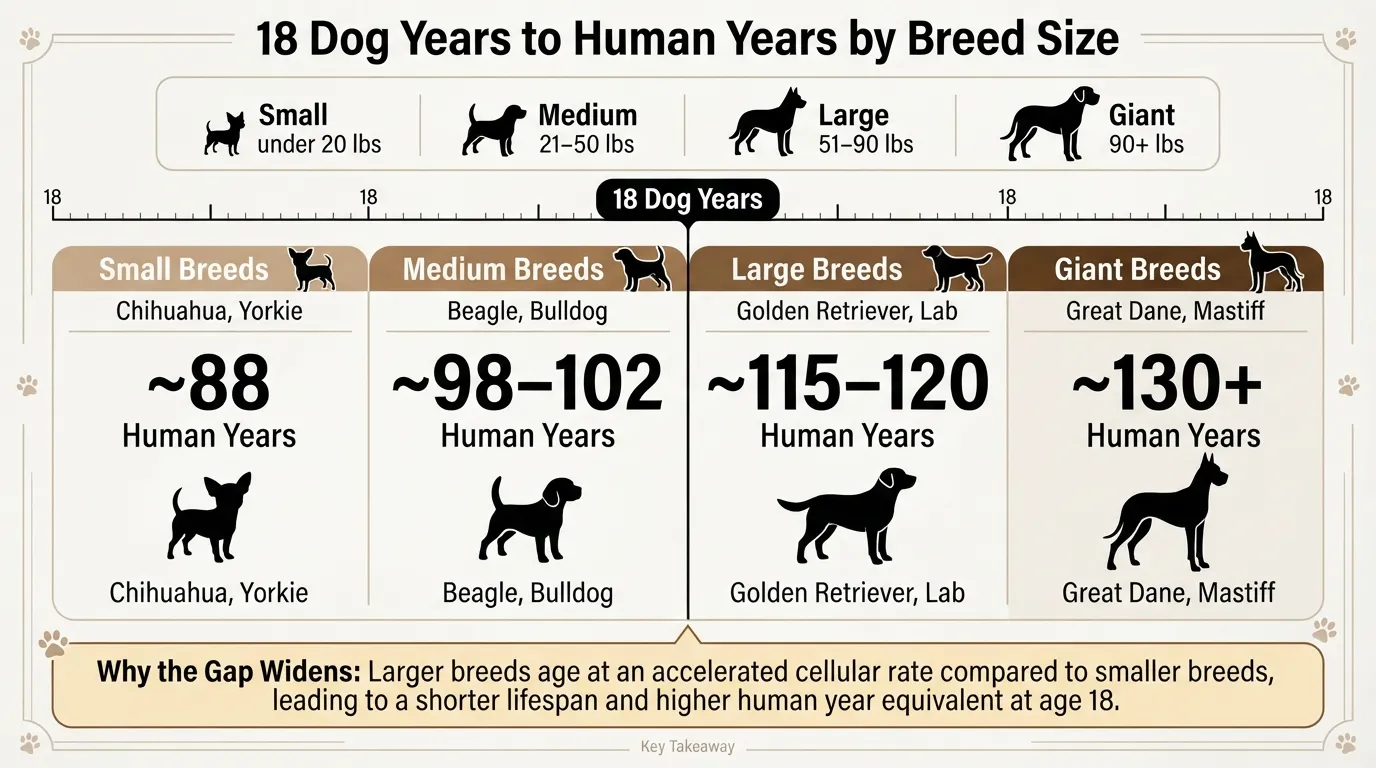
Different dog breeds carry unique genetic factors and metabolic rates that shape how they age. While size class gives a solid general estimate, seeing how specific popular breeds progress to their senior milestone helps contextualize your dog’s true biological age.
Below is a breed-by-breed look at how the 20-calendar-year milestone translates into human-year equivalents across small, medium, and large popular dogs.
| Breed | Size Category | Average Lifespan | 20 Dog Years in Human Years |
|---|---|---|---|
| Chihuahua | Small (< 20 lbs) | 14 – 16 years | ~96 human years |
| Toy/Miniature Poodle | Small (< 20 lbs) | 14 – 18 years | ~96 human years |
| Standard Poodle | Medium/Large (45 – 70 lbs) | 12 – 15 years | ~108 human years |
| Labrador Retriever | Large (55 – 80 lbs) | 10 – 12 years | ~117 human years |
| German Shepherd | Large (50 – 90 lbs) | 9 – 13 years | ~120 human years |
| Golden Retriever | Large (55 – 75 lbs) | 10 – 12 years | ~117 human years |
| French Bulldog | Small/Medium (16 – 28 lbs) | 10 – 12 years | ~102 human years |
How to Calculate Your Dog's Age Manually Step-by-Step
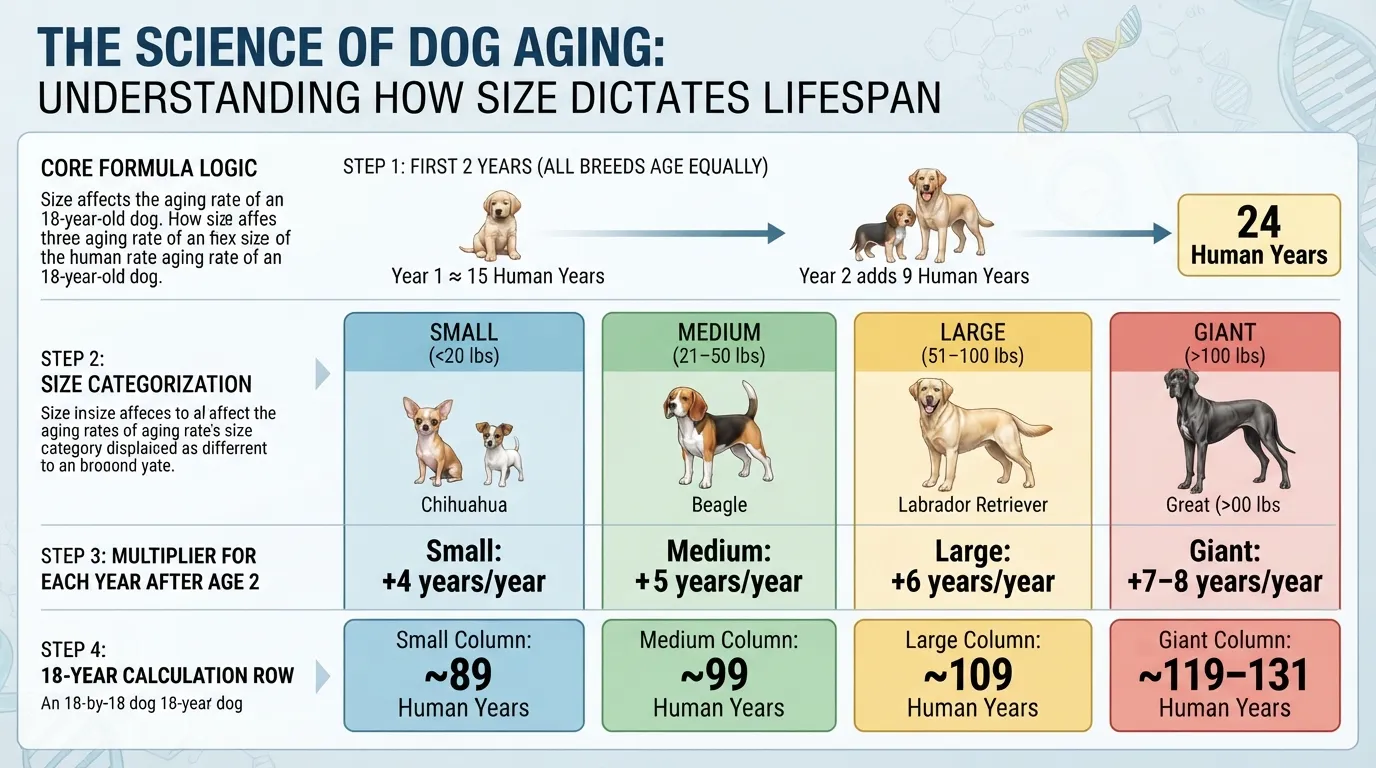
How to Calculate Your Dog's Age Manually (Step-by-Step)
If you prefer doing the math yourself rather than using an online tool, two primary methods offer accurate results: one based on veterinary clinical standards and another relying on modern genetic science.
Using the AVMA Formula
The American Veterinary Medical Association (AVMA) method provides a size-adjusted calculation that corrects the outdated "multiply by 7" rule by accounting for rapid early puppy development.
- Count year one as 15 human years: Give your dog 15 human years for their first calendar year of life to account for their fast growth into young adulthood.
- Add 9 human years for year two: Add 9 human years for your dog's second year. By age 2, a dog is roughly equivalent to a 24-year-old human.
-
Add 4 to 7 years per subsequent year based on size: For every year after age 2, add an annual multiplier based on weight class:
- Small breeds (<20 lbs): Add 4 human years per year.
- Medium breeds (20–50 lbs): Add 5 human years per year.
- Large breeds (50–90 lbs): Add 6 human years per year.
- Giant breeds (>90 lbs): Add 7+ human years per year.
Using the Epigenetic (DNA) Formula
Based on a 2019 study on DNA methylation across canine lifespans, researchers at UC San Diego created a genetic formula to determine cellular age:
-
Find the natural logarithm (ln) of your dog's age: Take your dog's age in calendar years and calculate its natural log.
Example: For a 20-year-old dog, ln(20) is approximately 2.996. -
Multiply the log result by 16: Take your step 1 result and multiply it by 16.
2.996 × 16 = 47.936 -
Add 31 to find the biological human equivalent: Add 31 to your step 2 total.
47.936 + 31 = 78.936 human years
Does Gender Affect the Conversion?
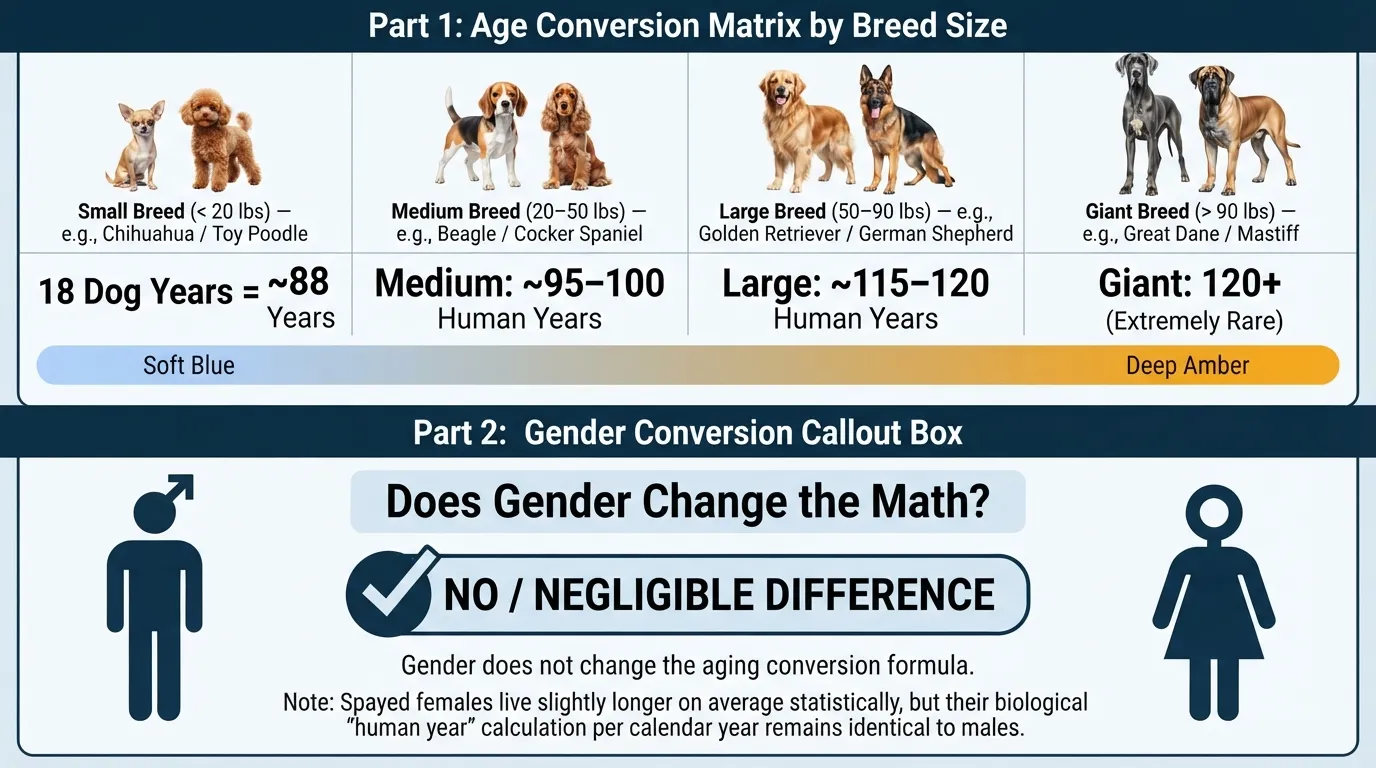
While size and breed genetics exert the strongest influence on a dog’s biological clock, biological sex and reproductive status also introduce subtle variations in how quickly a dog ages over a 20-year lifespan.
Male Dogs — Aging Differences
Intact male dogs often display slightly higher physical wear and metabolic strain earlier in life due to testosterone-driven behavioral patterns—such as increased roaming, territorial defense, and higher overall energy exertion. Structurally, males are generally larger and heavier than females of the same breed, which places greater baseline strain on their joints and cardiovascular system over two decades.
Female Dogs — Aging Differences
Female dogs generally have a slight longevity edge, consistent with trends seen across many mammalian species. Their smaller average frame size reduces cumulative physical stress on bones and organs. However, intact females that have carried litters undergo significant metabolic strain that can alter physical aging markers in their senior years.
Neutering/Spaying Impact on Aging: Spaying or neutering is one of the most significant reproductive factors affecting canine lifespan. Desexed dogs consistently outlive intact dogs—with studies showing spayed females living up to 20% longer and neutered males living up to 14% longer—due to reduced risks of reproductive cancers, uterine infections (pyometra), and dangerous roaming behaviors.
Other Common Age Conversions
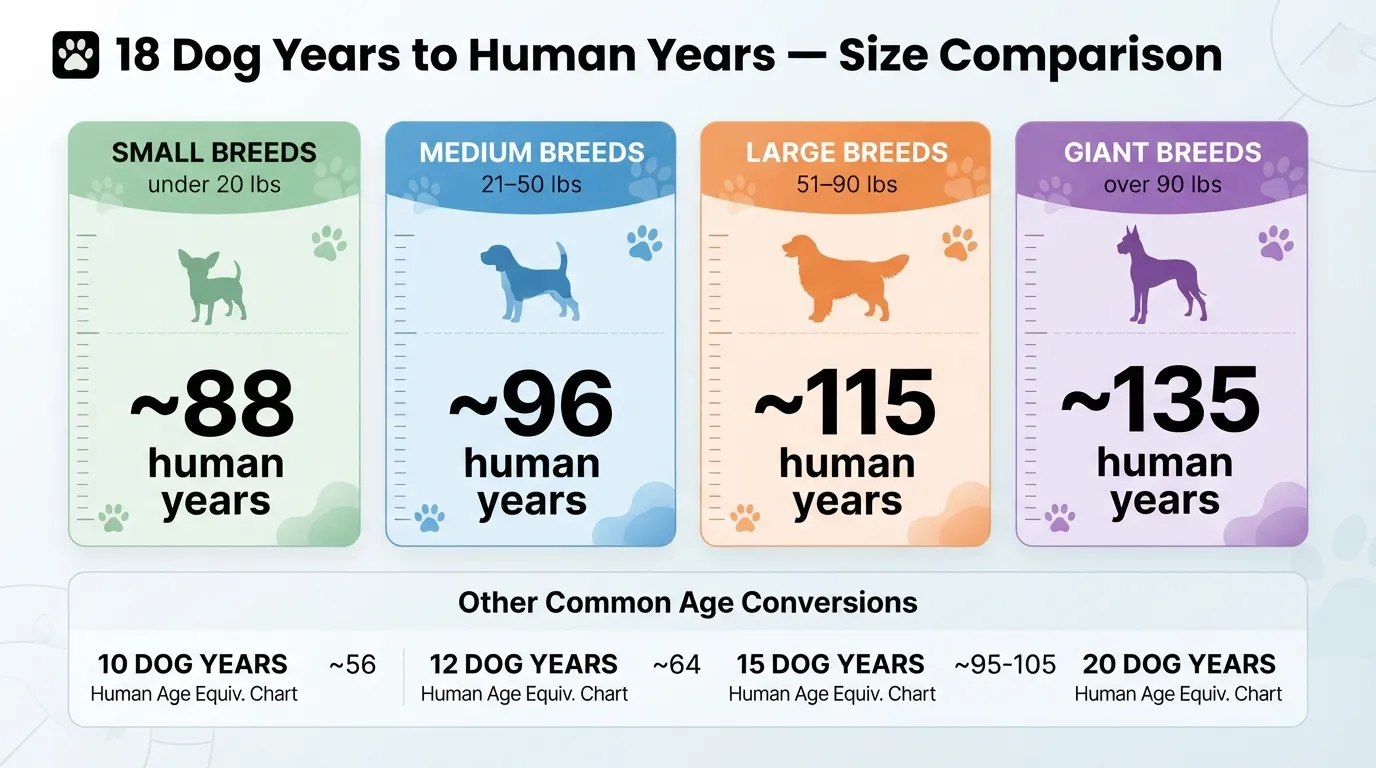
1 Human Year in Dog Years
A 1-year-old human is still an infant, but a 1-year-old dog has already zipped through childhood and reached early sexual maturity. On average, a dog’s first year equals roughly 15 human years. Use our interactive calculator above to check where your dog falls on the developmental growth curve.
5 Dog Years to Human Years
By 5 calendar years, a dog is entering their prime adult phase. Depending on their body size, 5 dog years equals roughly 36 human years for small breeds, 37 for medium breeds, and up to 45 for giant breeds. Plug your dog’s size into our calculator above to pinpoint their exact physical age.
15 Dog Years to Human Years
A dog that has lived for 15 calendar years is an advanced senior, equivalent to a 76 to 93-year-old human depending on their weight class. Small breeds at 15 sit near 76 human years, while large dogs reach roughly 93. Want to calculate your dog’s exact age? Use our free calculator above to get a size-adjusted breakdown.
18 Human Years to Dog Years
If you take an 18-year-old human reaching legal adulthood, the matching canine life stage is a 1 to 1.5-year-old dog. At this stage, a young dog has completed their rapid puppy growth spurt and reached full physical maturity. Run your dog’s age through our calculator above to compare their exact life stage.
40-Year-Old Dog in Human Years
While no dog in recorded history has ever reached 40 calendar years, the math puts a theoretical 40-year-old small dog at roughly 176 human years (and a giant breed over 280). The verified world record for the oldest dog belongs to Bluey, an Australian Cattle Dog who lived to 29 years and 5 months. Check where your dog ranks on the longevity scale using our calculator above.
90 Years Old in Dog Years
To find what “90 human years” looks like in a dog, you have to look at extreme canine old age: a small dog reaching 18 to 19 calendar years or a medium dog reaching 16 to 17 years. Very few dogs reach this milestone. Input your senior dog’s details into our calculator above to see if they’ve officially hit nonagenarian status.
100 in Dog Years
A dog reaching “100 human years” corresponds to 20 to 21 calendar years for small breeds, or around 15 to 16 calendar years for large and giant breeds. At this stage, dogs are canine super-centenarians requiring specialized senior care and mobility support. Try our free calculator above to see how close your dog is to joining the 100-year club.
Health Notes for a 20-Year-Old Dog
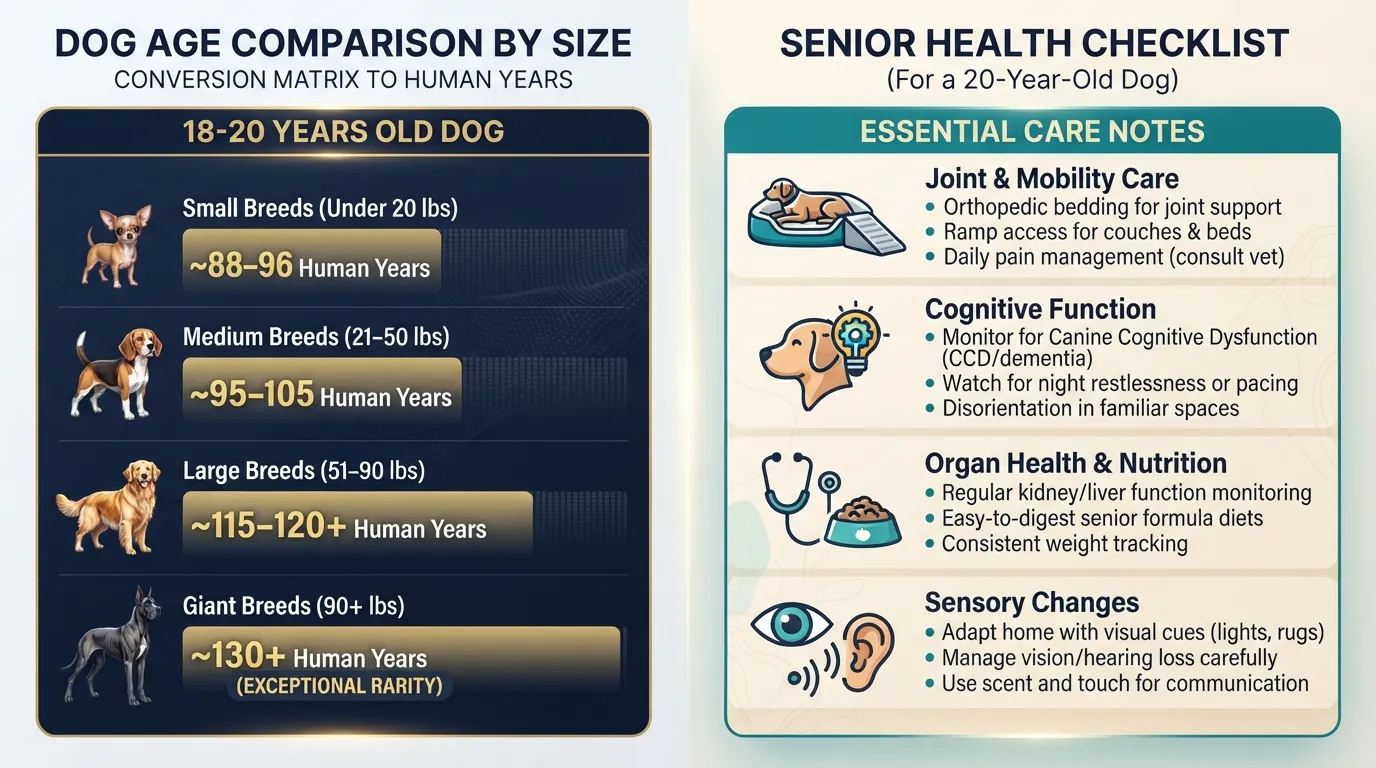
Senior vs. Geriatric Signs: A senior dog (around 7–10 human years equivalent) typically shows early stiffness, slight graying, or reduced stamina. A geriatric dog at 20 calendar years experiences end-stage aging marked by notable muscle wasting, cognitive dysfunction (disorientation/sundowning), severe joint loss, and changes in vision or hearing.
When to See a Vet More Often: Once a dog reaches extreme longevity, shift from annual checkups to vet visits every 3 to 6 months—or immediately if you notice sudden weight loss, appetite drops, incontinence, or persistent distress.
Frequently Asked Questions
How old is 20 years in dog years?
A 20-year-old dog ranges from roughly 96 to over 146 human years, depending entirely on their size. Small breeds (<20 lbs) at 20 calendar years equal around 96 human years, medium breeds reach about 105, large breeds reach 120, and giant breeds hit 146+ human years.
How old is a twenty-year-old dog?
A twenty-year-old dog is a canine super-centenarian. In biological terms, they have lived far past the average canine lifespan, placing them in the extreme geriatric stage—equivalent to a human in their late 90s to well over 100 years old.
How old is 100 in dog years?
Hitting “100 human years” in dog years corresponds to 20 to 21 calendar years for small dogs, 17 to 18 years for medium dogs, and 15 to 16 years for large or giant breeds due to their faster aging rate.
How old is a 40-year-old dog?
While no dog has ever lived to 40 calendar years (the verified record is 29 years and 5 months), mathematically a 40-year-old small dog would equal roughly 176 human years, while a giant breed would equal over 280 human years.
How old is 90 years old in dog years?
Reaching 90 human years equates to a small dog living to about 18 to 19 calendar years, a medium dog reaching 16 to 17 years, or a large dog reaching 14 to 15 years.
What is “I love you” in dog language?
Dogs express “I love you” through subtle body language cues rather than vocalizations: sustained gentle eye contact (which releases oxytocin), leaning their body weight against you, sleeping near you, enthusiastic tail wags with relaxed facial expressions, and bringing you their favorite toys.
Health Notes for a 20-Year-Old Dog
- Senior vs. Geriatric Signs: A senior dog (around 7–10 human years equivalent) typically shows early stiffness, slight graying, or reduced stamina. A geriatric dog at 20 calendar years experiences end-stage aging marked by notable muscle wasting, cognitive dysfunction (disorientation/sundowning), severe joint loss, and changes in vision or hearing.
- When to See a Vet More Often: Once a dog reaches extreme longevity, shift from annual checkups to vet visits every 3 to 6 months—or immediately if you notice sudden weight loss, appetite drops, incontinence, or persistent distress.
🐾 Other Age Guides

I built Dogagescalculator.com to give dog owners honest, science-backed answers instead of the outdated "×7" myth. Every figure here is checked against AKC, AVMA, and published veterinary research.
More about the author & this site →
Comments