
Golden Retriever Dog Years: Age Calculator & Human Years Chart
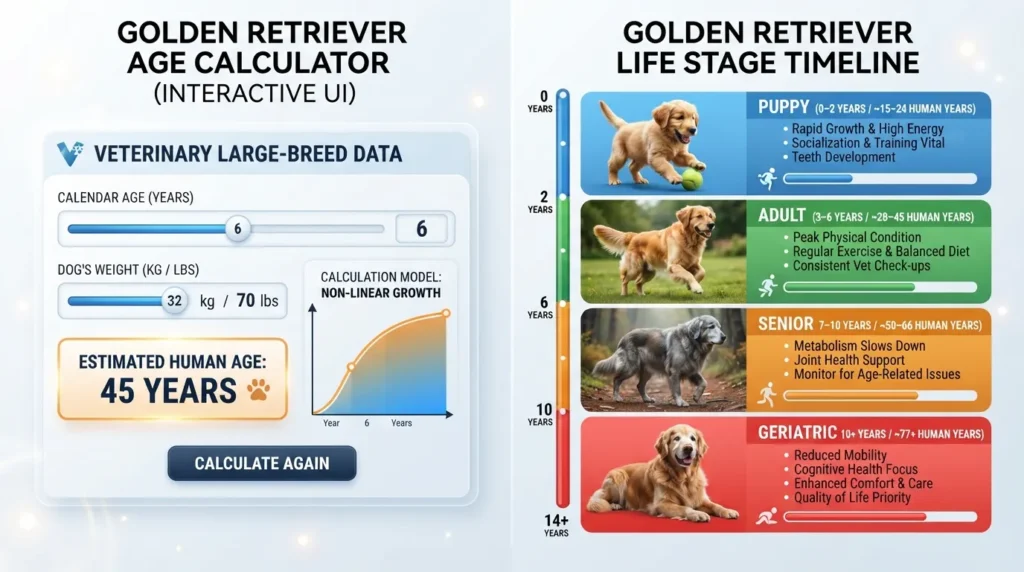
A Golden Retriever doesn’t age at a flat rate of seven human years for every calendar year. Instead, their development spikes dramatically during infancy and slows down into a steady climb as they mature.
During their first year of life, a Golden Retriever ages roughly 12 to 15 human years as they rapidly develop from a helpless puppy into a physical adult. By age two, they reach the equivalent of roughly 24 human years. After that early growth spurt settles, each additional calendar year equals about 4.5 to 5.5 human years, depending on your dog’s size, genetics, and overall health.
Use the tool below to calculate your Golden Retriever’s exact human age, or scroll down to check our comprehensive science-backed age chart.Dog Age Calculator
Golden Retriever Age Calculator
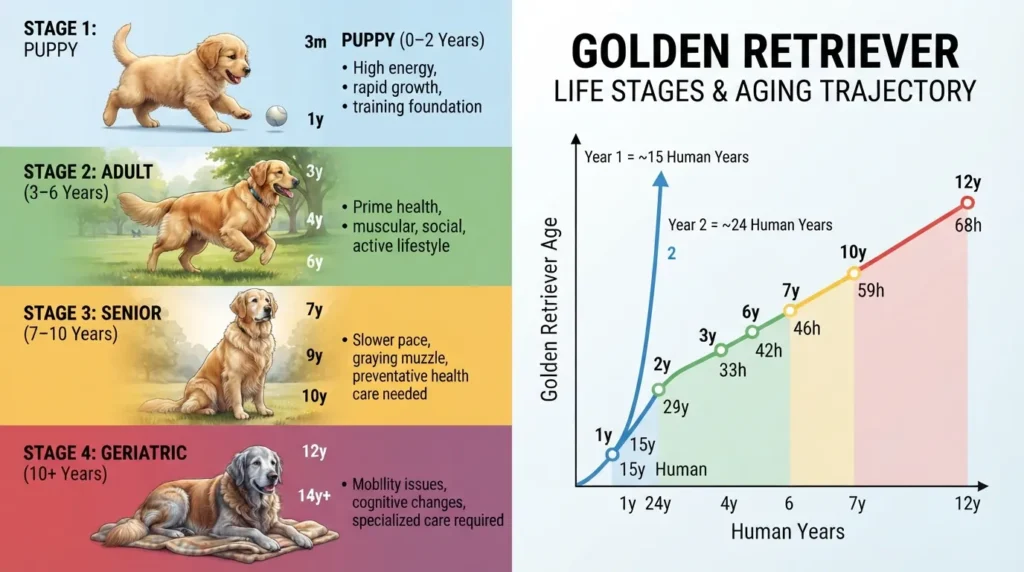
Enter your Golden Retriever’s age below to get an instant, breed-adjusted result.
(Results are based on large-breed aging data from the AKC and AVMA, not the outdated generic 7-year rule.)
Golden Retriever Dog Years to Human Years Chart
A Golden Retriever’s first year of life brings massive physical and mental changes, roughly equal to 15 human years. Their second year adds about 9 human years (reaching around 24 in human terms). Because Goldens are large-breed dogs weighing between 55 and 75 pounds, they age slightly faster after age two than smaller breeds, adding approximately 6 to 7 human years for every calendar year.
According to guidelines from the American Animal Hospital Association (AAHA), large breeds enter their senior stage earlier than small dogs. For a Golden Retriever, hitting 7 calendar years means they have reached their official senior milestone—roughly 50 human years.
Large Breed (55–75 lbs) Age Chart
| Golden Retriever Age | Human Years | Life Stage |
|---|---|---|
| 1 year | ~15 | Young Adult |
| 2 years | ~24 | Adult |
| 3 years | ~28 | Adult |
| 5 years | ~40 | Prime Adult |
| 7 years | ~50 | Senior Threshold |
| 10 years | ~66 | Senior |
| 12 years | ~77 | Golden Senior |
| 15 years | ~93 | Geriatric |
While the general rule of thumb used to be multiplying every dog year by 7, veterinary research shows that aging happens in front-loaded bursts. A 3-year-old Golden Retriever is settled into adult life at roughly 28 human years, while a 12-year-old dog has reached the human equivalent of a late-70s retiree.
Golden Retriever Puppy Age Chart (0–12 Months)
During their first 12 months, Golden Retriever puppies transition rapidly from dependent infants to energetic teenagers.
| Puppy Age | Human Age Equivalent | What to Expect |
|---|---|---|
| 2 months | ~9 months | Weaning, basic socialization, initial vaccinations |
| 6 months | ~10 years | Rapid physical growth, high energy, teething complete |
| 8 months | ~13 years | Adolescent testing stage, sexual maturity begins |
| 12 months | ~15 years | Full skeletal height reached, fills out physically |
By the time your Golden celebrates their first birthday, their rapid growth period slows down. While they may still act like a silly puppy mentally until around age two, physiologically, they have already stepped out of childhood and into young adulthood.
How Dog Years Are Calculated 3 Methods Compared
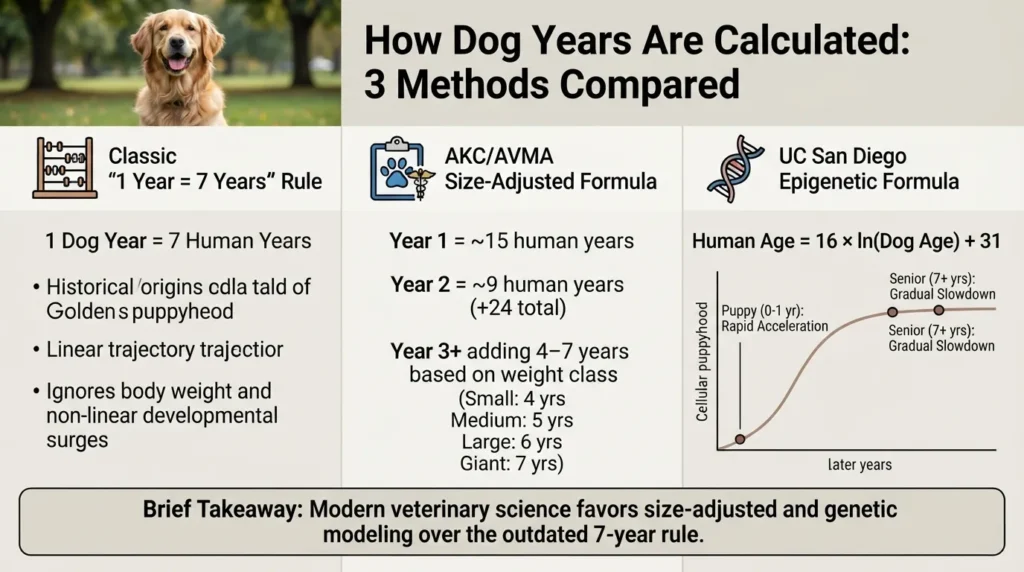
Calculating a dog’s age in human years isn’t as simple as multiplying by seven. Over the decades, veterinary science has evolved from quick rules of thumb to advanced genetic modeling to give us a much clearer picture of canine aging.
Here is how the three primary calculation methods compare.
The Classic “1 Year = 7 Human Years” Rule
For generations, the standard formula was simple: take your dog’s age in calendar years and multiply it by seven. This rule originated in the mid-20th century based on basic average lifespans at the time—assuming a human lived roughly 70 years and a dog lived about 10.
While easy to calculate in your head, it is scientifically flawed. Dogs do not age at a steady linear rate throughout their lives. A one-year-old dog has already reached full physical and sexual maturity, something a seven-year-old human child is years away from achieving. This rule also completely ignores body weight, making it especially misleading for larger breeds that experience accelerated aging later in life.
The AKC/AVMA Size-Adjusted Formula
To account for the uneven physical development of dogs, the American Veterinary Medical Association (AVMA) and the American Kennel Club (AKC) rely on a tiered, size-adjusted benchmark. This is currently the standard model used in clinical veterinary practice.
The calculation breaks down aging into clear developmental stages:
First Year: Equals approximately 15 human years, accounting for the massive growth spike from puppyhood to young adulthood.
Second Year: Adds roughly 9 human years, bringing a two-year-old dog to the equivalent of a 24-year-old human.
Third Year and Beyond: Adds 4 to 7 human years per year, directly adjusted for the dog’s size tier (small, medium, large, or giant).
Because larger dogs put more metabolic strain on their organs and musculoskeletal systems over time, their annual multiplier is higher in senior years. For everyday pet owners, this model offers the best balance of simplicity and real-world accuracy.
The UC San Diego Epigenetic (DNA Methylation) Formula
In 2020, quantitative biologists at the University of California, San Diego (led by Dr. Tina Wang and published in Cell Systems) introduced a groundbreaking model based on genetics. Instead of looking at behavioral milestones, the researchers analyzed chemical modifications on DNA—specifically DNA methylation patterns—which track biological age at the cellular level across species.
Their research yielded a logarithmic formula for converting dog years to human years:
Human Age = 16 × ln(Dog Age) + 31
(Here, ln represents the natural logarithm of the dog’s actual age in calendar years.)
Crucially, the UC San Diego study was derived from Labrador Retrievers—a breed that shares a close genetic lineage and body structure with Golden Retrievers. The data showed that dogs age incredibly fast on a molecular level during their first two years (a one-year-old retriever shares cellular markers with a 31-year-old human), but their epigenetic aging slows down substantially as they enter middle and senior age.
Golden Retriever Life Stages & Signs of Aging
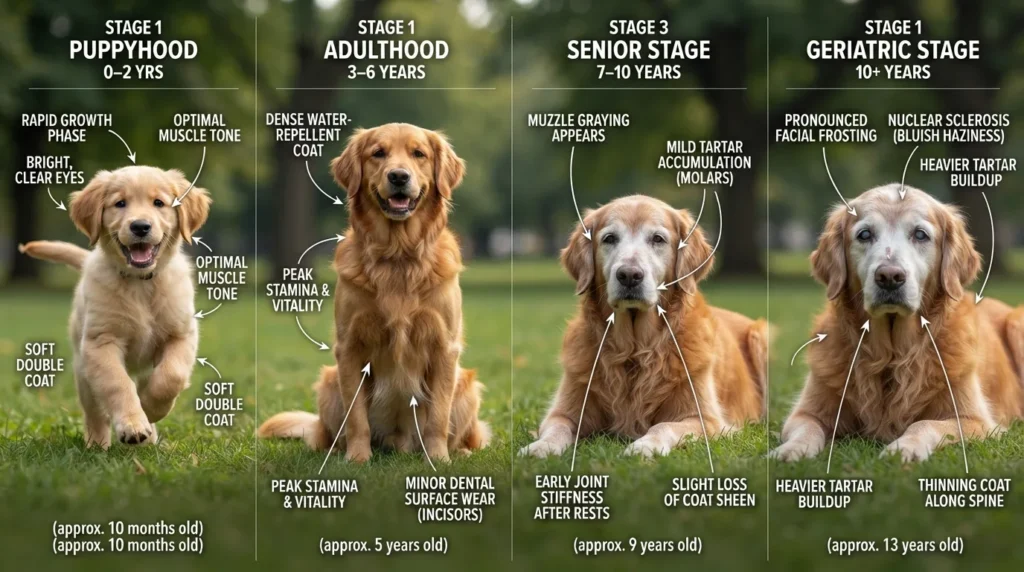
Golden Retrievers move through distinct developmental milestones, each requiring different care strategies as their body composition and energy levels evolve.
Puppy (0–2 yrs) → Adult (3–6 yrs) → Senior (7–10 yrs) → Geriatric (10+ yrs)
Puppyhood (0–2 years): Marked by explosive bone growth and high energy, Goldens reach full skeletal height around 12–18 months and emotional maturity near age two.
Adult (3–6 years): The prime athletic years where muscle tone, coat density, and stamina peak, requiring steady exercise to maintain joint health.
Senior (7–10 years): The transitional phase where metabolic rates drop, making joint support, weight management, and proactive wellness exams critical.
Geriatric (10+ years): Focus shifts entirely to comfort, cognitive health, mobility assistance, and preserving daily quality of life.
How to Tell Your Golden’s Age from Physical & Behavioral Signs
If you adopted a rescue or don’t know your Golden Retriever’s exact birthdate, physical markers offer reliable clues to estimate their age.
Teeth wear patterns: Young Goldens under two years have clean, white teeth with distinct pointed edges. By age five or six, minor wear appears along with light tartar, while dogs past age eight often show significant dulling, heavy tartar, or missing teeth.
Muzzle and facial graying: Silver hairs typically start appearing around the muzzle, lips, and brows between ages six and eight. In senior years, this frosting often spreads across the entire face.
Eye clarity: Clear, bright eyes indicate youth. Around age nine or ten, many Goldens develop nuclear sclerosis—a bluish-gray haziness in the lens that looks like cataracts but is a benign, natural aging effect.
Coat texture and thickness: A prime adult Golden boasts a thick, water-repellent double coat. As they cross into their senior years, the fur often thins, loses sheen, or becomes coarse along the back.
Energy and mobility: Young dogs spring up effortlessly from sleep and crave long play sessions. Older Goldens take noticeably longer to stand up after rest, show stiffness on cold mornings, and prefer leisurely walks over intense games of fetch.
Golden Retriever Lifespan & Longevity Factors

The average lifespan of a Golden Retriever is between 10 to 12 years. However, with proactive veterinary care, optimal nutrition, and targeted joint support, many Goldens comfortably reach 13 to 15 years.
Interestingly, historical data reveals a notable shift in the breed’s longevity. Back in the 1970s, Golden Retrievers routinely lived to be 16 or 17 years old. Modern studies—most notably the ongoing Golden Retriever Lifetime Study by the Morris Animal Foundation—trace today’s shorter average lifespan to increased rates of breed-specific health conditions. The data also highlights a subtle sex-based pattern: female Golden Retrievers generally live about 1 to 2 years longer than males.
What Affects Longevity
While genetic predisposition plays a foundational role, an individual Golden Retriever’s lifespan is shaped by a combination of daily management decisions and preventive medical care.
Key factors that dictate your dog’s biological aging rate include:
Genetics & Breeding Lineage: Responsible breeders screen parent dogs for inherited conditions, significantly reducing the passing down of life-limiting genetic faults.
Weight Control & Nutrition: Maintaining a lean body condition is the single most effective way to extend your dog’s life. Overweight Goldens face severe stress on their joints and heightened systemic inflammation.
Spay/Neuter Timing: Emerging scientific consensus suggests waiting until physical maturity (typically between 12 to 18 months) before spaying or neutering. This timing supports proper hormonal development and musculoskeletal health.
Health risks also impact longevity. Cancer—specifically hemangiosarcoma and lymphoma—accounts for a significant percentage of senior Golden Retriever mortalities. Other common challenges include hip and elbow dysplasia, cardiac conditions like subaortic stenosis, and hypothyroidism. Starting routine bi-annual preventive health screenings around age 7 allows your vet to catch metabolic changes, joint issues, or early disease markers long before outward symptoms appear.
Fun Fact — Oldest Golden Retriever Ever Recorded
While a 12-year lifespan is typical, some Goldens defy all genetic averages. The oldest documented Golden Retriever on record was a female named Augie (August), who lived to an astounding 20 years and 11 months—nearly double the breed’s standard life expectancy.
Adopted at age 14 by her owners in Oakland, Tennessee, Augie proved that exceptional care, daily exercise, and strong joint support can help a senior Golden thrive far beyond expectations.
Golden Retriever Types & Breed Comparison
Do All Golden Retriever Types Age the Same?
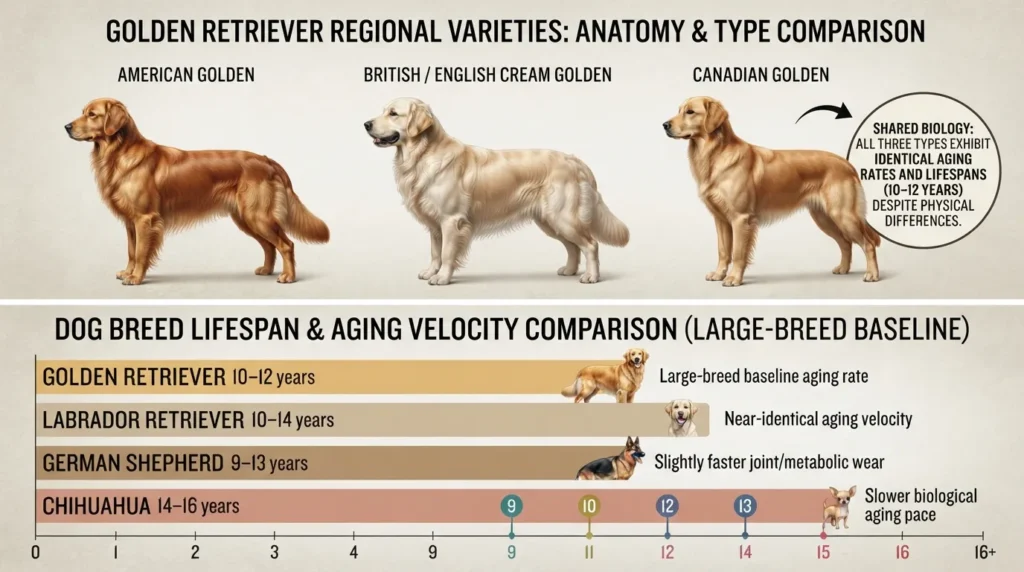
Whether your dog is an American, British (English Cream), or Canadian Golden Retriever, their biological clock ticks at virtually the same rate. While these field and show lines display subtle differences in coat color, bone structure, and physical height, their core metabolic aging process remains identical.
When calculating human age equivalents, body weight and genetic lineage matter far more than regional type. According to findings from the Golden Retriever Lifetime Study, variations in lifespan within the breed stem from health history, genetics, and diet rather than whether a puppy came from American or English bloodlines.
Golden Retriever vs. Other Breeds
To understand how a Golden Retriever’s biological clock compares to other dogs, it helps to look at body size. Larger frames place greater cellular and physical strain on a dog’s organs over time, which accelerates aging compared to toy or small breeds.
| Breed | Avg. Lifespan | Aging Speed |
|---|---|---|
| Golden Retriever | 10–12 yrs | Baseline (large breed) |
| Labrador Retriever | 10–14 yrs | Nearly identical |
| German Shepherd | 9–13 yrs | Slightly faster |
| Chihuahua (small breed reference) | 14–16 yrs | Notably slower |
As shown above, closely related sporting breeds like Labradors share a nearly identical aging curve with Goldens. On the other hand, a 17-year-old Golden Retriever has reached an extraordinary age benchmark—equivalent to a human living well past 100—whereas a tiny breed like a Chihuahua reaches 17 years at a somewhat slower biological pace.
Frequently Asked Questions
What is 1 Golden Retriever year in human years?
In their very first year, a Golden Retriever ages to the biological equivalent of roughly 15 human years. This initial growth surge accounts for their rapid transition from an entirely dependent puppy to a sexually mature, full-sized young adult.
Is the 7-year rule accurate for Golden Retrievers?
No, multiplying by seven is significantly inaccurate for Golden Retrievers. Goldens age much faster in their first two years—reaching about 24 human years by age two—and then age roughly 5 to 6 human years per calendar year due to their larger physical frame and metabolic rate.
At what age is a Golden Retriever considered a senior?
According to the American Animal Hospital Association (AAHA), Golden Retrievers are officially considered seniors around 7 to 8 years of age. At this benchmark, veterinarians recommend transitioning to bi-annual wellness checkups and proactive blood panels.
How can I help my Golden Retriever live longer?
The single most effective step is keeping your Golden at a lean body weight, as studies show lean dogs live up to 1.8 years longer. Additionally, providing daily low-impact exercise, feeding a nutrient-rich diet, starting joint supplements early, and switching to twice-yearly vet exams after age 7 will significantly improve longevity.
Do Golden Retrievers age faster than smaller dog breeds?
Yes. Larger breeds like Golden Retrievers experience higher cellular strain and growth acceleration early on compared to small breeds. While a small terrier might live 15 to 18 years, a Golden Retriever's typical lifespan is 10 to 12 years because their aging process speeds up in mid-to-late adult life.
How old is the oldest Golden Retriever on record?
The oldest verified Golden Retriever in history was Augie (Augusta) from Tennessee, who lived to be 20 years and 11 months old. Augie lived nearly twice as long as the breed average through attentive daily care, joint support, and regular veterinary monitoring.
🐾 Other Age Guides

I built Dogagescalculator.com to give dog owners honest, science-backed answers instead of the outdated "×7" myth. Every figure here is checked against AKC, AVMA, and published veterinary research.
More about the author & this site →
Comments