
How Big Will My Puppy Get? Puppy Weight & Size Calculator
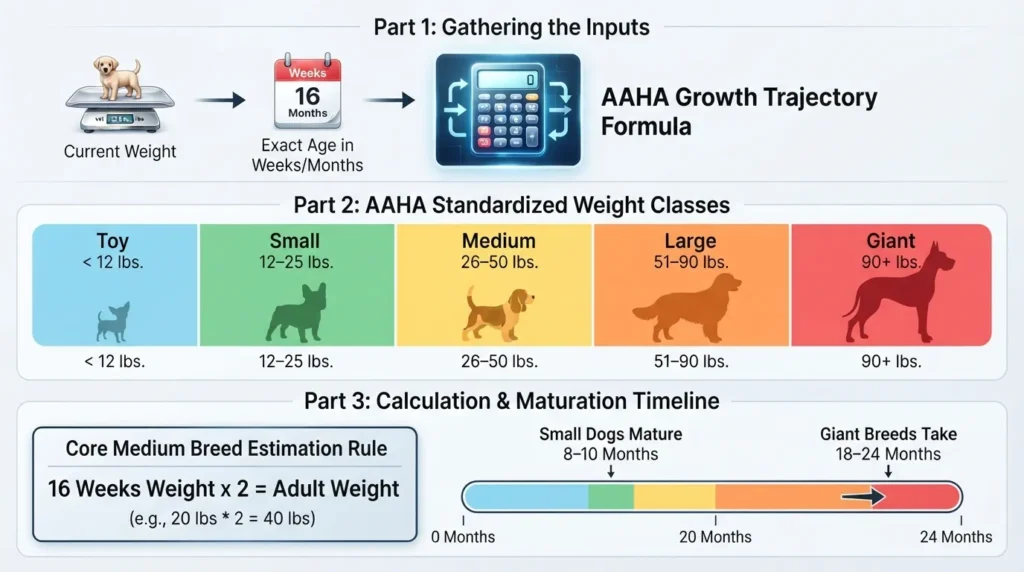
Wondering how big your puppy will get when fully grown? Your puppy’s current age, weight, breed, and expected adult size can provide useful clues about future growth. While no formula can predict an adult dog’s exact size, a puppy growth chart and weight-based calculation can give you a reasonable estimate.
Puppies do not all grow at the same rate. Small breeds usually reach their adult size earlier, while medium, large, and giant breeds may continue growing for a year or longer. A 5-month-old puppy, for example, may still have significant growth ahead, particularly if the puppy belongs to a larger breed.
Your puppy’s current weight can also help estimate adult dog weight, especially when combined with age and breed information. However, genetics, nutrition, health, sex, and individual growth patterns can all affect the final result.
In this guide, you’ll learn how to estimate your puppy’s adult size and weight, how puppy growth changes by age and breed size, how to use a puppy growth chart, and which factors can make your dog larger or smaller than an initial prediction. We’ll also explain common puppy weight formulas and how to interpret the results.
Puppy Growth Calculator — Estimate Your Dog's Adult Weight
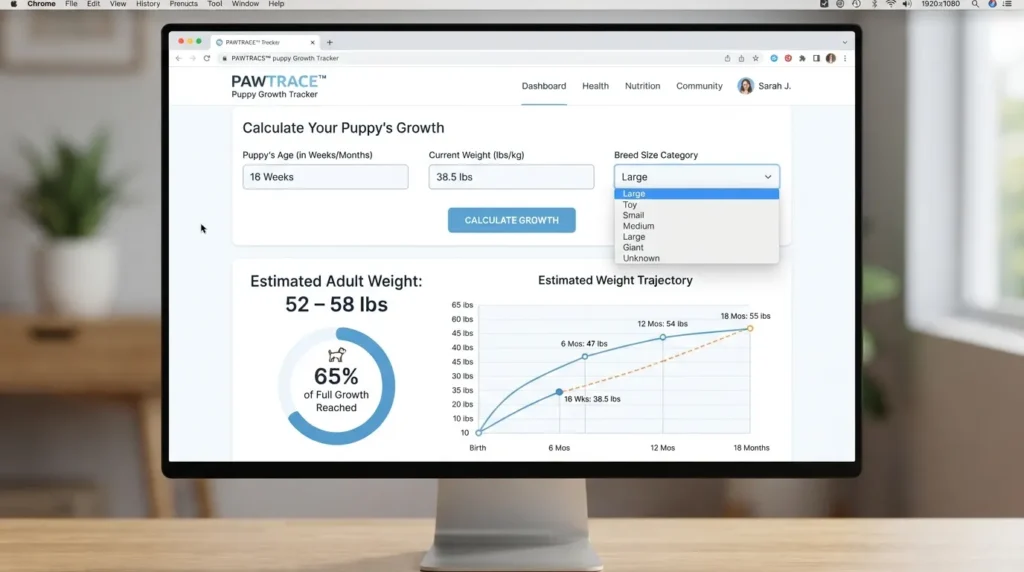
Tracking your puppy’s growth isn’t just about knowing if they’ll outgrow their crate or fit on your couch. It’s one of the most reliable ways to make sure they’re developing at a healthy, steady pace. Our puppy growth calculator takes the guesswork out of the equation by using established veterinary growth curves to predict your dog’s final size.
How to use the calculator
To get the most accurate prediction, you’ll need two quick pieces of information:
Your puppy’s current weight: Weigh your puppy on a digital scale (or weigh yourself holding them, then subtract your weight). Try to get this reading in pounds or kilograms within a day or two of checking.
Their exact age in weeks or months: Accuracy matters here—a 12-week-old puppy is at a very different developmental milestone than a 16-week-old puppy. If you don’t know their exact birth date, your shelter paperwork or your vet’s estimated age works great.
Once you input these numbers, select your puppy’s breed or general size category if known (toy, small, medium, large, or giant). If you have a mixed-breed pup and aren’t sure, select “unknown”—the calculator will estimate based strictly on their age-to-weight trajectory.
What you’ll get
After entering your puppy’s details, the calculator generates a custom growth profile with clear, actionable estimates:
Estimated adult weight range: Rather than giving a rigid single number, you’ll receive a realistic weight span (for example, 52 to 58 lbs). Growth rates naturally vary based on genetics, nutrition, and spay/neuter timing, so a target range gives you a far better baseline to monitor.
Official size category: Your puppy will be categorized into standard canine size tiers—Toy (under 12 lbs), Small (12–25 lbs), Medium (26–50 lbs), Large (51–90 lbs), or Giant (over 90 lbs).
Growth progress percentage: You’ll see roughly what percentage of their final adult frame they’ve already built, helping you anticipate when their major growth spurts will wrap up.
How Is My Puppy's Adult Size Calculated? The Methods Explained
Predicting how big your puppy will get isn’t based on guesswork—it relies on proven biological growth curves. Veterinarians and breeders track canine growth trajectories using a few specific methods, ranging from straightforward mathematical formulas to visual body cues.
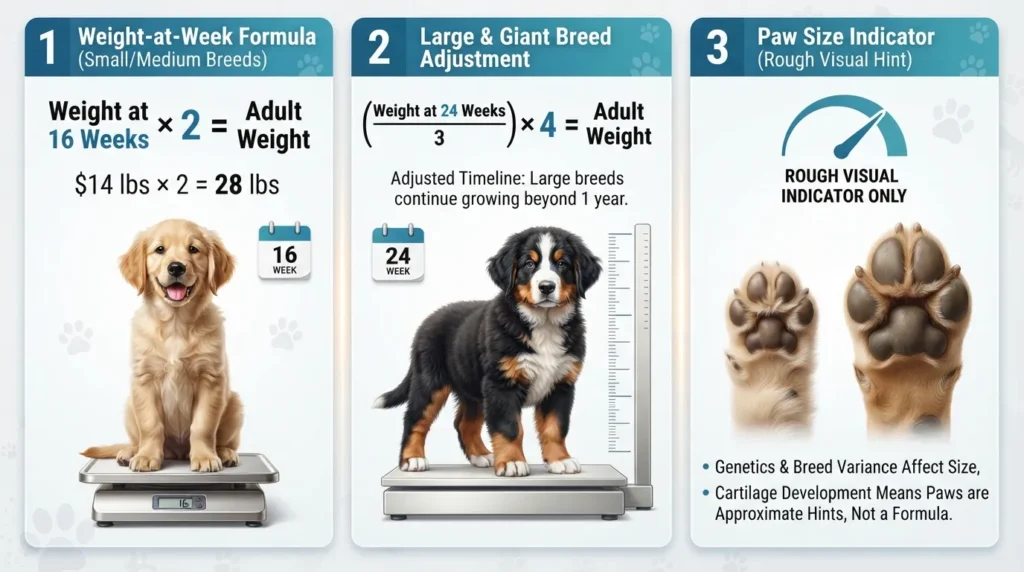
Method 1 — The weight-at-week formula (small/medium breeds)
For small and medium-sized dogs, puppy growth follows a remarkably predictable linear path during the first few months of life. Because these breeds reach sexual and physical maturity earlier than large dogs, their weight at 12 to 16 weeks offers an accurate baseline for calculating final adult weight.
The standard calculation for medium breeds uses your puppy’s weight at 16 weeks (4 months):
Adult Weight Calculation:
Weight at 16 weeks × 2 = Estimated Adult Weight
For toy and small breeds, who mature even faster, you can use their weight at 6 weeks (multiply by 4) or 12 weeks (multiply by 2, then add a small margin of 5–10%).
These formulas work well up to roughly 12 months of age because small and medium breeds complete the vast majority of their skeletal development within their first year. After this point, any added weight is typically muscle mass or fat rather than skeletal frame expansion.
Worked Example:
If your prospective medium-breed pup weighs 14 pounds at 16 weeks old, the math is simple:
14 lbs × 2 = 28 lbs adult weight
Expect your puppy to mature into an adult weighing right around 26 to 30 pounds.
Method 2 — Large & giant breed adjustment
If you apply the standard “double-at-4-months” formula to a Great Dane or a Mastiff, you’ll end up with a wildly inaccurate number. Standard formulas consistently underestimate final size for large and giant breeds because these dogs follow an extended, non-linear growth curve.
Unlike small dogs who finish growing rapidly, large dogs experience a prolonged growth phase that doesn’t peak until much later in their development. Doubling their 16-week weight misses months of crucial bone and joint development.
Note: Large and giant breeds mature at a much slower pace than smaller dogs—a complete breakdown of their extended timeline is detailed in our “When Do Dogs Stop Growing?” section below.
To estimate a large breed’s size, veterinarians typically calculate weight at 6 months (24 weeks) instead:
(Weight at 24 weeks ÷ 3) × 4 = Estimated Adult Weight
Method 3 — Paw size as a rough indicator
It’s one of the oldest tropes in dog ownership: “Look at those massive paws, he’s going to be huge!” But honestly, relying on paw size alone is far more myth than reliable method.
While oversized paws on a young puppy can suggest a larger frame, paw-to-body proportion is an unreliable signal. A puppy’s feet often experience sudden growth spurts before the long bones in their legs and torso catch up, making them look clumsily disproportionate for weeks at a time.
Bone plates vs. paw cartilage: Paws contain complex connective tissue and small bones that often reach near-adult proportions early to provide stability for a growing, awkward frame.
Breed variations: Certain breeds (like Basset Hounds, English Bulldogs, or Pugs) are genetically bred to have heavy, thick paws relative to a shorter stature, rendering paw size useless as a height or weight predictor.
The takeaway: Think of paw size as a fun, rough visual hint—not a precision measurement tool. Sticking to age-and-weight formulas gives you a far more accurate picture of your dog’s future size.
Puppy Growth Stages Chart Birth to Adulthood
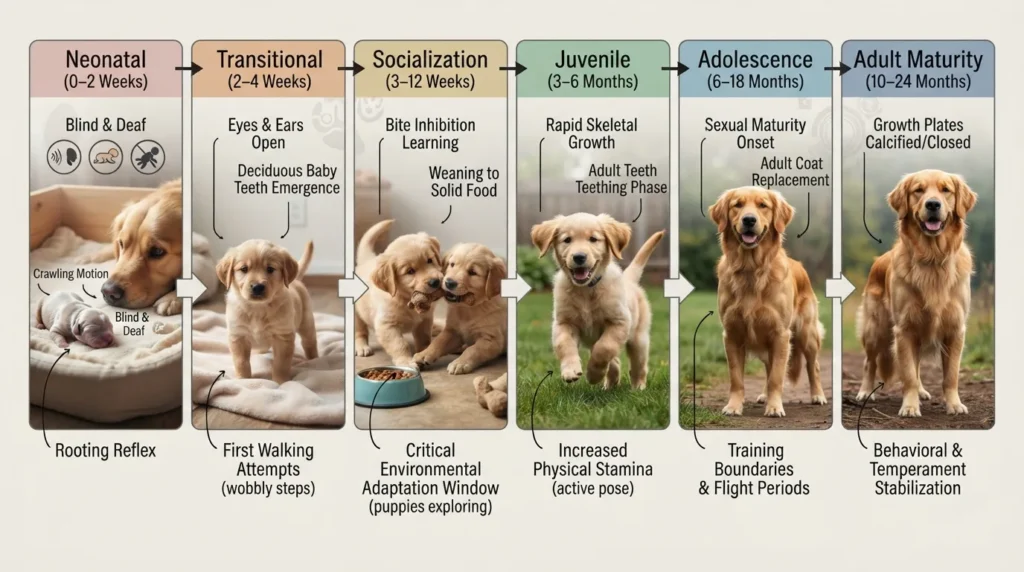
Neonatal (0–2 weeks)
During the neonatal phase, puppies are entirely dependent on their mother for survival. They are born blind, deaf, and unable to regulate their own body temperature or eliminate waste independently.
Their physical activity is limited to a crawling motion powered by their front legs, guided almost exclusively by scent and touch to locate nursing spots. Key behavioral milestones include the emergence of the rooting reflex and quiet vocalizations to signal discomfort or hunger.
Transitional (2–4 weeks)
The transitional period brings rapid neurological and sensory breakthroughs. Puppies open their eyes (typically between days 10 and 14) and their ear canals unfold, allowing them to process sight, light movement, and sound for the first time.
Physical milestones include the appearance of baby teeth (deciduous teeth) and the first uncoordinated attempts at walking instead of crawling. Puppies begin to wag their tails, react to littermates, and start emitting soft barks as social awareness begins to take root.
Socialization (3–12 weeks)
This is the most critical behavioral window in a dog’s life. During these weeks, a puppy’s brain is uniquely receptive to forming bonds, learning social boundaries, and adapting to novel sounds, surfaces, and environments.
Physical progress: Full motor control develops, baby teeth finish emerging, and puppies transition from maternal milk to solid food.
Behavioral milestones: Littermates teach each other bite inhibition through play-fighting. Puppies learn to recognize human interactions, read canine body language, and express fear or curiosity toward new stimuli.
Juvenile (3–6 months)
The juvenile stage marks a surge in independence, physical stamina, and energy. Skeletal growth is rapid during this window, often leading to a temporary “lanky” or disproportionate physical appearance.
Puppies begin shedding their milk teeth around month four as permanent adult teeth push through, triggering an intense teething urge. Behavioral patterns lean heavily into testing boundaries, exploring scent trails, and displaying higher focus during structured training sessions.
Adolescence (6–18 months)
Adolescence kicks off with the onset of sexual maturity and elevated hormonal activity. Female dogs experience their first heat cycle unless spayed, while males show increased scent-marking and roaming instincts.
Physical markers: The adult coat fully replaces the soft puppy fur, muscle tone thickens across the chest and shoulders, and permanent teeth finish setting into place.
Behavioral shifts: Puppies often display temporary regression in training or impulse control. Flight responses can temporarily resurface during secondary fear periods, requiring consistent, positive reinforcement.
Adult (varies by breed size — see “Stop Growing” section)
A dog reaches the adult stage once physical bone growth plates fully close and behavioral maturity stabilizes. Energy levels transition from frantic puppy play to steady, predictable daily routines.
At this phase, your dog’s personality is well-established, sexual maturity is complete, and their body focus shifts from frame expansion to maintaining muscle tissue, joint health, and overall condition.
Puppy Weight Chart by Age Reference Table
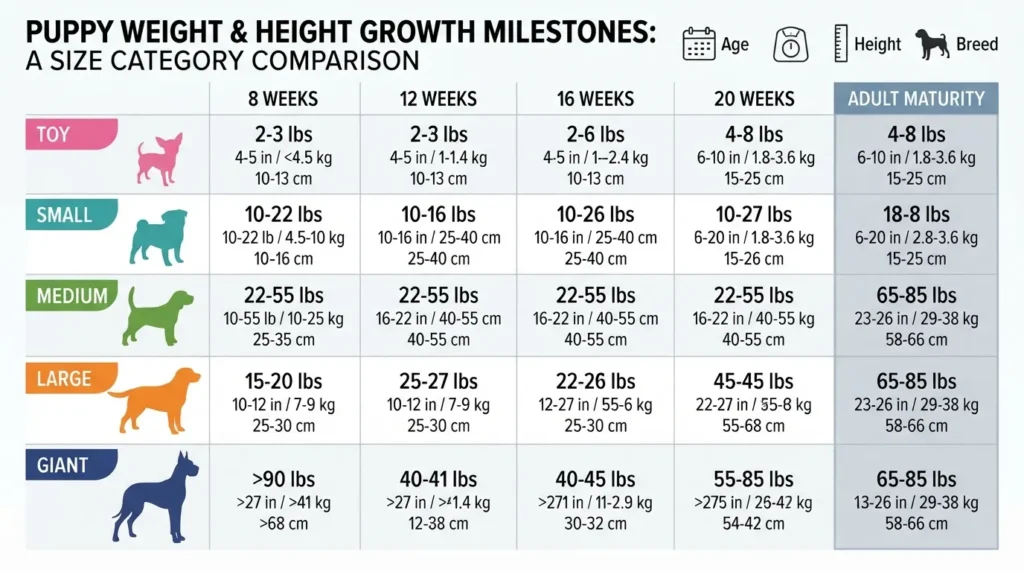
Tracking your puppy’s milestones helps ensure they are developing normally. Standard growth curves show that smaller dogs mature much faster than larger breeds, reaching adult size earlier in life.
Toy breeds (<12 lb adult)
Toy breeds experience rapid initial growth, reaching full physical maturity between 8 to 10 months of age.
8 Weeks: 1.5–2.5 lbs (0.7–1.1 kg) | 3–5 in (8–13 cm)
12 Weeks: 2.5–4.5 lbs (1.1–2.0 kg) | 4–6 in (10–15 cm)
16 Weeks: 3.5–6.5 lbs (1.6–2.9 kg) | 5–7 in (13–18 cm)
20 Weeks: 4.5–8.5 lbs (2.0–3.9 kg) | 6–8 in (15–20 cm)
Adult Weight: 5–12 lbs (2.3–5.4 kg) | 6–10 in (15–25 cm)
Small breeds (12–22 lb)
Small dogs complete most of their bone growth around 10 to 12 months of age.
8 Weeks: 2.5–4.5 lbs (1.1–2.0 kg) | 4–6 in (10–15 cm)
12 Weeks: 4.5–8.0 lbs (2.0–3.6 kg) | 6–8 in (15–20 cm)
16 Weeks: 7.0–12.0 lbs (3.2–5.4 kg) | 8–10 in (20–25 cm)
20 Weeks: 9.0–15.0 lbs (4.1–6.8 kg) | 9–11 in (23–28 cm)
Adult Weight: 12–22 lbs (5.4–10.0 kg) | 10–14 in (25–36 cm)
Medium breeds (22–57 lb)
Medium breeds achieve full skeletal maturity between 12 to 14 months before filling out with muscle.
8 Weeks: 5.0–10.0 lbs (2.3–4.5 kg) | 6–9 in (15–23 cm)
12 Weeks: 10.0–18.0 lbs (4.5–8.2 kg) | 8–12 in (20–30 cm)
16 Weeks: 15.0–26.0 lbs (6.8–11.8 kg) | 11–15 in (28–38 cm)
20 Weeks: 18.0–33.0 lbs (8.2–15.0 kg) | 13–17 in (33–43 cm)
Adult Weight: 22–57 lbs (10.0–25.9 kg) | 14–22 in (36–56 cm)
Large breeds (57–90 lb)
Large dogs undergo prolonged growth, requiring 14 to 18 months to reach full adult frame size.
8 Weeks: 10.0–18.0 lbs (4.5–8.2 kg) | 8–12 in (20–30 cm)
12 Weeks: 18.0–32.0 lbs (8.2–14.5 kg) | 12–16 in (30–41 cm)
16 Weeks: 28.0–48.0 lbs (12.7–21.8 kg) | 15–20 in (38–51 cm)
20 Weeks: 35.0–60.0 lbs (15.9–27.2 kg) | 18–22 in (46–56 cm)
Adult Weight: 57–90 lbs (25.9–40.8 kg) | 22–26 in (56–66 cm)
Giant breeds (90 lb+)
Giant breeds have an extended development timeline, taking 18 to 24 months to complete skeletal growth.
8 Weeks: 15.0–30.0 lbs (6.8–13.6 kg) | 10–14 in (25–36 cm)
12 Weeks: 30.0–55.0 lbs (13.6–24.9 kg) | 14–18 in (36–46 cm)
16 Weeks: 45.0–80.0 lbs (20.4–36.3 kg) | 18–24 in (46–61 cm)
20 Weeks: 60.0–100.0 lbs (27.2–45.4 kg) | 22–28 in (56–71 cm)
Adult Weight: 90–180+ lbs (40.8–81.6+ kg) | 26–34+ in (66–86+ cm)
Adult Weight by Popular Breed (Quick-Reference Table)
Here is a condensed reference table showing average healthy adult weight ranges for top popular breeds across all size classes.
| Breed Name | Size Category | Average Adult Weight (lbs / kg) |
|---|---|---|
| Chihuahua | Toy | 3 – 6 lbs (1.4 – 2.7 kg) |
| French Bulldog | Small | 16 – 28 lbs (7.3 – 12.7 kg) |
| Beagle | Medium | 20 – 30 lbs (9.1 – 13.6 kg) |
| Labrador Retriever | Large | 55 – 80 lbs (24.9 – 36.3 kg) |
| Golden Retriever | Large | 55 – 75 lbs (24.9 – 34.0 kg) |
| German Shepherd | Large | 50 – 90 lbs (22.7 – 40.8 kg) |
| Great Dane | Giant | 110 – 175 lbs (49.9 – 79.4 kg) |
What Affects How Big a Dog Gets?
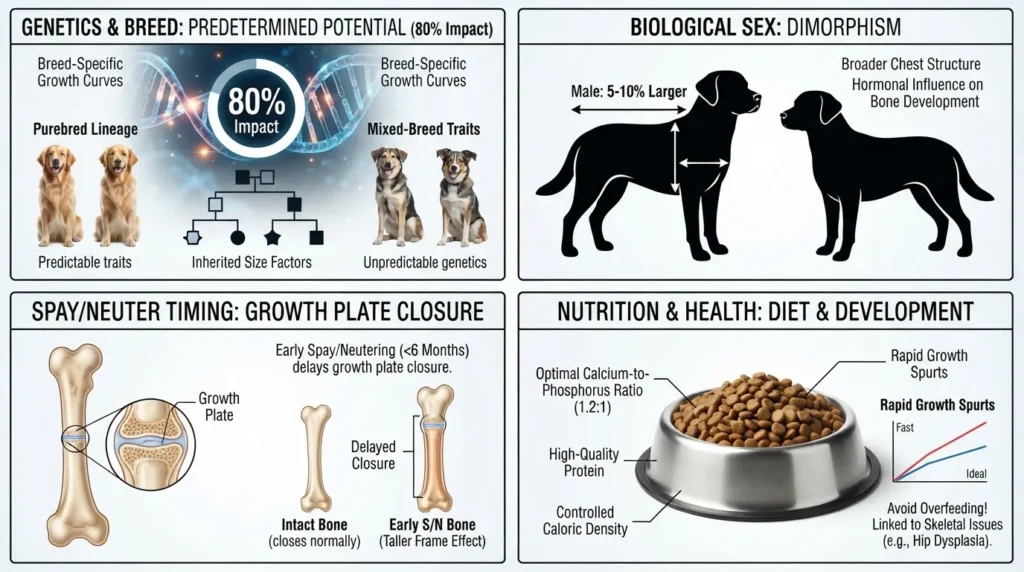
While standard growth charts give a reliable baseline, every puppy develops individually. A combination of biological traits, routine care, and key developmental choices determines where your dog lands within or outside their expected weight class.
Genetics & breed
Genetics play the single largest role in deciding your dog’s ultimate size. Broadly speaking, DNA dictates roughly 80% of a dog’s growth potential, setting the biological ceiling for their height, bone structure, and weight frame.
Purebred predictability: Purebred puppies generally stay close to standard kennel club ranges because their lineage carries consistent genetic markers over generations.
Mixed-breed variables: DNA inheritance in mixed-breed dogs is far less linear. A puppy can inherit the heavy skeletal frame of a Labrador parent alongside the shorter stature of a Beagle, resulting in unique weight distributions.
Gender (males often slightly larger)
Sex-based size differences are standard across almost all canine breeds. On average, male dogs grow 5% to 10% larger in both weight and height compared to females from the same litter.
Skeletal mass: Males tend to develop broader chests, thicker bone density, and wider heads.
Lean tissue: Higher natural testosterone levels in intact males promote greater overall muscle mass during late adolescent development.
Exceptions: In certain toy and small breeds, size differences between males and females can be negligible, often differing by less than a pound.
Spaying/neutering timing
The timing of pediatric sterilization directly impacts how a puppy’s long bones develop. Sex hormones (estrogen and testosterone) send the biological signal for growth plates—the soft cartilage areas at the ends of long bones—to close and solidify.
When a puppy is spayed or neutered very early (typically before 6 months of age), the delayed removal of these hormones allows the growth plates to stay open longer.
According to research reviewed by the American Animal Hospital Association (AAHA), dogs neutered or spayed at a very young age often grow slightly taller and rangier than those fixed after reaching full sexual maturity. However, this extra height usually comes from elongated limb bones rather than added muscle mass or broader body structure.
Nutrition during growth phases
While diet doesn’t override genetic potential, proper nutrition determines whether a puppy reaches that potential safely. Overfeeding or underfeeding during critical development windows can alter a dog’s health trajectory.
Caloric excess & joint stress: Feeding excessive calories won’t make a dog genetically larger; it simply causes them to grow too quickly or put on excess fat. In large and giant breeds, rapid growth puts severe strain on developing joint cartilage, increasing the risk of hip dysplasia.
Balanced calcium-to-phosphorus ratios: Large-breed puppies require precise mineral balances to support slow, steady bone development rather than rapid spikes.
Under-nutrition: Severe nutritional deficiencies or heavy parasite loads during early puppyhood can stunt growth, preventing a dog from ever reaching their full genetic potential.
When Does a Puppy Stop Growing?
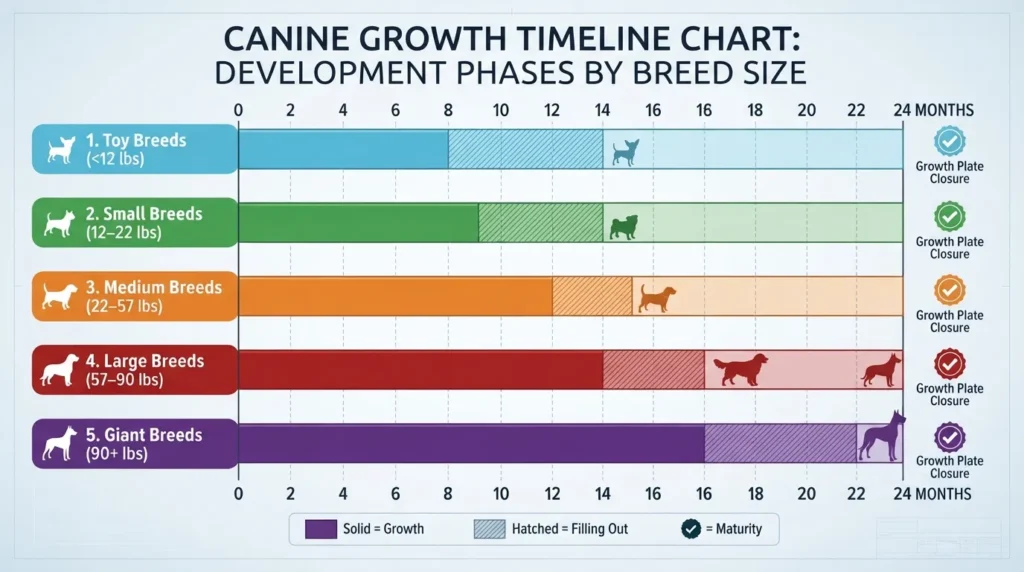
Every puppy matures on its own schedule, but skeletal growth is dictated entirely by breed size. Small dogs reach their full physical height and frame early in life, while large and giant breeds continue developing structural bone for up to two full years.
Timeline by size category (toy → giant) — the definitive reference table
While small breeds finish growing within 8 to 12 months, giant dogs undergo an extended growth period that lasts up to 24 months. According to AAHA life stage guidelines, dogs achieve full adult stature only after their long bone growth plates completely close.
| Size Category | Target Adult Weight | Active Bone Growth Phase | Muscle Filling-Out Phase | Total Months to Full Maturity |
|---|---|---|---|---|
| Toy | Under 12 lbs (5.4 kg) | 0 – 6 months | 6 – 10 months | 8 – 10 months |
| Small | 12 – 22 lbs (5.4 – 10 kg) | 0 – 8 months | 8 – 12 months | 10 – 12 months |
| Medium | 22 – 57 lbs (10 – 25.9 kg) | 0 – 10 months | 10 – 14 months | 12 – 14 months |
| Large | 57 – 90 lbs (25.9 – 40.8 kg) | 0 – 12 months | 12 – 18 months | 14 – 18 months |
| Giant | 90+ lbs (40.8+ kg) | 0 – 16 months | 16 – 24+ months | 18 – 24+ months |
Signs your puppy has reached adult size (checklist)
Beyond tracking age and weight milestones on a chart, you can look for concrete physical indicators that confirm your puppy has finished growing:
Closed growth plates: Your veterinarian can confirm on an X-ray that the soft cartilaginous growth plates at the ends of long bones have fully calcified into solid bone.
Proportional body structure: Their paws, ears, and legs no longer look oversized relative to their body frame; the clumsy “gawkiness” of adolescence gives way to balanced proportions.
Stable weight over 3 consecutive months: Weekly weight gains flatten out completely. Any subsequent weight gain past this baseline represents muscle mass or body fat rather than frame expansion.
Adult coat transition: The soft, fuzzy puppy coat is replaced by a thicker, denser adult coat texture.
Chest depth and muscle fill: The ribcage broadens and muscle definition sets in across the shoulders and hindquarters, marking the shift from structural bone height to mature body mass.
Frequently Asked Questions
The easiest way to estimate your puppy's adult size is by looking at their weight at 16 weeks (4 months). For small to medium breeds, doubling their 16-week weight gives an accurate target for adult weight. For large or giant breeds, divide their weight at 24 weeks (6 months) by 3, then multiply by 4.
For mixed-breed puppies, tracking their weekly weight gain between 12 and 16 weeks is the most reliable strategy. DNA tests can identify parent breeds to check target weight ranges, but following a weight curve calculator using their current age and weight provides the best real-time estimate.
Puppies finish growing based on their breed size category. Toy and small breeds finish growing around 8 to 12 months. Medium breeds take about 12 to 14 months, while large breeds need 14 to 18 months. Giant breeds like Mastiffs or Great Danes continue growing up to 24 months.
No, paw size is mostly a myth and an unreliable indicator. Paws and cartilage often experience early growth spurts before leg bones and torso catch up. Some small breeds naturally have large paws relative to their frame, making age and weight growth formulas far more accurate.
Yes, spaying or neutering a puppy before their bone growth plates close can cause them to grow slightly taller. Hormones signal growth plates to close, so early spay/neuter delays this signal, allowing long bones to keep growing a bit longer than usual.
Severe illness, heavy parasite infections, or extreme malnutrition can temporarily stunt a puppy's growth. However, once treated with proper veterinary care and balanced nutrition, most puppies undergo compensatory growth and reach their full genetic size potential.
Online puppy size calculators are typically accurate within 10% to 15% of actual adult weight when used between 12 and 20 weeks of age. They work best for purebred puppies and standard growth curves, serving as a reliable target range rather than an absolute exact number.
🐾 Other Age Guides

I built Dogagescalculator.com to give dog owners honest, science-backed answers instead of the outdated "×7" myth. Every figure here is checked against AKC, AVMA, and published veterinary research.
More about the author & this site →
Comments