
What Is 7 Human Years in Dog Years? Complete Guide
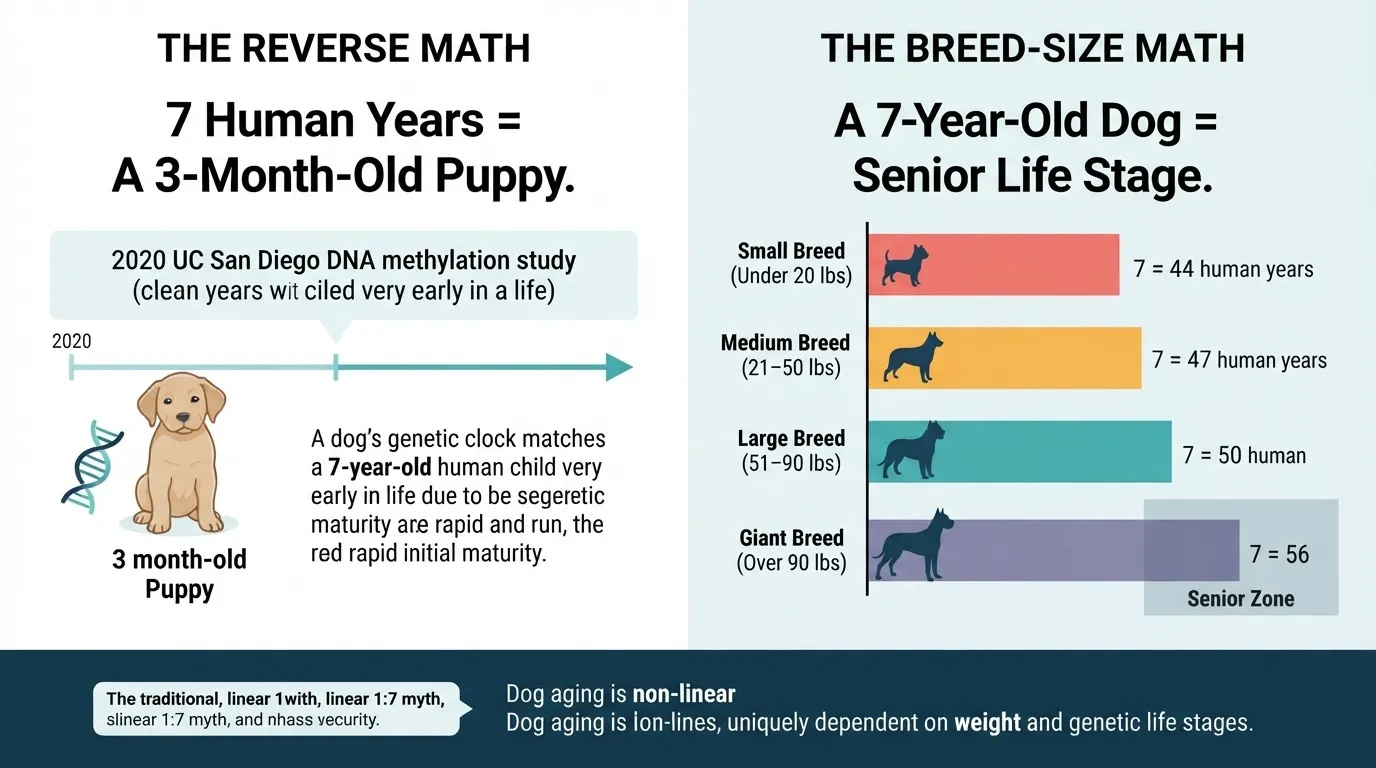
If you’re wondering what is 7 human years in dog years, there is no exact one-to-one conversion. The traditional “1 human year equals 7 dog years” rule is only a rough shortcut and does not accurately explain how dogs develop.
A 7-year-old human is still a child, while dogs reach major developmental milestones much faster. During their first year, dogs experience rapid physical growth, social development, and behavioral changes, so their age is better compared by life stage, breed, and size rather than a simple number.
7 human years in dog years cannot be converted to one exact number. A developmental comparison is more useful:
| Human Age | Approximate Dog Life Stage | Development |
|---|---|---|
| 7 human years | Young puppy | Rapid growth and social development |
| 10–12 human years | Older puppy / adolescent | Increasing independence |
| 15 human years | Around 1 dog year | Major maturity milestone |
So, 7 human years in dog years should be understood as a developmental comparison, not as 49 dog years. The old 7× formula works poorly because canine aging is not linear.
Wait — Did You Mean "7 Dog Years in Human Years"?
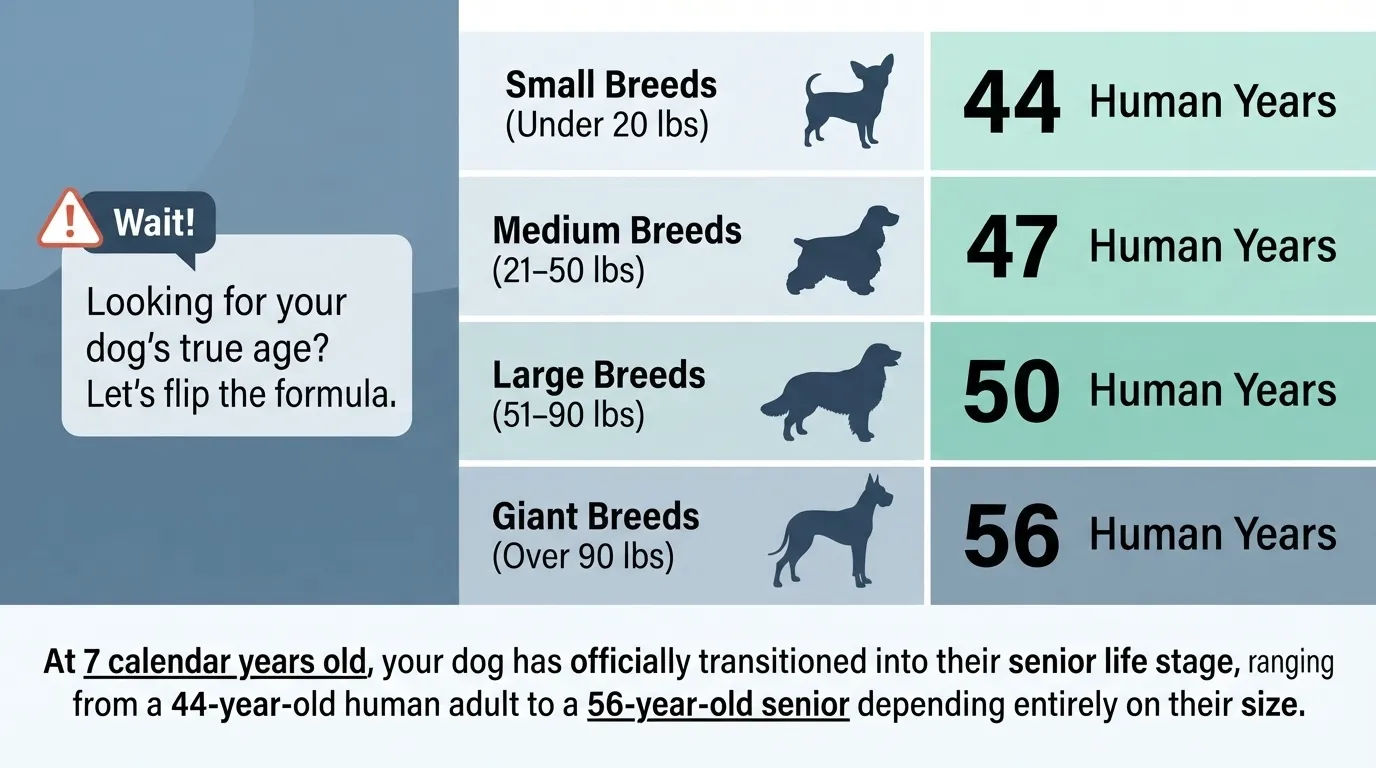
Are you looking for your dog’s age or your own? It is incredibly common to flip this question around. If you are trying to figure out how old your 7-year-old dog is in human terms, you are actually looking for 7 dog years in human years.
If that sounds like what you meant, you are far from alone. Google handles thousands of searches every month from pet parents who accidentally phrase the question backward.
To clear up the confusion right away: if your furry best friend has celebrated exactly seven birthdays, they aren’t a teenager or a young adult. In human terms, a 7-year-old dog is roughly 44 to 56 years old, depending entirely on their breed size.
Larger breeds like Great Danes age much faster and are considered seniors at this stage, while smaller pups like Chihuahuas are just entering middle age. If this is the answer you were actually looking for, don’t worry—we break down the exact math for every dog size further down this page.
The "1 Dog Year = 7 Human Years" Myth
Where Did the 7x Rule Come From?
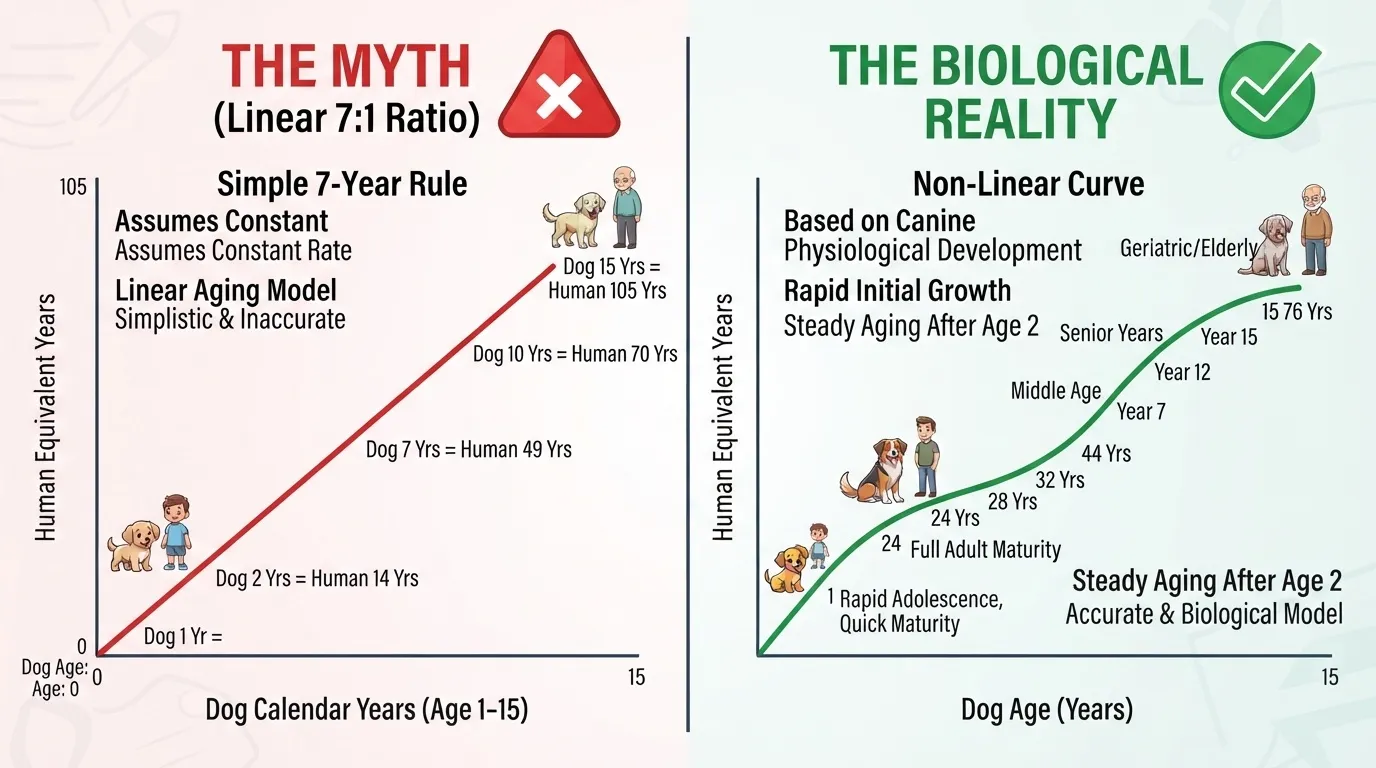
We have all heard it a thousand times: to figure out how old your dog is, just multiply their age by seven. It turns out this widely accepted rule of thumb was never based on real science. Instead, it was born out of a incredibly simple math assumption made decades ago.
Sometime around the mid-20th century, statisticians noticed a basic pattern. The average human lifespan at the time was roughly 70 years, while the average companion dog lived for about 10 years. If you divide 70 by 10, you get seven. It was essentially a clever marketing-era estimate designed to encourage pet owners to bring their dogs to the vet at least once a year, rather than a breakthrough in veterinary biology.
The Simple Math (7 ÷ 7 = 1 Dog Year)
If we strictly follow this traditional logic to answer what 7 human years means for a dog, the math reverses. To convert human years back into traditional dog years using the old rule, you divide the human age by seven.
The basic formula looks like this:
$$\text{Human Years} \div 7 = \text{Traditional Dog Years}$$
Using this exact 7:1 ratio, a human who has been alive for 7 years would technically be equivalent to a 1-year-old dog at the very end of their puppyhood. Here is how that linear math scales across the early decades of a human’s life:
| Human Age (Years) | Traditional Dog Year Equivalent |
| 7 | 1 |
| 14 | 2 |
| 21 | 3 |
| 28 | 4 |
| 35 | 5 |
| 42 | 6 |
| 49 | 7 |
Why Vets Say This Rule Is Outdated
While that chart is incredibly simple, veterinarians and researchers have officially retired the 7-year rule because dog aging is not linear. A dog does not age at the exact same pace every year of its life, and treating their development like a steady countdown misses how canine biology actually works.
Rapid early maturity: A one-year-old dog is physically and socially comparable to a human teenager, not a 7-year-old child. They undergo massive hormonal and skeletal growth during those first 12 to 24 months.
The size disconnect: A Great Dane and a Chihuahua age at vastly different rates. Giant breeds face senior health challenges much earlier in life, whereas smaller dogs frequently live well into their mid-teens. The 7:1 rule treats both breeds exactly the same, which can lead to misjudging a pet’s true medical needs.
Modern scientific consensus: Organizations like the American Animal Hospital Association (AAHA) favor canine life stage guidelines over rigid multipliers. Because the old math fails to account for genetic reality, it can cause owners to overlook early signs of age-related conditions in larger dogs or treat young, energetic dogs like senior pets too soon.
The Real Science: 2020 UC San Diego DNA Study
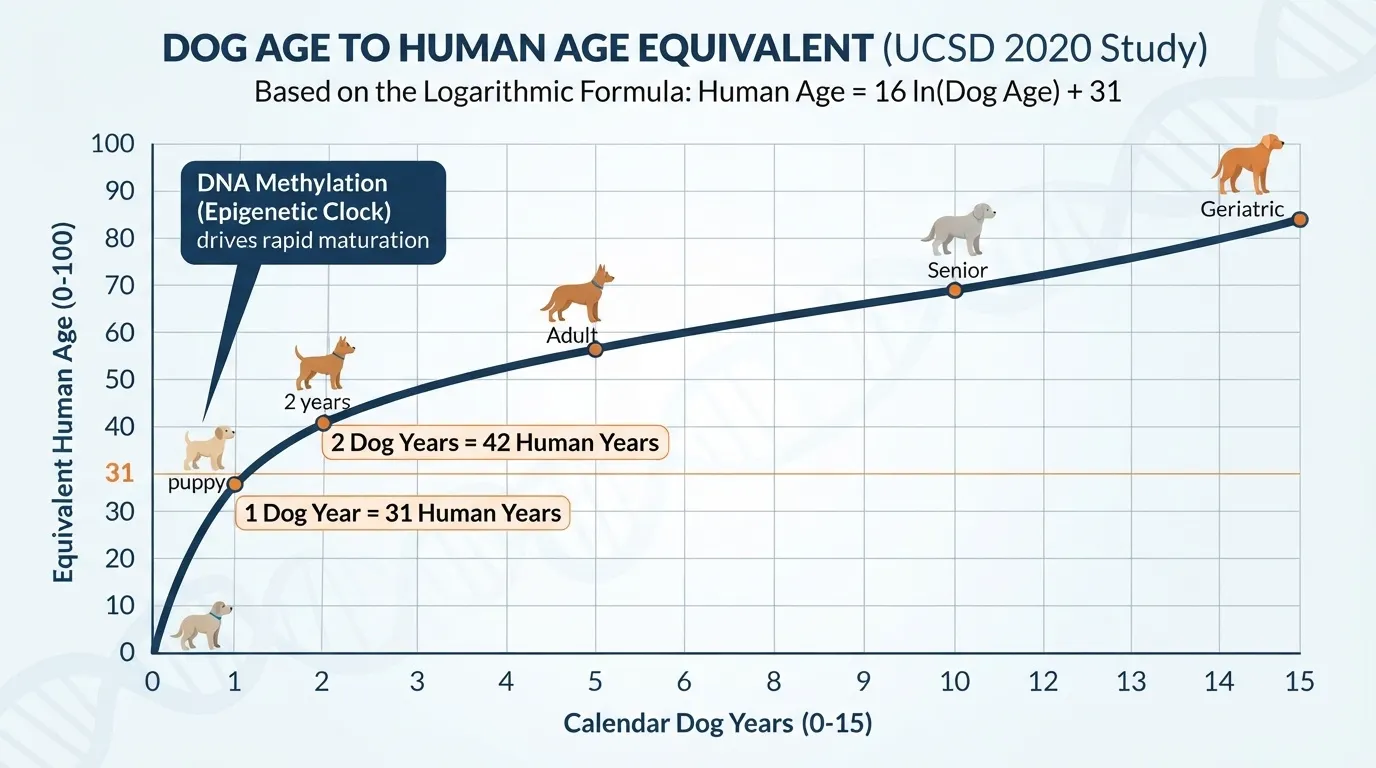
The Formula: Human Age = 16 x ln(Dog Age) + 31
In 2020, researchers at the University of California, San Diego published a groundbreaking study in the journal Cell Systems that changed how we measure canine aging. Instead of guessing based on lifespans, the scientists looked directly at the DNA of Labrador Retrievers. They tracked DNA methylation, which are chemical marks that change on the genome as animals age.
What they discovered is that dogs and humans share a very similar genetic aging clock, but it ticks at drastically different speeds depending on life stage. To map this out accurately, the team developed a logarithmic formula that reflects the true, non-linear way dogs age:
Human Age = 16 x ln(Dog Age) + 31
The “ln” stands for natural logarithm. It simply represents a mathematical curve that starts off incredibly steep and then levels out. Here is how you can use this formula at home with a smartphone or scientific calculator:
Type your dog’s age in calendar years into your calculator.
Press the ln button (on an iPhone, turn the calculator sideways to see this button).
Multiply that result by 16.
Add 31 to get the final human age equivalent.
Reverse-Calculated: What “7 Human Years” Really Means
Because the science shows that dogs age at warp speed during their first two years of life, the math looks entirely different when we reverse the formula. If someone asks what 7 human years equals in dog years using this new genetic model, we have to solve the equation backward for a human age of seven.
The math breaks down like this:
7 = 16 x ln(Dog Age) + 31
-24 = 16 x ln(Dog Age)
-1.5 = ln(Dog Age)
Dog Age = e^(-1.5) which equals approximately 0.223 years
When you convert 0.223 years into months, the result is roughly 2 to 3 months old.
This is a massive departure from the old rule of thumb, which claimed 7 human years equaled a 1-year-old dog. The UC San Diego study proves that a dog’s genetic clock matches our own much earlier than we thought. By the time a puppy is just a few months old, its biological DNA changes already mirror those of a 7-year-old human child.
Old Rule vs. New Formula — Comparison Table
To see just how much the old 7-to-1 assumption misses the mark, compare the traditional linear method with the science-backed UCSD logarithmic formula side-by-side.
| Dog's True Chronological Age | Old 7:1 Method (Human Age Equivalent) | New 2020 DNA Study (Human Age Equivalent) |
|---|---|---|
| 2 Months (0.16 years) | 1.1 Years | 1.7 Years |
| 3 Months (0.25 years) | 1.75 Years | 8.8 Years |
| 6 Months (0.5 years) | 3.5 Years | 19.9 Years |
| 1 Year | 7 Years | 31.0 Years |
| 2 Years | 14 Years | 42.1 Years |
| 5 Years | 35 Years | 56.8 Years |
| 10 Years | 70 Years | 67.8 Years |
| 15 Years | 105 Years | 74.3 Years |
As the data shows, the new formula turns the old rule completely on its head. A 1-year-old dog isn’t a child; biologically, they have the DNA markers of a 31-year-old adult. However, notice how the aging curve dramatically slows down later in life. By age 10, the two methods actually align quite closely, proving that dogs sprint through childhood and early adulthood before settling into a much slower aging pace as seniors.
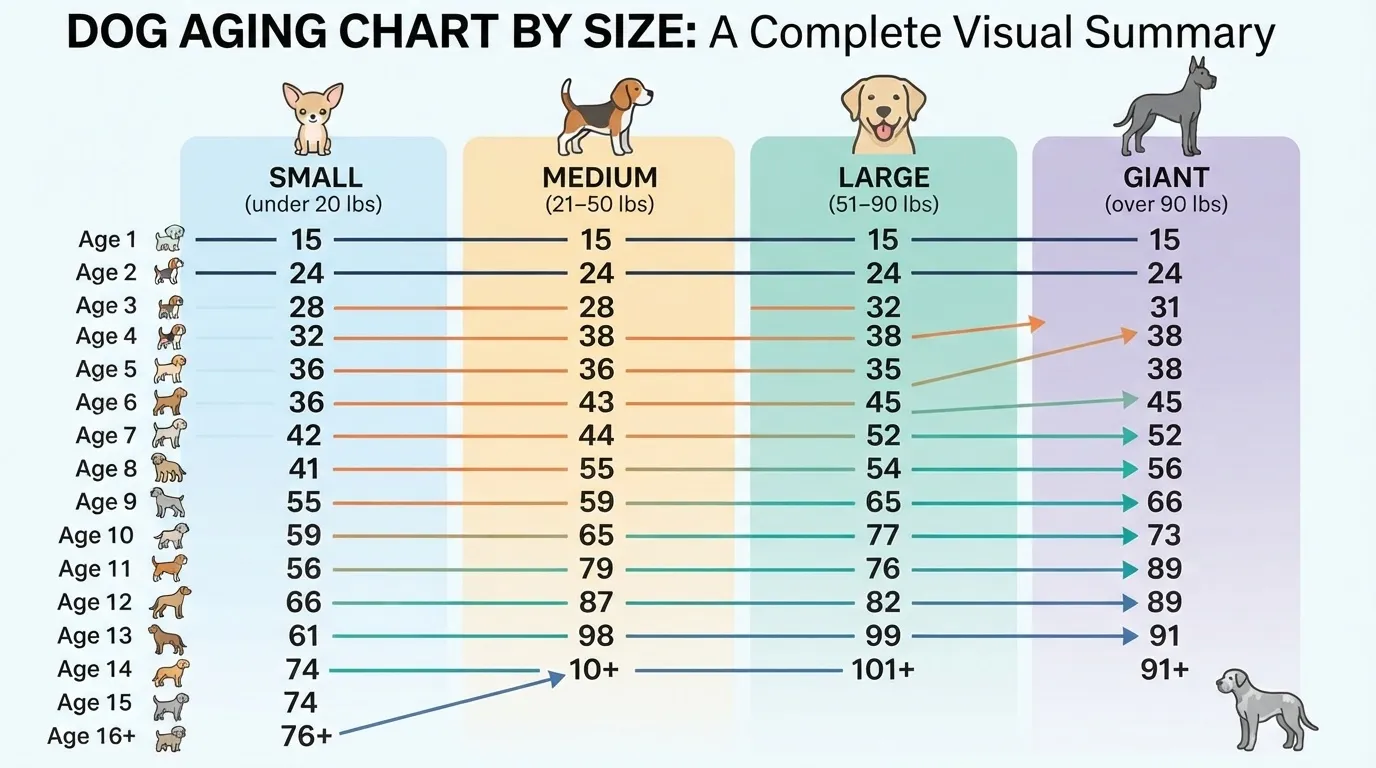
The Most Accurate Method: Size & Breed-Based Conversion AAHA
Why Breed and Size Change the Answer
While genetic formulas give us a fascinating look at DNA, the American Animal Hospital Association (AAHA) emphasizes that a dog’s physical size and breed are the most practical ways to determine their true age. In the canine world, a blanket rule simply does not work because small dogs and giant breeds live on completely different biological timelines.
Counterintuitively, smaller dogs mature much faster in their first year of life than large dogs, but they age at a significantly slower rate long-term. A giant breed like a Great Dane takes longer to fully grow into adulthood, but their biological clock ticks much faster as they mature, often entering their senior years by age 5 or 6. This is why a 10-year-old Chihuahua is often still sprightly, while a 10-year-old Mastiff is considered a very elderly dog.
The “First Year = 15 Human Years” Rule
Because the old “multiply by 7” rule is biologically impossible, modern veterinarians use a much more realistic milestone system for a dog’s early development. Instead of counting the first 12 months as 7 human years, the current consensus is that a dog’s first year is actually equal to about 15 human years.
The aging process then breaks down into a predictable, tiered structure:
Year 1: Adds 15 human years (taking the puppy from infancy to mid-teens).
Year 2: Adds roughly 9 more human years (bringing the dog to full young-adulthood at about 24 human years).
Year 3 and Beyond: The clock slows down, adding roughly 4 to 5 human years per calendar year, entirely depending on the dog’s weight category
Frequently Asked Questions
Depending on the size of your dog, 7 dog years is roughly equivalent to 44 to 56 human years. This age marks the transition into their senior years, where large and giant breeds age at a faster rate than smaller breeds. For a detailed breakdown of how this math changes based on your dog's exact weight class, see our comprehensive size and breed-based chart above.
Yes, but only after they reach adulthood. Small dogs actually mature faster than large dogs during their first year or two of life. However, once they are fully grown, small dogs age at a much slower biological pace—around 4 human years per calendar year—whereas giant breeds can age by up to 7 to 9 human years annually.
A dog's first year is equivalent to approximately 15 human years. This rapid development explains why a one-year-old dog behaves more like a human teenager than a small child, as they undergo massive skeletal, hormonal, and mental growth during their first 12 months.
No, veterinarians and major organizations like the American Animal Hospital Association (AAHA) have retired the 7-year rule. Instead, modern veterinary medicine relies on defined life stages (puppy, young adult, mature adult, senior) combined with size-specific aging charts to provide accurate senior wellness and medical care
🐾 Other Age Guides

Gulfam Haider Mehdi
Founder & Developer
I built Dogagescalculator.com to give dog owners honest, science-backed answers instead of the outdated "×7" myth. Every figure here is checked against AKC, AVMA, and published veterinary research.
More about the author & this site →📌 Featured Guides
28 in dog years
→
what is 20 dog years in human years
→
yorkie mix breeds
→
how long do red bone coon hounds live
→
50 in dog years
→
What Is 7 Dog Years in Human Years
→
70 in dog years
→
20 human years in dog years
→
puppy age calculator weeks to months
→
how many calories does my dog need calculator
→
Comments