
What Is 5 Human Years in Dog Years?
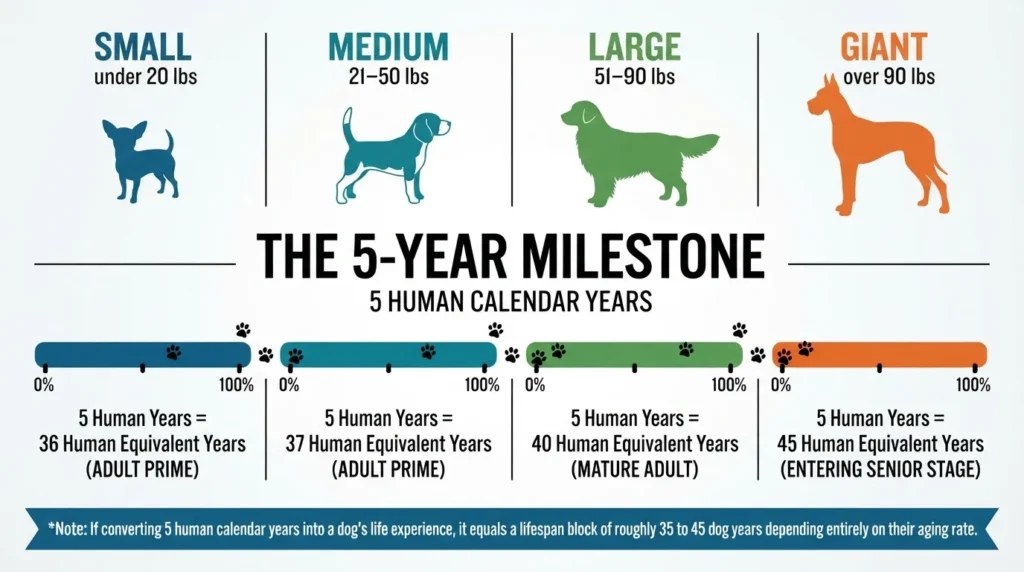
If you’re wondering what is 5 human years in dog years, the answer depends on the dog’s breed and size. Dogs do not age at a fixed rate, so the traditional “multiply by 7” rule is not an accurate way to calculate canine age.
In general, 5 human years in dog years can be represented by different canine ages depending on size and life stage. Small, medium, large, and giant breeds age at different rates, especially after the first two years.
What is 5 human years in dog years? The approximate equivalent varies by dog size:
| Dog Size | Approx. Dog-Year Equivalent |
|---|---|
| Small | ~31 years |
| Medium | ~34 years |
| Large | ~38 years |
| Giant | ~41 years |
These are approximate comparisons, not exact biological conversions. Breed, genetics, size, health, and lifestyle can all influence how quickly a dog ages.
Understanding the Confusion — Which Question Are You Really Asking?
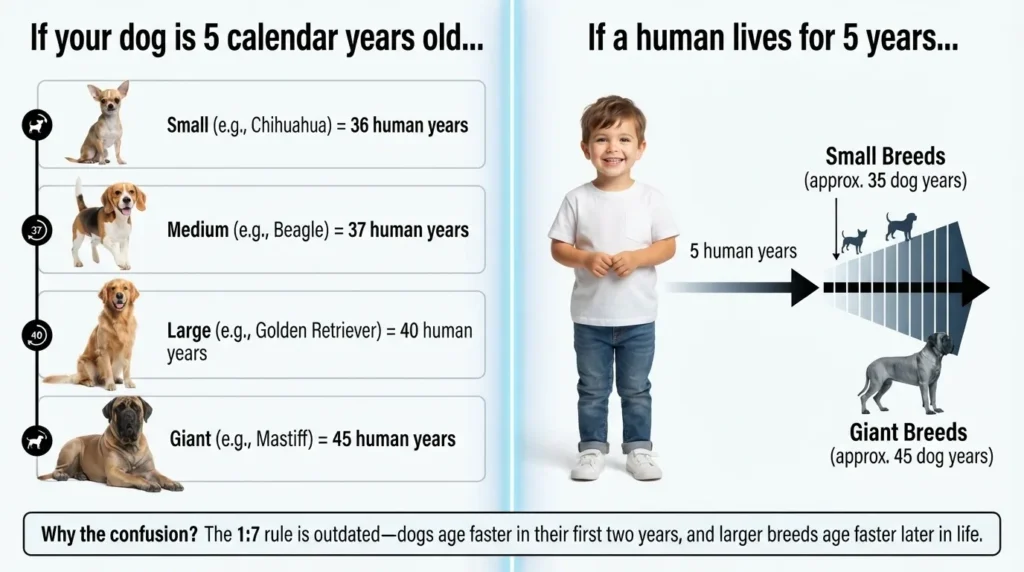
Language can be tricky when we talk about pet ages. If you typed “what is 5 human years in dog years” into a search bar, you are likely looking for one of two entirely different calculations.
Veterinary clinics see this confusion all the time. To clear it up, we need to look at who is doing the aging: the person or the dog. Let’s look at both sides of the coin so you get the exact answer you need.
What “5 Human Years in Dog Years” Actually Means (Human → Dog conversion)
If we take this phrase literally, you are asking: If a human lives for 5 calendar years, how many “dog years” have they accumulated?
Because dogs pack more physiological development into a single calendar year than humans do, a human who has been alive for 5 years has actually lived the equivalent of a very senior canine. Under the traditional “1 human year equals 7 dog years” rule of thumb, a 5-year-old child would be 35 dog years old.
While this is the literal translation of the phrasing, it is rarely what pet owners actually mean when they start searching.
What “5 Dog Years in Human Years” Means (Dog → Human conversion)
Most of the time, what a dog owner really wants to know is the reverse: My dog has been alive for 5 calendar years, so how old are they in human terms?
If your furry friend is celebrating their 5th birthday, they are not a senior. They are a fully mature adult in the prime of their life. According to updated life-stage guidelines from the American Animal Hospital Association (AAHA), a 5-year-old dog is roughly equivalent to a human in their mid-30s to early 40s, depending entirely on the dog’s size and breed.
Two Ways to Look at the Number 5
To see how these two interpretations contrast, look at how the math shifts depending on who is blowing out the birthday candles:
If you are looking at...
Literal Interpretation (Human is 5)
Intended Interpretation (Dog is 5)
The Subject
A 5-year-old human child
A 5-year-old adult dog
The Calculation
5 years × 7
Modern veterinary lifestage formula
The Result
35 dog years (An aging canine)
36 to 40 human years (A mature adult)
The Reality
A kid entering kindergarten
A dog in their physical prime
5 Human Years in Dog Years — The Real Math
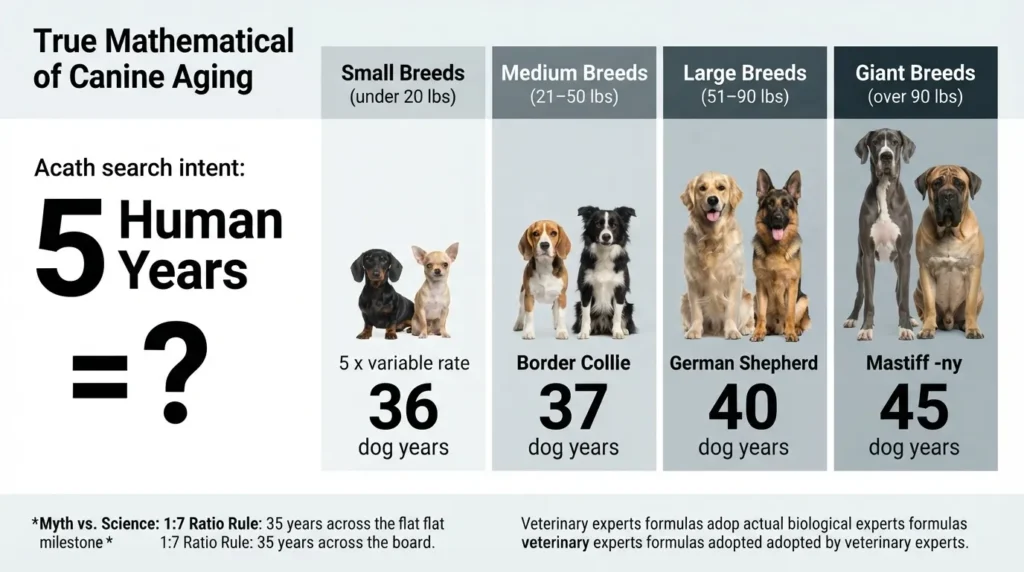
Why This Isn’t a Simple Calculation (Dogs Age Non-Linearly)
The old rule of thumb was that one human year equals seven dog years. While that math is simple, biology is not. Dogs do not age at a steady, linear pace throughout their lives.
Instead, a dog’s aging curve is incredibly steep at the beginning and tapers off later. During the first year or two of life, a puppy matures into a fully formed adult at a rate that far outpaces human development. Once a dog reaches physical maturity, their aging process slows down significantly.
Because of this non-linear progression, you cannot simply multiply a dog’s age by a single number. A one-year-old dog is essentially a teenager, but a two-year-old dog is already a young adult.
A Dog’s First Year Broken Down
To understand how rapidly a dog matures, it helps to look closely at the milestones of their first twelve months. Veterinary aging guidelines show that a puppy hits developmental markers in weeks that take humans years to reach.
2 Months: At eight weeks old, a puppy is ready to leave their mother. They have a full set of baby teeth and are rapidly developing social skills. In terms of emotional and physical maturity, this brief window is roughly equivalent to a 2-year-old human toddler.
6 Months: By half a year, most dogs are entering adolescence. Their permanent adult teeth are finishing coming in, and they are experiencing major hormonal shifts. A six-month-old pup behaves and tests boundaries much like a 10-to-12-year-old human.
8–12 Months: As they approach their first birthday, dogs reach sexual maturity and near their full adult height. While they still have plenty of puppy energy, their physiological development aligns closely with a 15-year-old human teenager.
If a Person Is 5 Years Old, What Would That Be in “Dog Years”?
If we take the literal phrasing of “what is 5 human years in dog years” and apply it to a 5-year-old human child, the calculation reverses. We have to look at how far a dog has progressed along their own life timeline to match a 5-year-old human.
A 5-year-old child is a preschooler—fully mobile and communicative, but still at the very beginning of their childhood development.
Because a dog compresses an entire childhood and adolescence into their first several months, a dog matches the developmental stage of a 5-year-old human child when the dog is roughly 3 to 4 months old. At this stage, the puppy is past the toddler phase, highly curious, learning basic rules, and rapidly absorbing information about the world around them.
How Old Is a 5-Year-Old Dog in Human Years?
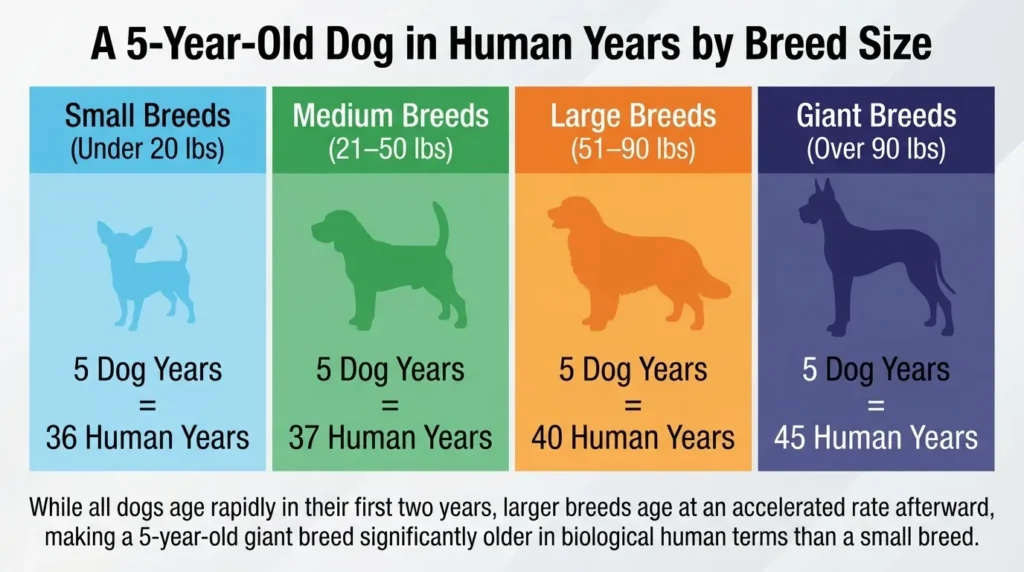
When people ask “what is 5 human years in dog years,” they usually want to know the reverse: how old is a 5-year-old dog in human terms? If we went by the traditional seven-year rule, a 5-year-old dog would be 35.
Veterinary science has moved past that oversimplified math. The truth is that a 5-year-old dog is generally between 36 and 45 human years old, depending entirely on their size and breed.
During the first two years of life, all dogs age rapidly as they reach sexual and physical maturity. By age 2, most dogs are roughly equivalent to a 24-year-old human. After that initial growth spurt, their aging rate slows down, and physical size begins to dictate how fast they mature.
The Official AAHA Dog Age Chart
The American Animal Hospital Association (AAHA) provides standard life-stage guidelines that veterinarians use to determine a dog’s real age. This system breaks dogs into four distinct size categories because a 10-pound Chihuahua ages very differently than a 120-pound Great Dane.
The table below shows how a dog’s human age equivalent changes by the time they reach their fifth birthday, based on these veterinary guidelines.
Dog Size Category
Weight Range
Human Age Equivalent at 5 Dog Years
Small Dogs
Under 20 lbs (9 kg)
36 years old
Medium Dogs
21 to 50 lbs (10 to 23 kg)
37 years old
Large Dogs
51 to 90 lbs (24 to 41 kg)
40 years old
Giant Dogs
Over 90 lbs (41 kg)
45 years old
Why Size Makes a Difference
Size is the single biggest factor in how a dog ages. In most of the animal kingdom, larger mammals live longer than smaller ones—an elephant outlives a mouse by decades. Dogs completely defy this biological rule.
Giant and large breeds age at an accelerated rate compared to small dogs. While a small breed dog spends its first five years pacing itself, a giant breed dog hits middle age much faster.
This accelerated aging in larger dogs is closely tied to rapid cellular growth. Large dogs grow from tiny puppies into massive adults in a very short window, which causes higher oxidative stress and faster cellular damage. By age 5, a giant breed dog is already transitioning into their senior years, while a small dog is still firmly in their prime.
Breed Also Affects the Result (Not Just Size)
Weight alone does not tell the whole story. Genetic lineages and specific breed histories play a massive role in a dog’s life expectancy and aging curve.
Two dogs can weigh exactly the same but have entirely different biological ages at 5 years old. For example, a 65-pound Boxer or Flat-Coated Retriever is genetically predisposed to faster aging and higher cancer risks than a 65-pound mutt or Standard Poodle.
Some breeds are simply prone to hereditary health conditions that accelerate physical decline. When calculating a dog’s true life stage, veterinarians look at the specific breed’s average lifespan alongside standard weight charts to get an accurate picture of their health needs.
Does Spaying/Neutering Affect a Dog’s Aging Rate?
Whether a dog is intact or fixed does alter their aging trajectory, though not always in a straightforward way. Large-scale veterinary demographic studies show that spayed and neutered dogs generally live longer than intact dogs.
This variance is partly behavioral and partly medical. Fixing a dog eliminates the risk of reproductive cancers and significantly reduces roaming behaviors that lead to accidents.
However, the timing of the procedure matters. Altering a dog alters their hormone balance, which affects when their growth plates close. In large and giant breeds, spaying or neutering too early can impact joint development, potentially leading to orthopedic issues like arthritis earlier in life. While it may not change the literal number on an age chart, proper timing helps keep a 5-year-old dog feeling younger and moving better.
The "1 Dog Year = 7 Human Years" Myth — Its History and Why It's Wrong
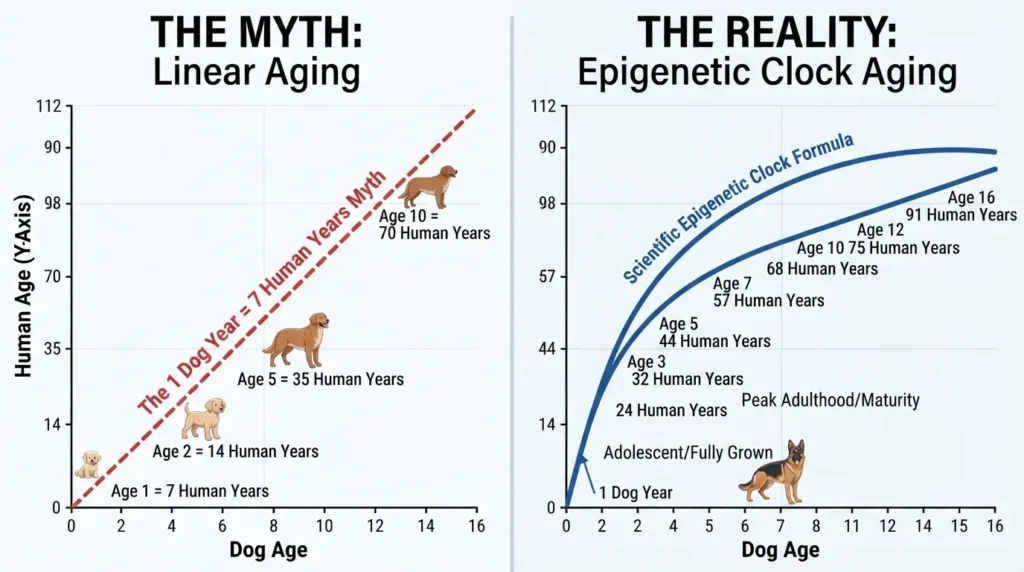
Where This Myth Came From (1950s Origin)
The idea that one dog year equals seven human years has been around since the mid-20th century. It likely originated in the 1950s as a simple marketing tactic and a math shortcut. At the time, the average human life expectancy was about 70 years, and the average dog lived to be about 10. Dividing 70 by 10 yielded a clean, easy-to-remember ratio of 7:1.
Veterinarians initially used this rule of thumb as a helpful tool to encourage pet owners to bring their dogs in for annual checkups. It visually demonstrated to owners that a year away from the clinic meant much more significant aging for a pet than for a human. While it worked well for awareness campaigns, it completely ignored the biological realities of how dogs actually develop.
The New Scientific Formula (UCSD DNA Methylation Study)
We no longer have to rely on guesswork or outdated math. In 2020, researchers at the University of California, San Diego (UCSD) published a groundbreaking study that looked directly at the DNA of dogs to track how they age.
The researchers studied chemical markers on dog DNA called methyl groups. As dogs and humans age, these molecules attach to DNA in a predictable pattern, a process known as DNA methylation. By tracking these changes across different life stages, scientists created an “epigenetic clock” that maps canine aging directly to human aging based on actual cellular biology.
Why This Formula Is More Accurate
The UCSD study proved that dogs do not age at a steady, linear rate of seven years per year. Instead, dogs age incredibly fast during their youth and slow down significantly as they get older.
According to this genetic data, a 1-year-old dog has a biological age closer to a 30-year-old human. By age 4, they are closer to a 53-year-old human. After this initial growth spurt, the aging rate decelerates. By the time a dog reaches age 10, they are biologically similar to a 68-year-old human.
This non-linear curve explains why a one-year-old puppy can breed and has fully formed teeth, whereas a 7-year-old human child is still years away from adolescence. The new formula gives veterinarians a biologically accurate look at a dog’s life stage, allowing for better preventative care, tailored nutrition, and more accurate age-related screenings.
Dog Age Calculator — Find Your Dog's Exact Age
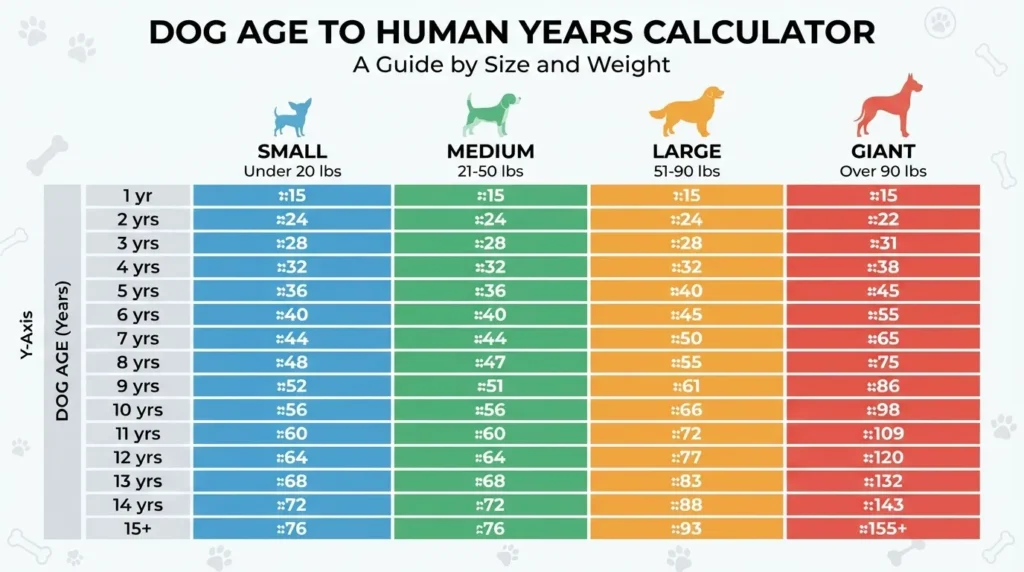
To get an instant, precise calculation tailored to your dog’s specific breed size and history, use our main interactive tool. It applies the latest veterinary aging formulas to give you an accurate human-to-dog year conversion in seconds.
Calculate Your Dog’s Exact Age
How to Use the Calculator
Getting an accurate reading takes just a few quick steps:
Select your dog’s weight category: Dog size heavily influences aging. Choose between Small (under 20 lbs), Medium (20–50 lbs), Large (51–90 lbs), or Giant (over 90 lbs).
Enter their calendar age: Input your dog’s current age in years or months.
Get instant results: The tool automatically calculates your dog’s equivalent age in human years based on current American Animal Hospital Association (AAHA) life stage guidelines.
What Life Stage Is a 5-Year-Old Dog In?
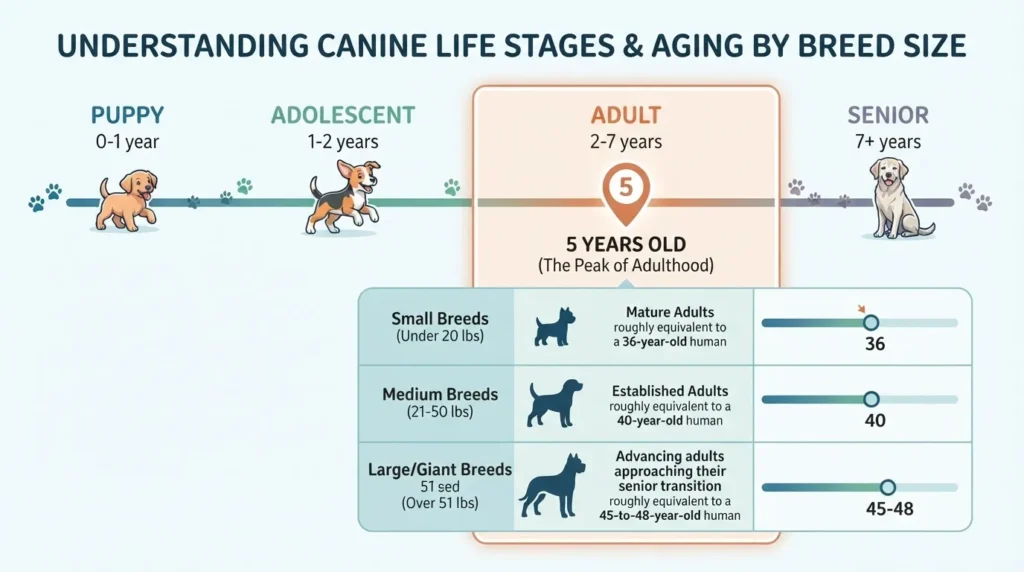
At five years old, your dog stands at a fascinating crossroads. In human terms, they are roughly in their mid-to-late thirties. They have officially outgrown the chaotic energy of extended puppyhood, but they are far from being old.
Where exactly your dog sits on the spectrum of youth to middle age depends almost entirely on their biological clock, which is dictated by their breed and adult weight.
Young Adult vs. Middle-Age (Depends on Size)
A dog’s size determines how quickly their internal clock ticks. Because smaller dogs enjoy significantly longer lifespans than larger breeds, a single calendar year represents a different percentage of their total life.
Small and Toy Breeds (Under 20 lbs): At five years old, Chihuahuas, Yorkies, and Maltese are still firmly in their young adult years. They have reached full emotional and physical maturity but have barely scratched the surface of their expected lifespans, which often stretch to 15 years or more.
Medium Breeds (21 to 50 lbs): Dogs like Cocker Spaniels or French Bulldogs are entering true middle age. They are stable, settled, and at the absolute peak of their adult prime.
Large and Giant Breeds (Over 50 lbs): For Great Danes, Mastiffs, or even Golden Retrievers, five years old marks the transition into the late afternoon of middle age, tipping toward their senior years. Giant breeds age at an accelerated rate, meaning a five-year-old large dog has already spent a significant portion of their expected lifespan.
What to Watch For at This Age (Regular Vet Checkups)
Five is the age where proactive care pays the highest dividends. While your dog might look and act completely healthy, subtle changes are beginning under the surface. Annual veterinary visits shift focus from routine vaccinations to baseline health screening.
Veterinary groups like the American Animal Hospital Association (AAHA) emphasize tracking specific health markers at this life stage. Your vet will likely recommend baseline blood work to check liver and kidney function, alongside routine screenings for heartworm and tick-borne illnesses.
Dental health is the biggest priority at five years old. Up to 80% of dogs exhibit signs of periodontal disease by age three. If left untreated, plaque and bacteria under the gumline can enter the bloodstream, causing permanent damage to the heart, kidneys, and liver.
Physical and Behavioral Changes at 5 Years Old
Behaviorally, five-year-old dogs are usually a delight. The destructive chewing and hyperactive boundary-testing of their younger years are gone. Instead, you will notice a predictable, emotionally intelligent companion who understands household routines and settles down easily.
Physically, you might spot the very first signs of maturity:
The “Sugar Face”: A few stray white or gray hairs may start appearing around the muzzle and eyebrows, especially in dark-coated breeds.
Metabolism Shifts: Your dog’s metabolic rate naturally begins to slow down, making it easier for them to gain weight on the same amount of food they ate at age two.
Activity Recovery: While they still love a good game of fetch, they might sleep a little harder or take slightly longer to recover after an intensely active weekend.
Is a 5-Year-Old Dog Considered a Senior?
The short answer is no, a five-year-old dog is not a senior.
Even for giant breeds, who face the shortest lifespans, age five is considered late-middle age rather than senior status. A dog is generally classified as a senior when they reach the final 25% of their breed’s estimated lifespan. For a typical medium-sized dog, senior status does not hit until around age seven or eight. For small dogs, it occurs closer to age ten.
Enjoy this phase—your five-year-old dog is currently enjoying their golden adult prime, possessing the perfect balance of physical capability and mental maturity.
Diet and Exercise Adjustments to Consider at This Age
Because your dog’s metabolism begins to decelerate around age five, maintaining their youthful figure requires deliberate effort. Carrying even a few extra pounds puts unnecessary stress on their joints, accelerating the onset of arthritis.
Review their daily caloric intake. If your dog is settling into a calmer lifestyle, you may need to measure their food precisely rather than eyeing it, or switch from a high-energy puppy/young adult formula to a standard adult maintenance diet. Keep treats to less than 10% of their total daily calories.
Exercise should remain consistent but mindful. Keep up the daily walks and mental stimulation to preserve muscle mass and keep their mind sharp. If you have a larger breed, talk to your vet at their next checkup about starting a high-quality joint supplement containing glucosamine and chondroitin to protect their cartilage before any stiffness actually begins.
Frequently Asked Questions
If a human lives for 5 years, that translates to roughly 35 to 45 dog years, depending on the size and breed of the dog. Because dogs mature rapidly in their first two years of life and larger breeds age faster than smaller ones later on, there is no single flat number.
For a small breed, 5 human calendar years represents about 36 dog years. For a giant breed like a Great Dane, those same 5 calendar years cover a much larger chunk of their expected lifespan, equating to roughly 45 dog years.
The popular "1 human year equals 7 dog years" rule of thumb dates back to the mid-20th century. It originated primarily as a clever marketing and public health tool used by veterinarians to encourage pet owners to bring their dogs in for annual checkups.
By reminding owners that a single calendar year represents a significant chunk of a dog's life, vets successfully shifted pet care toward preventative medicine. While the 1:7 ratio is a helpful simplification, modern veterinary science has since replaced it with more accurate, breed-specific aging curves.
Sterilization does not change the mathematical formula used to calculate dog years, but large-scale veterinary data shows it does influence overall life expectancy.
Spayed and neutered dogs tend to live slightly longer on average than intact dogs. This longevity boost is largely because sterilization eliminates the risk of uterine infections (pyometra) and testicular cancers, while also reducing behavioral urges that can lead to roaming, fights, or accidents.
The most scientifically accurate method comes from a 2020 study by researchers at the University of California, San Diego (UCSD). Instead of guessing based on average lifespans, scientists looked at DNA methylation, which tracks chemical markers on a dog's genome to measure true biological age.
The resulting formula is:
$$\text{Human Age} = 16 \times \ln(\text{Dog Age}) + 31$$
To use it, you take the natural logarithm ($\ln$) of your dog's real age, multiply it by 16, and add 31. While this formula matches the cellular data perfectly for Labrador Retrievers, veterinarians still adjust calculations using traditional size-based charts because giant and toy breeds have such vastly different life expectancies.
No, dogs do not age at the same rate. While almost all dogs mature incredibly fast during their first year of life—reaching the human equivalent of mid-teens by month 12—their aging trajectories diverge dramatically after age two.
Larger dogs experience accelerated biological aging compared to smaller dogs. A 10-year-old Chihuahua is often still spry and biologically equivalent to a human in their mid-50s, whereas a 10-year-old Mastiff is considered extremely senior, equivalent to a human well into their 80s.
A 5-year-old dog is roughly equivalent to a human in their mid-30s to early 40s. At this stage, most dogs have fully settled out of puppyhood and are in the prime of their adult lives.
The exact conversion varies based on your dog's weight category:
Small dogs (under 20 lbs): About 36 human years.
Medium dogs (21–50 lbs): About 37 human years.
Large dogs (51–90 lbs): About 40 human years.
Giant dogs (over 90 lbs): About 45 human years.
Generally, a 5-year-old dog is not considered a senior. For small, medium, and large breeds, age 5 represents the peak of adulthood.
The single exception is giant breeds. Because dogs over 90 pounds have shorter lifespans, they transition out of adulthood much sooner. A giant breed dog enters their senior years around age 5 or 6, meaning you may need to start watching for early signs of arthritis or switching them to a senior-specific diet sooner than you would for a smaller dog.
🐾 Other Age Guides

Gulfam Haider Mehdi
Founder & Developer
I built Dogagescalculator.com to give dog owners honest, science-backed answers instead of the outdated "×7" myth. Every figure here is checked against AKC, AVMA, and published veterinary research.
More about the author & this site →📌 Featured Guides
how to find out what your dog is mixed with
→
What Is 6 Human Years in Dog Years
→
how much to feed a french bulldog puppy
→
What Is 18 Dog Years in Human Years
→
what age does a dog have a period
→
chihuahua dog years to human years
→
oldest french bulldog
→
what is the life expectancy of a jack russell terrier
→
jrt beagle mix
→
What Is the Lifespan of a Miniature Pinscher?
→
Comments