
What Is 4 Human Years in Dog Years? (Complete Breed-Wise Guide)
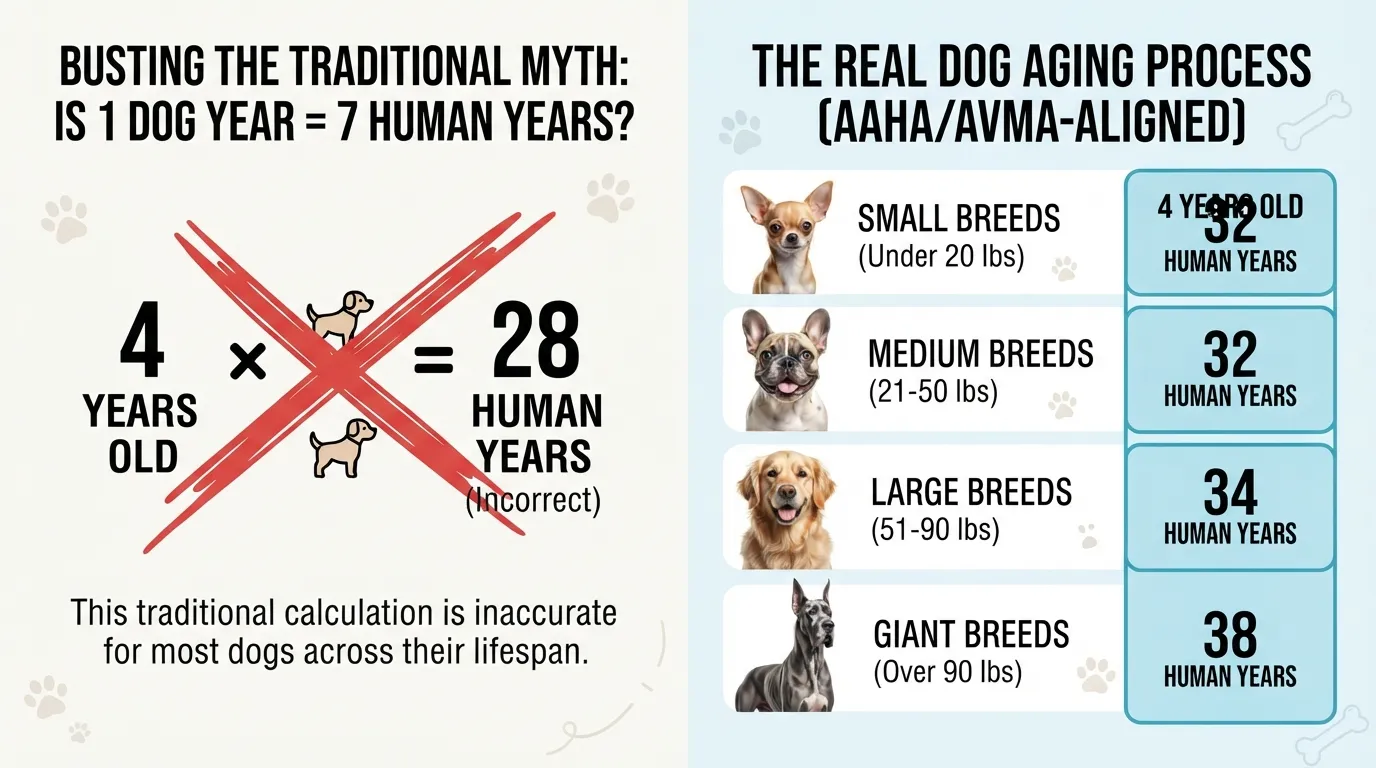
Four human years are roughly equal to 32 to 36 human years for a dog, depending entirely on your pup’s breed size. According to modern veterinary guidelines from the AAHA, a 4-year-old dog has officially transitioned out of adolescence and is living their best adult life.
Small Breeds (under 20 lbs): 32 human years
Medium Breeds (21 to 50 lbs): 32 human years
Large Breeds (51 to 90 lbs): 34 human years
Giant Breeds (over 90 lbs): 36 human years
4 Human Years vs. 4 Dog Years — Which One Did You Mean?
When people search for what is 4 human years in dog years, they usually mean one of two entirely different things. Because dog aging is non-linear, it’s easy to flip the math.
Let’s clear up the confusion right away so you get the exact number you need.
If You Meant “4 Human Years → Dog Years”
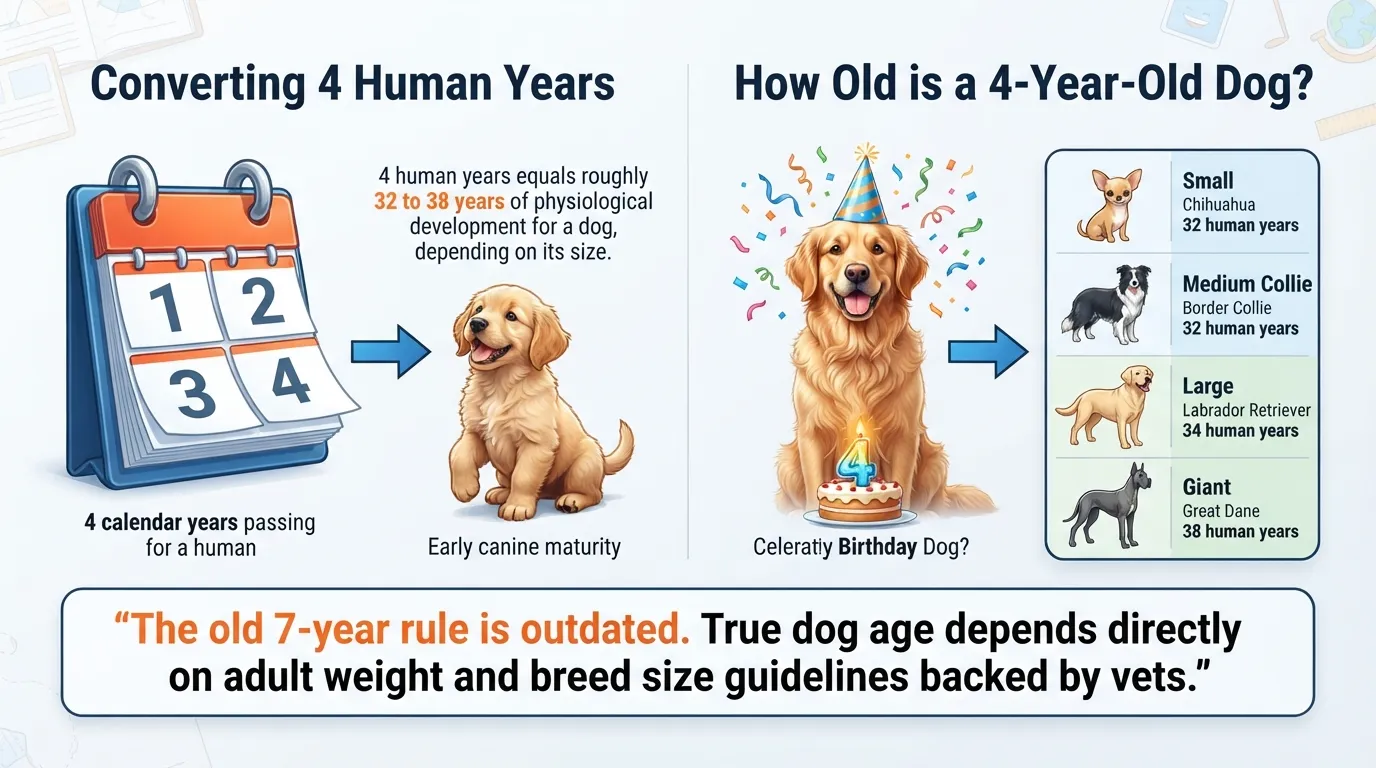
If exactly 4 years have ticked by on your wall calendar, that means your dog has experienced 4 human years of chronological time. In terms of biological aging, your dog is not 4 years old—they are much older.
According to official canine life stage guidelines, a dog that has been alive for 4 human years is roughly 32 to 40 years old in human equivalent terms, depending entirely on their breed size.
If You Meant “4 Dog Years → Human Years”
If your goal is to find out how old a 4-year-old dog is in human terms, you are looking at the peak of their adulthood. This is the most common search intent, and the old “multiply by 7” rule will give you the wrong answer.
The American Animal Hospital Association (AAHA) framework shows that dogs mature incredibly fast in their first two years, then slow down. A 4-year-old dog’s precise age depends heavily on their weight class:
Small Breeds (under 20 lbs): About 32 human years. Small dogs age the slowest after their initial growth spurt.
Medium Breeds (21–50 lbs): About 32 to 34 human years.
Large Breeds (51–90 lbs): About 34 to 36 human years. Large breeds begin to age a bit faster after age two.
Giant Breeds (over 90 lbs): About 38 to 40 human years. Giant breeds face accelerated biological aging, putting them closer to middle age by year four.
How Old Is a 4-Year-Old Dog in Human Years? (Exact Numbers by Breed Size)
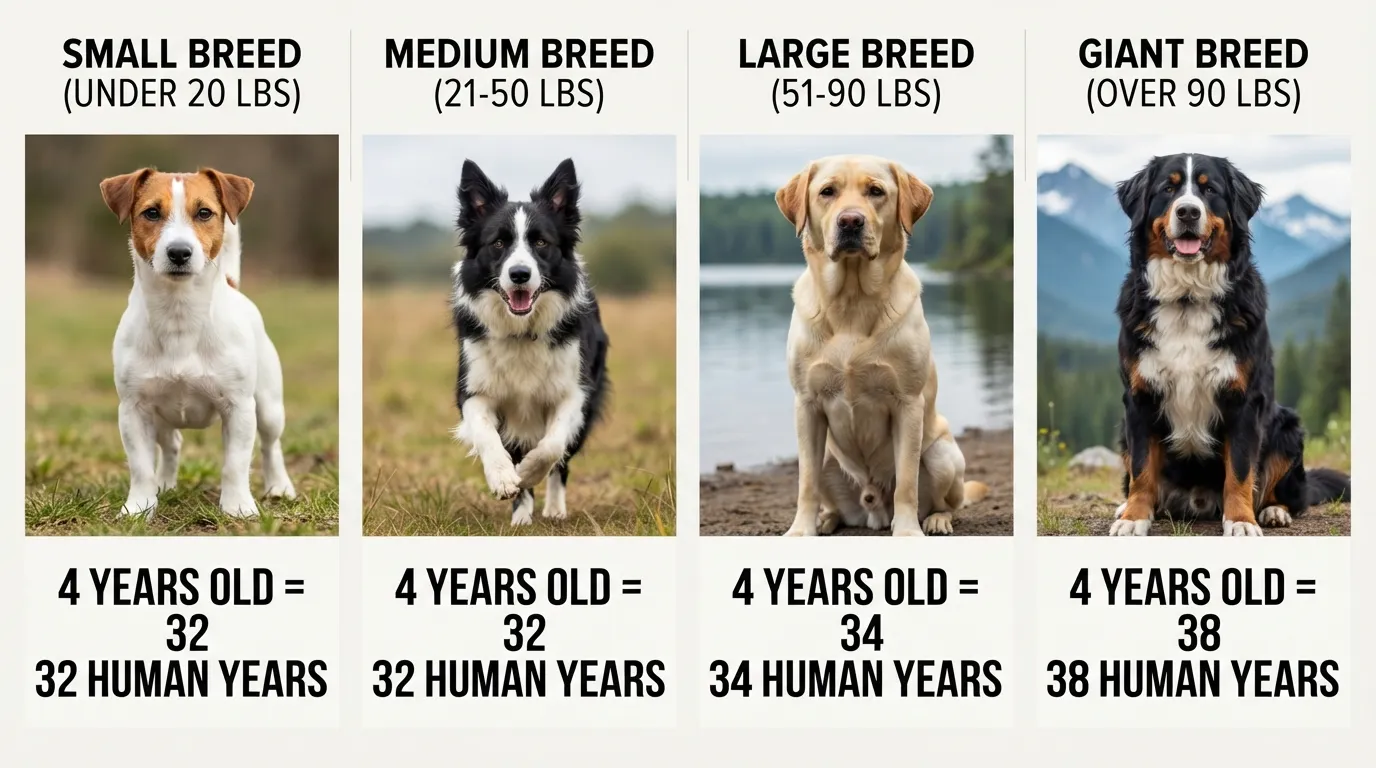
While the old rule of thumb was to simply multiply by seven, canine aging is a bit more nuanced. According to veterinary guidelines from the American Animal Hospital Association (AAHA), dogs mature rapidly during their first two years. By the time a dog celebrates their second birthday, they are already roughly 24 human years old. After age two, their aging rate stabilizes and begins to depend heavily on their adult weight.
At four years old, a small dog is still in their young prime, while a giant breed is already approaching their senior years.
| Dog Age | Small Breeds (Under 20 lbs) | Medium Breeds (21-50 lbs) | Large Breeds (51-90 lbs) | Giant Breeds (Over 90 lbs) |
|---|---|---|---|---|
| 1 Year Old | 15 human years | 15 human years | 15 human years | 15 human years |
| 2 Years Old | 24 human years | 24 human years | 24 human years | 24 human years |
| 3 Years Old | 28 human years | 28 human years | 29 human years | 31 human years |
| 4 Years Old | 32 human years | 32 human years | 34 human years | 38 human years |
1 Year Old
Small Breeds
15 human years
Medium Breeds
15 human years
Large Breeds
15 human years
Giant Breeds
15 human years
2 Years Old
Small Breeds
24 human years
Medium Breeds
24 human years
Large Breeds
24 human years
Giant Breeds
24 human years
3 Years Old
Small Breeds
28 human years
Medium Breeds
28 human years
Large Breeds
29 human years
Giant Breeds
31 human years
4 Years Old
Small Breeds
32 human years
Medium Breeds
32 human years
Large Breeds
34 human years
Giant Breeds
38 human years
Here is exactly what that 4-year-old milestone means for your dog based on their size:
Small Breeds: At 32 human years, small dogs like Chihuahuas or Yorkies are young adults with plenty of energy left. They age the slowest and often live the longest.
Medium Breeds: Also sitting at 32 human years, medium dogs like Cocker Spaniels or French Bulldogs are in a stable, healthy adult phase of life.
Large Breeds: At 34 human years, a large dog like a Golden Retriever or German Shepherd is firmly rooted in adulthood, where regular joint support becomes a smart preventative measure.
Giant Breeds: At 38 human years, Great Danes, Mastiffs, and other giant breeds age much faster, meaning a 4-year-old giant dog is already entering their mature, pre-senior years.
How Dog Age Is Actually Calculated
The Old “1 Dog Year = 7 Human Years” Myth (why it’s wrong)
The classic rule of multiplying your dog’s age by seven is a complete myth. It was created as a simple marketing tool to encourage owners to bring their pets in for annual vet checkups, but it completely ignores basic biology. Dogs don’t age at a linear rate, and a tiny Chihuahua experiences life stages at a vastly different pace than a massive Great Dane. Relying on the seven-year rule means you will likely misjudge your dog’s actual life stage and nutritional needs.
Why the First 2 Years Count Differently
Canine development happens at lightning speed during the first twenty-four months of life. A one-year-old dog has already reached full sexual maturity and skeletal growth, which is biologically equivalent to a human teenager. By the time a dog reaches two years old, they have zipped through their childhood, adolescence, and young adult milestones. Because this initial growth burst is so intense, treating the first two years of a dog’s life the same as their later years throws off any chronological comparison.
The Modern Vet-Approved Formula (AAHA/AVMA reference)
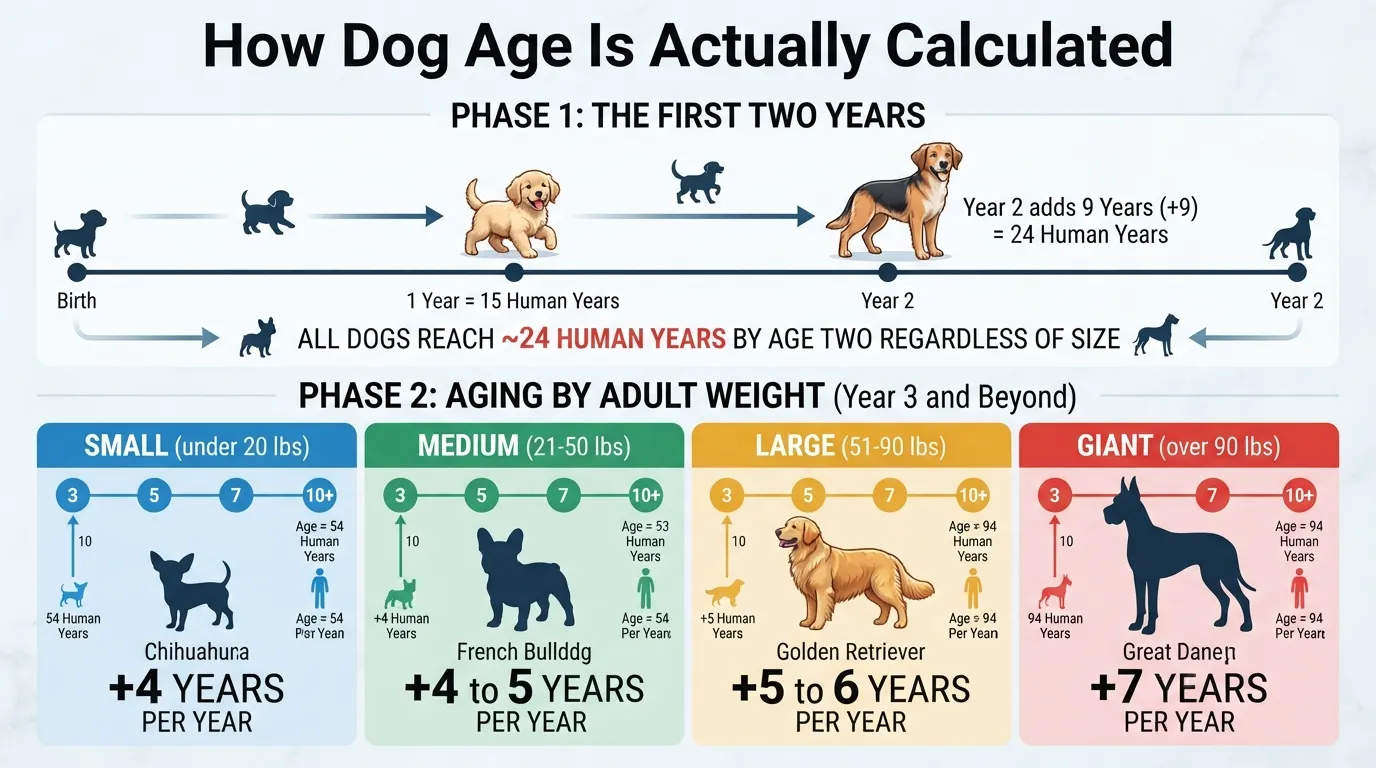
Today, veterinary medicine relies on a much more precise calculation method. According to official life-stage guidelines from the American Animal Hospital Association (AAHA), a dog’s first year is roughly equal to 15 human years, and their second year adds another 9 human years to the total.
Once a dog passes their second birthday, the math shifts to reflect their physical size. For every year after age two, small and medium dogs age roughly 4 human years per calendar year, while large and giant breeds age closer to 5 to 7 human years annually. This tiered formula ensures that life stages—from playful adulthood to senior care—are accurately tracked based on your pet’s actual size and biology.
Is a 4-Year-Old Dog Still a Puppy or Fully Adult?
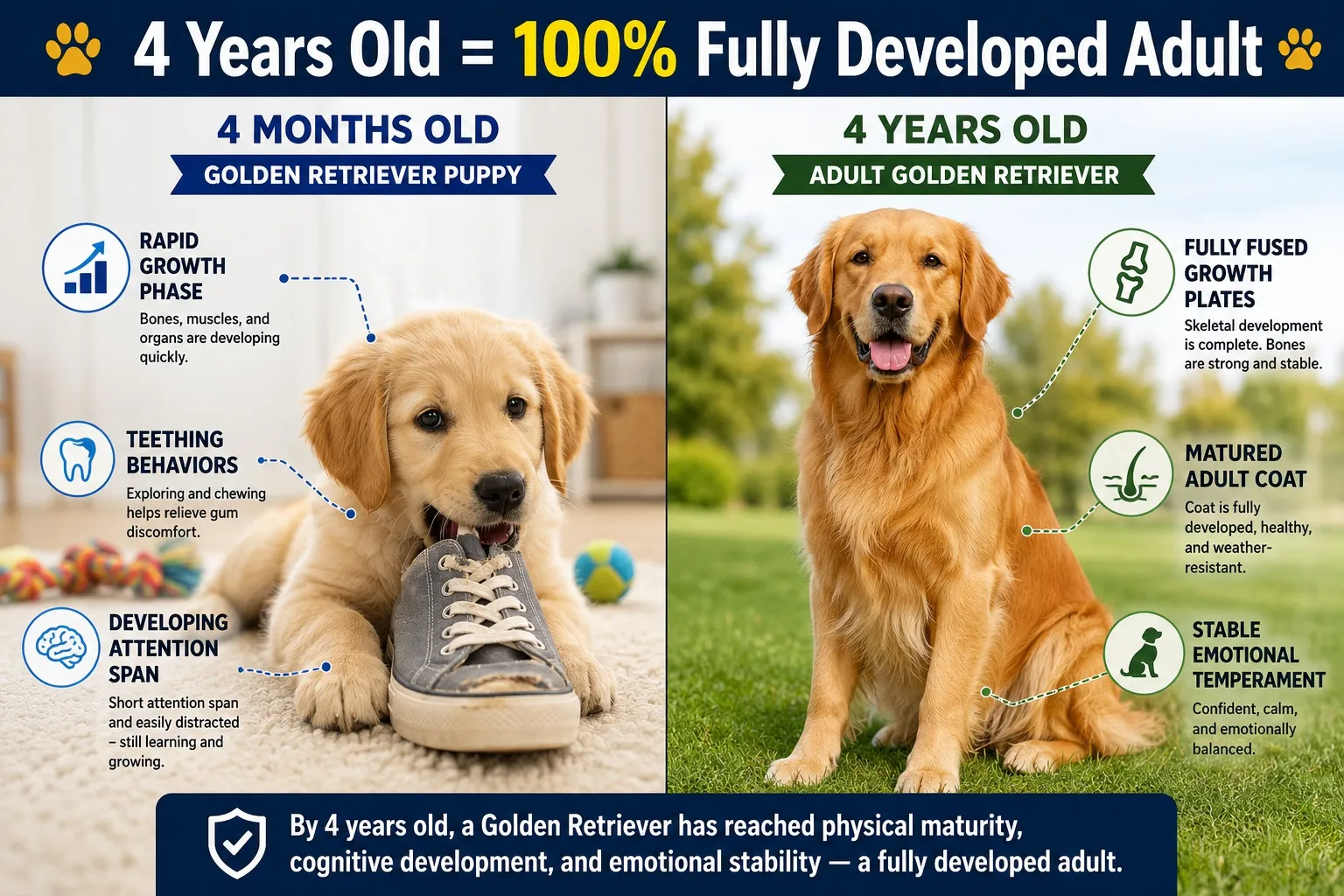
At 4 years old, your dog is definitively a fully mature adult. The energetic, chaotic puppy days are well behind them, and even the unpredictable adolescent phase has passed. According to veterinary age milestones outlined by the American Animal Hospital Association (AAHA), a 4-year-old dog is comparable to a human in their early-to-late 30s, placing them squarely in the prime of their adulthood.
While some high-energy breeds might still exhibit playful, “puppy-like” bursts of excitement, their physical, mental, and skeletal systems are completely developed.
Here are the clear signs of adulthood you will notice in a 4-year-old dog:
Settled Temperament: They are mentally mature, showing better emotional regulation, fewer destructive chewing habits, and a greater capacity for focus compared to their younger years.
Physical Maturity: Their growth plates have long since fused, and they have reached their final adult height, structural frame, and muscle density.
Established Sleep Patterns: Adult dogs at this stage adapt seamlessly to the household routine, spending a significant portion of the day resting rather than requiring constant stimulation.
Early Dental Shifts: Physically, their adult teeth are fully formed, though without routine care, this is often the age where early signs of tartar buildup can begin to surface.
Frequently Asked Questions
No, the old "multiply by 7" rule is a complete myth. It was a simple mathematical guess based on the average lifespan of dogs versus humans decades ago, but it fails to account for how dogs actually develop. Dogs mature incredibly fast during their first two years of life—reaching the equivalent of a human teenager or young adult in just 24 months. After age two, their aging process slows down significantly and varies based on their body mass.
To get an accurate number, follow the official canine life stage guidelines backed by the American Animal Hospital Association (AAHA). Give your dog 15 human years for their first year, and add 9 human years for their second year. For every year after that, add roughly 4 to 5 human years for small and medium breeds, or 6 to 7 human years for large and giant breeds. If you want to skip the math entirely, you can easily use our main tool on dogagescalculator.com to get an instant, weight-specific result.
Yes, small breeds consistently outlive larger ones. While a 4-year-old Chihuahua is still structurally a young adult, a 4-year-old Great Dane is already approaching late middle age. Large and giant breeds put immense physiological strain on their hearts and joints due to their rapid growth spurts during puppyhood, causing them to show signs of cellular aging much earlier in life than toy or small breeds.
A dog enters their senior years when they reach the final 25% of their breed's average lifespan. Because life expectancy varies so drastically by size, this milestone happens at different times. Giant breeds can be considered senior citizens as early as 5 or 6 years old, whereas small breeds typically don't reach senior status until they hit 10 to 11 years old.
A 4-year-old dog is a fully developed adult across all breed sizes. They have long outgrown their adolescent phase, their growth plates are completely fused, and their behavioral personality is locked in. While a 4-year-old dog will still have plenty of playful energy, they possess the emotional maturity and focus of an adult dog, making it the perfect age to build on advanced training or explore active outdoor adventures.
🐾 Other Age Guides
What Is 11 Dog in Human Years?
Read More →
What is 16 dog years in human years
Read More →
what is 6 human years in dog years
Read More →
What Is 13 Dog Years in Human Years
Read More →