
What Is 2 Human Years in Dog Years?
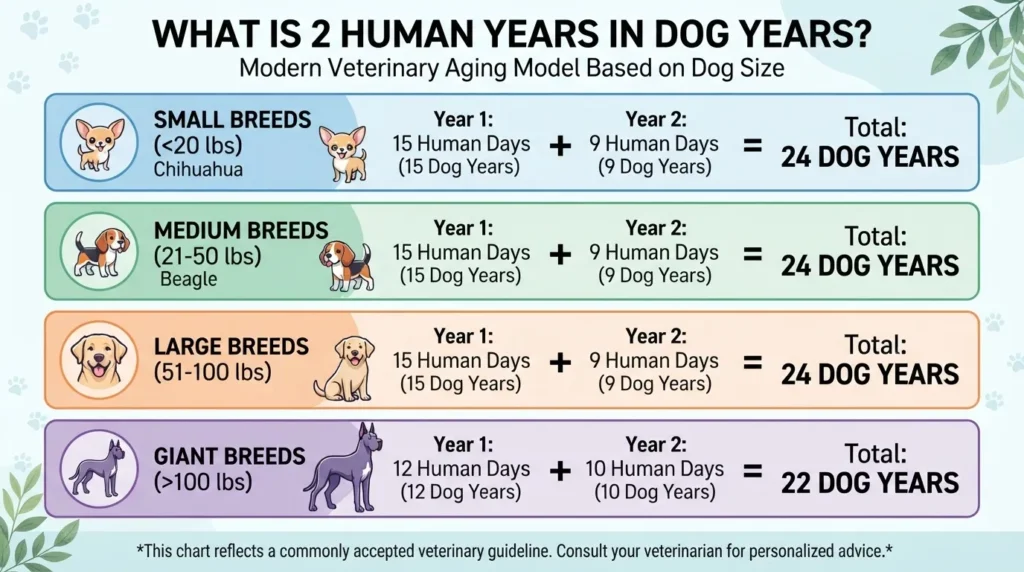
If you are wondering what is 2 human years in dog years, there is no exact one-to-one conversion. The traditional “1 human year equals 7 dog years” rule would make 2 human years equal to less than one dog year, but this shortcut does not accurately reflect how dogs develop. Dogs mature much faster during their first year and follow a very different biological timeline from humans.
At 2 human years, a child is still in early childhood, while a dog at a similar developmental stage is only a very young puppy. This is why converting human years to dog years cannot be done reliably with a simple multiplication or division formula.
How Does 2 Human Years Compare With Dog Age?
The best way to understand 2 human years in dog years is through developmental stages rather than assigning an exact calendar-age equivalent. A young puppy goes through rapid physical and behavioral development during its first months, including teething, socialization, learning, and increasing independence.
| Human Age | Approximate Dog Developmental Stage | What Is Happening? |
|---|---|---|
| 2 human years | Very young puppy stage | Rapid growth, early learning, teething, and social development |
| 7 human years | Young puppy stage | Continued physical and behavioral development |
| 15 human years | About 1 dog year | Major transition toward adolescence and physical maturity |
So, 2 human years does not equal 14 dog years in any scientifically reliable sense. The familiar 7-to-1 calculation is a historical rule of thumb, not a true biological conversion. Dogs and humans develop at different rates, particularly during the first few years of life.
If you actually meant 2 dog years in human years, that is a different calculation. A 2-year-old dog is generally comparable to a human young adult, with the exact estimate varying by the dog’s adult size and breed. You can check your dog’s age with our free dog age calculator.
What Are Dog Years? (And Why This Question Gets Confusing)
When we talk about “dog years,” we are simply trying to calculate how a dog’s age aligns with human life stages. It is a shorthand way of understanding where a dog stands in their journey from puppyhood to old age. For decades, the popular rule of thumb was that one calendar year for a dog equals seven years for a human.
However, modern veterinary science has proven that this static 7:1 ratio is a myth. According to the American Veterinary Medical Association (AVMA), dogs age much faster during their first two years of life than they do afterward. A one-year-old dog is structurally and developmentally closer to a 15-year-old human teenager than a 7-year-old child.
This non-linear aging process is exactly why calculating canine age gets confusing. A dog’s breed, size, and genetics all dictate how quickly their body matures and senesces. While a small breed dog might just be entering their senior years at age ten, a giant breed dog is already considered geriatric.
Did You Mean: 2 Dog Years in Human Years? If you are calculating the age of a young pup rather than a senior dog, 2 dog years equals roughly 24 human years. After this rapid initial growth period, a dog’s aging curve slows down significantly.
Quick Answer: 17 Dog Years in Human Years
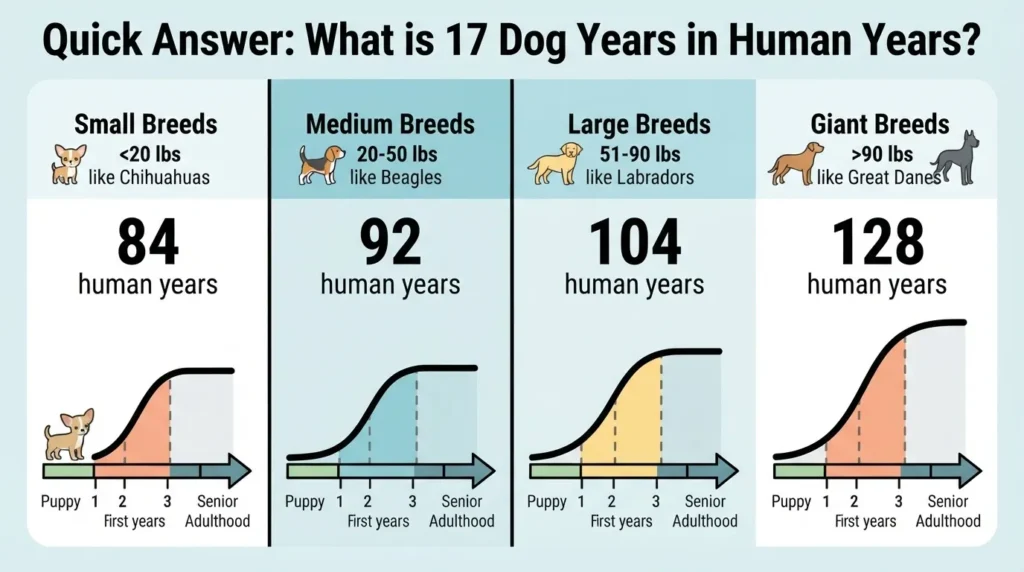
If you are looking for a fast estimate, 17 dog years is roughly equal to 84 to 120 human years. The exact age depends entirely on the size and breed of your dog, as larger dogs age much faster than smaller ones.
Here is how that breaks down using both the traditional rule of thumb and modern veterinary standards:
The Old 7:1 Method: Under the traditional formula (multiplying by 7), a 17-year-old dog would be a staggering 119 human years old.
The Modern Veterinary Method: According to current guidelines from the American Animal Hospital Association (AAHA), a 17-year-old dog is considered a “super-senior.” In human terms, a small breed is approximately 84 years old, a medium breed is about 90 years old, and a large or giant breed is well over 100 to 120 years old.
While the old 7-year rule is a simple baseline, it fails to capture how dogs actually mature. Modern canine medicine looks at life stages rather than rigid multiplication, recognizing that a 17-year-old dog has reached an incredibly venerable, high-senior milestone that deserves specialized care and attention.
How the Calculation Works
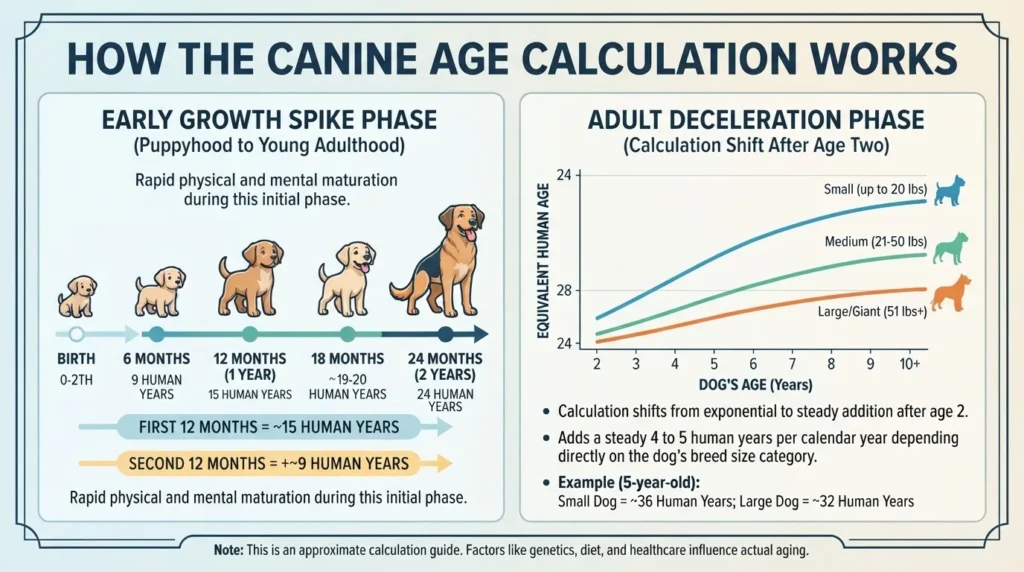
Determining your dog’s true age isn’t as simple as multiplying by seven. Canine development moves fast early on and slows down later, meaning the calculation changes depending on whether you are looking at calendar years or biological milestones.
2 Human Years → Dog Years
If you are trying to figure out what 2 human years (calendar years) look like in terms of a dog’s life progression, the calculation depends heavily on their size category.
The Formula: According to the American Veterinary Medical Association (AVMA), the first human year counts as roughly 15 dog years, and the second human year adds about 9 dog years. After age two, each additional human year adds roughly 4 to 5 dog years depending on the dog’s breed size.
🔢 Example Calculation (For a Medium Dog)
| Timeframe | Equivalent Age |
| Year 1 | 15 dog years |
| Year 2 | +9 dog years |
| Total Age | 24 dog years |
📊 Final Formula:
15 + 9 = 24 Dog Years
2 Dog Years → Human Years
Flip the equation around, and the modern calculation shows us exactly where a 2-year-old dog stands in terms of human maturity.
The Formula (AKC/Modern Method): The American Kennel Club (AKC) uses a tiered lifestage model rather than a fixed multiplier. The modern consensus splits a dog’s initial growth into a steep developmental curve:
First 12 months: Equal to 15 human years (rapid physical and sexual maturity).
Second 12 months: Equal to 9 human years (transition from adolescence to young adulthood).
🔢 Example Calculation (Your 2-Year-Old Dog)
| Dog’s Life Stage | Human Year Equivalent |
| First Dog Year | 15 human years |
| Second Dog Year | +9 human years |
| Current Maturity | 24 human years |
📊 Final Formula:
15 + 9 = 24 Human Years
💡 Quick Summary: On average, 1 dog year is equivalent to 15 human years for the first year of life, tapering down to a 1:4 ratio later in senior adulthood.
⚠️ Puppy Note: Formula adult dogs ke liye hai, kyunki puppies alag grow hote hain. During the first six months, a puppy develops at a massive exponential rate that standard linear formulas cannot accurately capture.
Full Dog Age Chart by Size (With Breed Examples)
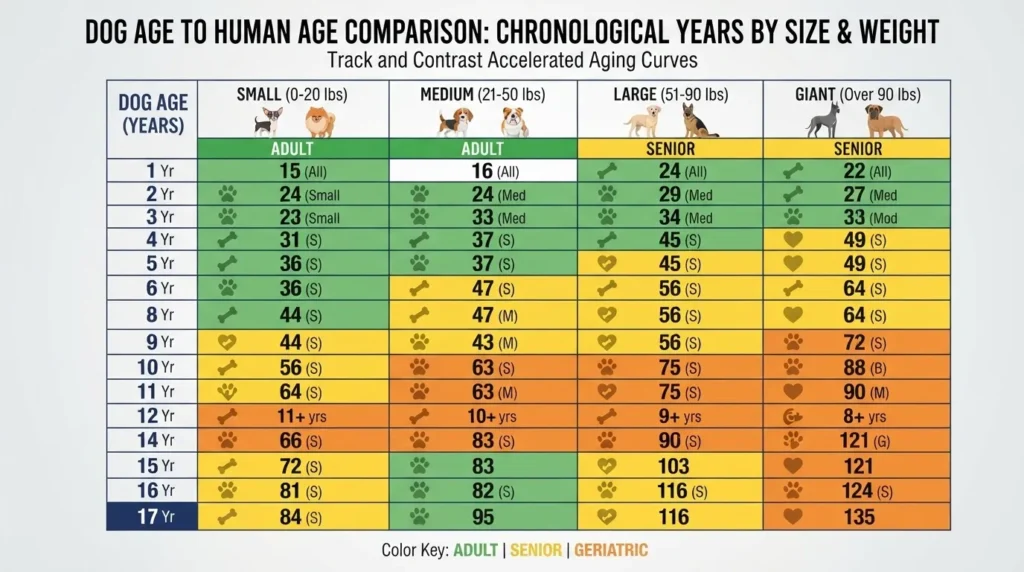
Because dogs age at drastically different rates depending on their physical build, a single universal formula doesn’t work. Small dogs enjoy a much longer adulthood, while giant breeds experience accelerated biological aging after their first two years of life.
Instead of overwhelming you with a massive historical timeline, the targeted chart below breaks down exactly how a senior dog’s calendar age translates to human years across four distinct size categories around the crucial 17-year milestone.
Calendar Age
Small Breeds
Medium Breeds
Large Breeds
Giant Breeds
15 Years
Small: 76 human years
Medium: 83 human years
Large: 93 human years
Giant: 114 human years
16 Years
Small: 80 human years
Medium: 87 human years
Large: 99 human years
Giant: 121 human years
🎯 17 Years
Small: 84 human years
Medium: 92 human years
Large: 104 human years
Giant: 128 human years
18 Years
Small: 88 human years
Medium: 96 human years
Large: 109 human years
Giant: 135 human years
19 Years
Small: 92 human years
Medium: 101 human years
Large: 115 human years
Giant: 142 human years
20 Years
Small: 96 human years
Medium: 105 human years
Large: 120 human years
Giant: 149 human years
🔍 Looking for the Complete Database? If your dog is younger, or you want to explore the full lifetime matrix from age 1 up to 100+ years, you can access our complete interactive tool on the Dog Ages Calculator Home Page.
📊 Understanding the Matrix: Notice the dramatic shift as your dog crosses into senior status. A 17-year-old dog in human years can range anywhere from an 84-year-old human senior (for small toys like Chihuahuas) to a highly exceptional, record-breaking 128-year-old equivalent for a giant breed.
Other Factors That Affect Dog Aging
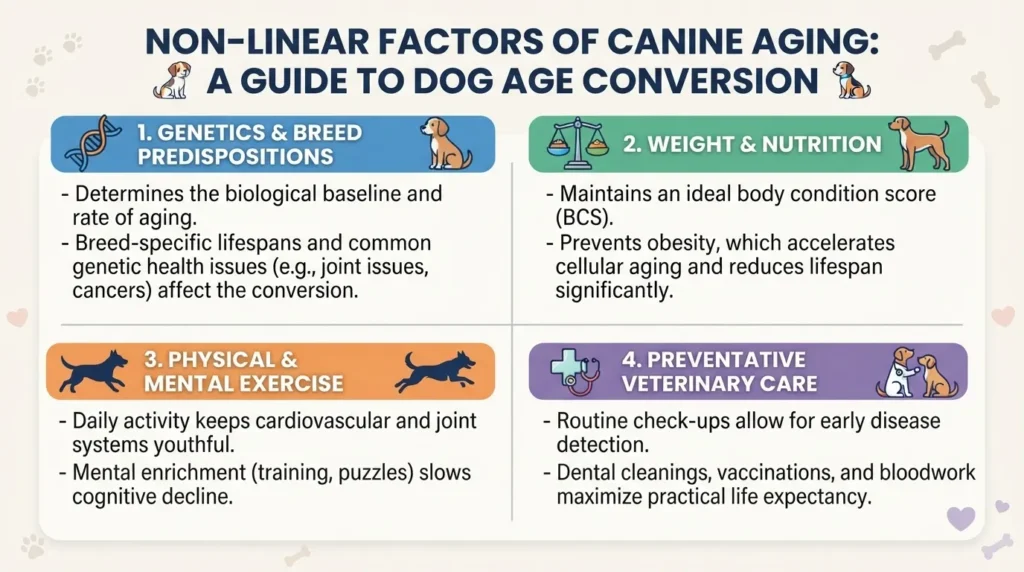
While a chart gives you a solid biological baseline, it isn’t the final word on how your specific dog grows old. Two dogs born on the exact same day can look and act completely different by the time they reach old age. Veterinary science shows that everyday factors, genetics, and preventative care drastically shift how gracefully a dog moves through their senior years.
Understanding these variables gives you a much clearer picture of what a 17-year-old dog in human years actually looks like physically and mentally:
Weight and Body Condition: Excess weight is arguably the biggest accelerator of canine aging. According to data tracked by the American Veterinary Medical Association (AVMA), carrying even a few extra pounds strains a senior dog’s joints, accelerates arthritis, and places immense metabolic stress on internal organs like the heart and kidneys.
Genetics and Breed Lineage: Beyond the standard small-versus-large rule, specific genetic lineages dictate how a dog handles age. Some breeds are highly prone to early-onset hereditary conditions like canine cognitive dysfunction or cardiac disease, while others inherit resilient genes that help them sail smoothly into advanced age.
Spay or Neuter Status: The timing and status of sterilization alter a dog’s hormonal profile for life. Studies suggest that altered dogs tend to have a slightly longer average lifespan, largely because it eliminates the risk of reproductive cancers and life-threatening uterine infections like pyometra in senior female dogs.
Diet and Lifestyle: High-quality, bioavailable nutrition packed with antioxidants and omega-3 fatty acids actively fights systemic inflammation. Pair that with regular, low-impact mental and physical exercise, and you keep both the brain and the musculoskeletal system firing efficiently well past a decade of life.
Try Our Free Dog Age Calculator
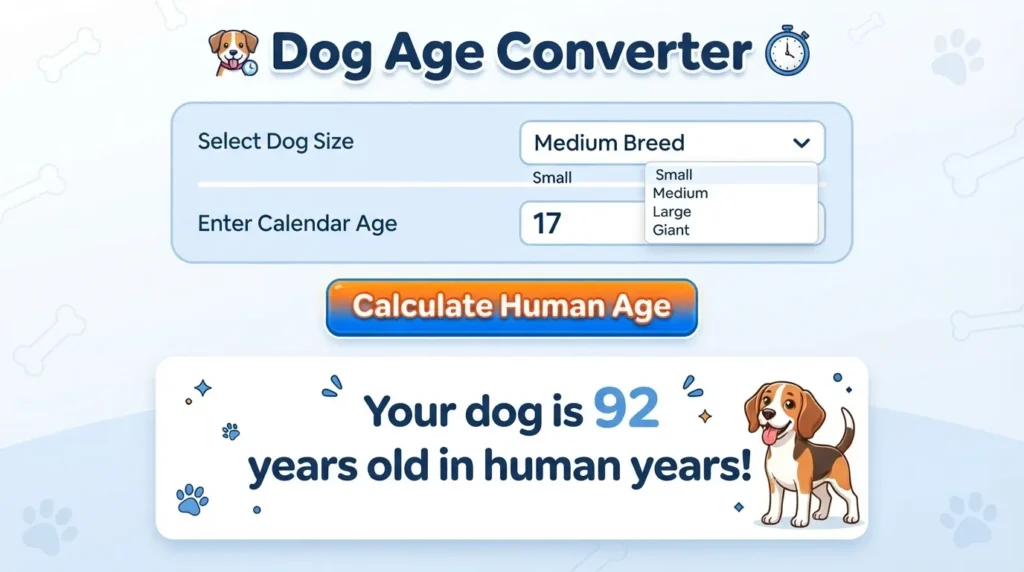
Want an instant calculation based on your pet’s size? Our tool uses the latest AVMA frameworks to pinpoint your dog’s true biological age.
Simply select your dog’s size and weight using our online dog age to human years calculator to get an instant conversion!
Frequently Asked Questions
If you adopted a rescue dog and don't have an official birth date, a veterinarian can evaluate specific physical biomarkers to estimate their chronological age.
Dental Wear and Tartar: Puppies have distinct erupting teeth, while adult dogs show progressive wear, staining, and tartar buildup as they cross the 5-year mark.
Ocular Changes: Many senior dogs develop a cloudy, blue-grey tint over their pupils around age 6 to 8, a normal and harmless condition known as lenticular sclerosis.
Coat Graying: Silvering around the muzzle, eyebrows, and face often starts appearing during middle age, though stress and genetics can cause early graying.
No, dogs and cats follow entirely different biological aging timelines. While both species experience an immense burst of physical and social growth during their first 24 months, cats generally age much more slowly and uniformly than dogs over the long term.
A 2-year-old cat is roughly equivalent to a 24-year-old human—very similar to a dog—but an older 17-year-old cat is only about 84 human years, regardless of their breed or size category.
Yes, breed and physical size are the absolute biggest variables in how quickly a dog ages. While a 17-year-old dog in a small breed like a Chihuahua might be the equivalent of an 84-year-old human, a large breed like a German Shepherd would reach that same geriatric milestone much earlier in calendar time.
Smaller dogs mature faster in their first year of life but enjoy a significantly slower biological decline, whereas larger and giant breeds experience a highly accelerated aging curve after they cross their third calendar year.
These baseline calculations provide an incredibly reliable clinical estimate, but they aren't flawless. Modern veterinary guidelines combine data from classic lifestyle frameworks with cutting-edge genetic studies, such as the peer-reviewed DNA methylation aging research from UC San Diego (Wang et al.).
While weight and skeletal size give us a highly predictable map of cellular aging, individual factors like genetics, diet, and proactive preventative care will always play a massive role in your dog's actual physical vitality.
No, the traditional "one human year equals seven dog years" rule is a myth. It assumes dogs age at a completely linear rate throughout their entire lives, which isn’t biologically accurate.
According to the American Veterinary Medical Association (AVMA), a dog's first year actually equals about 15 human years, their second year adds about 9 human years, and each subsequent year slows down to a much more gradual pace of 4 to 5 human years.
🐾 Other Age Guides

Gulfam Haider Mehdi
Founder & Developer
I built Dogagescalculator.com to give dog owners honest, science-backed answers instead of the outdated "×7" myth. Every figure here is checked against AKC, AVMA, and published veterinary research.
More about the author & this site →📌 Featured Guides
oldest historical picture of the breed shar pei
→
how long can a puppy hold their pee
→
17 human years in dog years
→
what is 5 human years in dog years
→
chihuahua corgi mix dog
→
belgian malinois age in human years
→
How much food should I feed my German Shepherd
→
how much does a german shorthaired pointer weigh
→
32 years in dog years
→
Senior Dog Care
→
Comments