
35 in Dog Years: What Age Does That Really Mean?
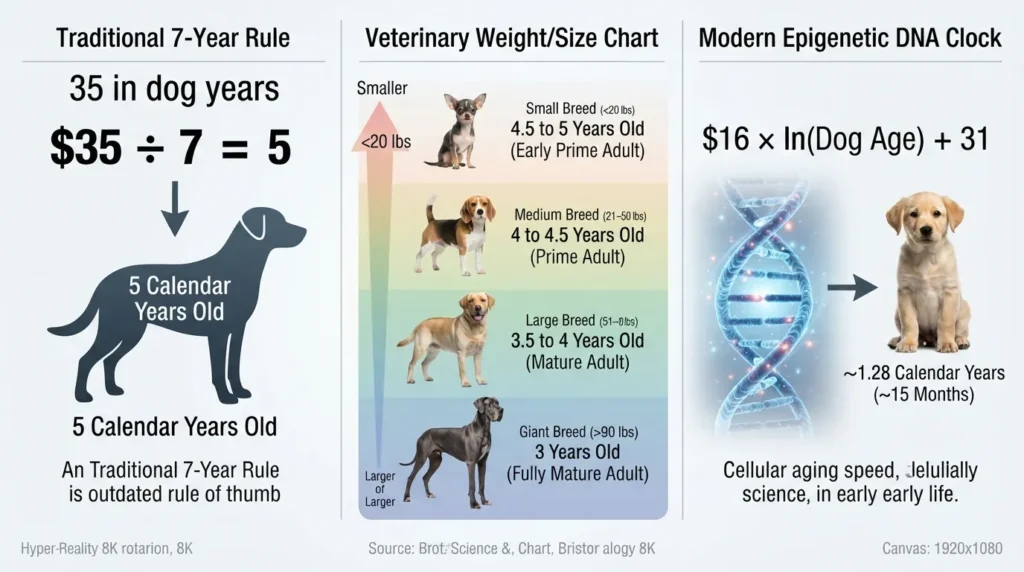
If you are looking at a dog that is roughly 4 to 5 calendar years old, you might hear someone say they are “35 in dog years.” Alternatively, if you have a senior pup who has reached 17 actual calendar years, you are likely wondering what that translates to in human equivalent aging.
Understanding how canine aging works requires moving past the outdated “multiply by 7” rule. Depending on your dog’s size, breed, and genetics, canine development follows a non-linear path that varies significantly across life stages.
What Is 17 Dog Years in Human Years?
A 17-year-old dog is equivalent to a human aged 84 to 120+ years, depending entirely on the dog’s size category.
According to life stage guidelines established by the American Animal Hospital Association (AAHA), small dogs age more slowly in their senior years than giant breeds. Because very few extra-large or giant dogs reach age 17, a 17-year-old dog of any size is considered a super-senior in the highest tier of canine longevity.
Here is how 17 actual calendar years translate across different weight classes:
| Dog Size Category | Weight Range | Human Age Equivalent at 17 Years |
|---|---|---|
| Small Breed | Under 20 lbs | 84 – 88 human years |
| Medium Breed | 21 – 50 lbs | 88 – 93 human years |
| Large Breed | 51 – 90 lbs | 95 – 105 human years |
| Giant Breed | Over 90 lbs | 115 – 120+ human years |
The Science of Canine Aging: Why the “Rule of 7” Is Outdated
For decades, popular culture relied on a simple formula: multiply a dog’s age by 7. Modern veterinary geriatrics has proven this approach inaccurate because dogs do not age at a steady rate throughout their lives.
Rapid Early Development
A dog develops at an accelerated pace during its first two years of life. According to the American Veterinary Medical Association (AVMA):
Year 1: Approximately 15 Human Years (Rapid Development & Adolescence)
Year 2: Adds 9 Human Years (Reaching physical maturity at roughly 24 Human Years total)
Year 3 and Beyond: Adds 4 to 7 Human Years per calendar year (Heavily influenced by body mass and size)
The Epigenetic Clock (DNA Methylation Study)
In 2020, researchers led by Wang et al. published a landmark study in Cell Systems examining canine aging at the cellular level. By analyzing DNA methylation patterns (epigenetic marks on DNA that change as organisms age), researchers tracked molecular aging in dogs compared to humans.
The study established a logarithmic formula for canine-to-human age conversion:
Human Age = 16 × ln(Dog Age) + 31
(Where ln represents the natural logarithm of the dog’s actual age in calendar years).
Using this molecular clock:
A 1-year-old dog corresponds to a 31-year-old human at the cellular level due to rapid initial development.
A 5-year-old dog corresponds to roughly 57 human years.
A 17-year-old dog calculates to approximately 76 human years at the pure molecular level, though clinical veterinary observation adjusts this higher for physical strain and joint wear in larger breeds.
How Size and Breed Impact Aging Rates
Small breeds enjoy longer lifespans on average than large breeds. While a Chihuahua or Toy Poodle reaching 17 calendar years is impressive, it is relatively common in veterinary practice. For a Great Dane or Mastiff, reaching 17 years is exceptionally rare.
Expected Lifespan Trends by Size:
Small Breeds (Under 20 lbs): 14 to 18+ Years
Medium Breeds (21 to 50 lbs): 12 to 15 Years
Large Breeds (51 to 90 lbs): 10 to 13 Years
Giant Breeds (Over 90 lbs): 7 to 10 Years
Why Larger Dogs Age Faster
Biologists attribute accelerated aging in larger dogs to rapid early growth. Large and giant breeds grow from birth weight to adult size at a rate that requires immense metabolic activity. This rapid cell division generates higher levels of free radicals and cellular stress early in life, leading to earlier onset of age-related conditions like osteoarthritis, cardiac disease, and cognitive decline.
Key Health Signs in a 17-Year-Old (Super-Senior) Dog
Reaching 17 calendar years represents an extraordinary milestone. At this stage, daily care focuses on comfort, mobility, and cognitive health.
1. Mobility and Joint Changes
Most 17-year-old dogs experience some degree of osteoarthritis. Watch for:
Stiffness when standing up, especially after resting.
Hesitancy on stairs or slippery floors.
Loss of muscle mass along the hind legs and spine.
2. Cognitive Health
Canine Cognitive Dysfunction (CCD), similar to human dementia, is common in super-seniors. Symptoms include:
Disorientation or pacing, particularly in the evening (sundowning).
Changes in sleep-wake cycles.
Forgetting previously mastered house-training habits.
3. Sensory Changes
Vision loss from nuclear sclerosis or cataracts, alongside progressive hearing loss, is expected in senior dogs. Environmental consistency—keeping furniture in fixed locations and using scent cues—helps maintain their confidence.
Practical Care Tips for Super-Senior Dogs
Supporting a 17-year-old dog involves modifying their daily routine to match their reduced physical reserves.
Schedule Bi-Annual Vet Exams: AAHA guidelines recommend wellness visits every six months for senior dogs to monitor blood pressure, kidney function, and pain management.
Improve Home Traction: Place non-slip rugs or yoga mats over hardwood and tile floors to prevent slips and joint strain.
Adjust Diet and Hydration: Senior dogs often need easily digestible protein and added fiber. Ensure water bowls are raised to a comfortable height and placed in easily accessible spots.
Maintain Gentle Engagement: Short, frequent sniffing walks provide mental stimulation without causing joint fatigue.
35 in Dog Years: What Age Does That Really Mean? Vet-Reviewed Guide
Quick Answer — 35 in Dog Years at a Glance
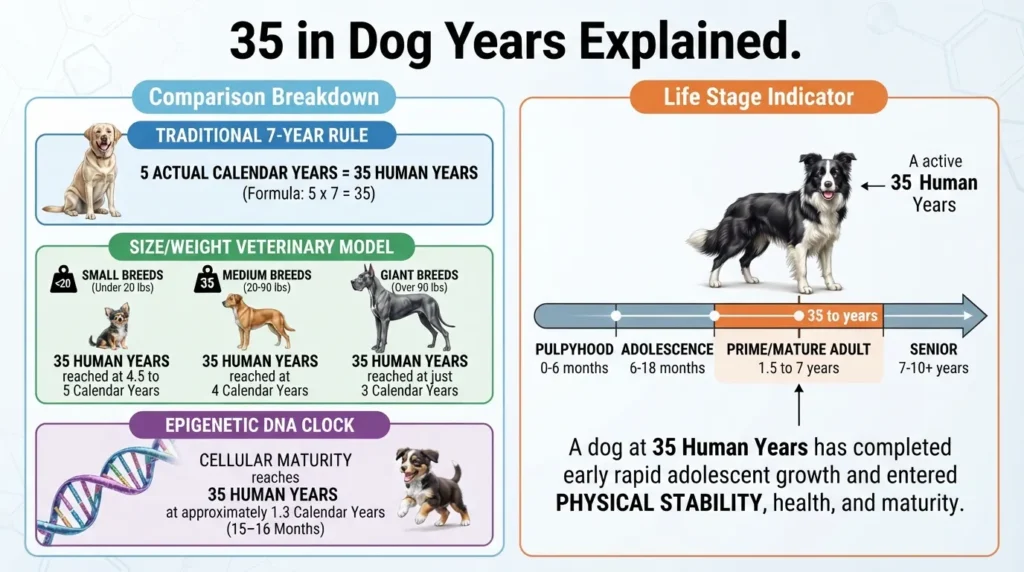
| Method | Real Dog Age Equal to 35 Human Years |
| 7-Year Rule | 5 years old |
| Size-Based Chart | ~4 years old (varies by size) |
| Scientific DNA Formula | ~1.3 years old |
Key Takeaway: There is no single fixed answer—a dog that is “35 in human years” ranges from 1.3 to 5 calendar years old depending on whether you use traditional rules of thumb, size-adjusted veterinary charts, or modern DNA aging science.
If you are trying to figure out what 35 in dog years actually means, the answer depends entirely on the calculation method you use. While the old popular belief says a 5-year-old dog is 35, modern veterinary guidelines and genetics show that canine maturity happens much faster in early life and varies significantly by breed size.
Method 1 — The Traditional 7-Year Rule
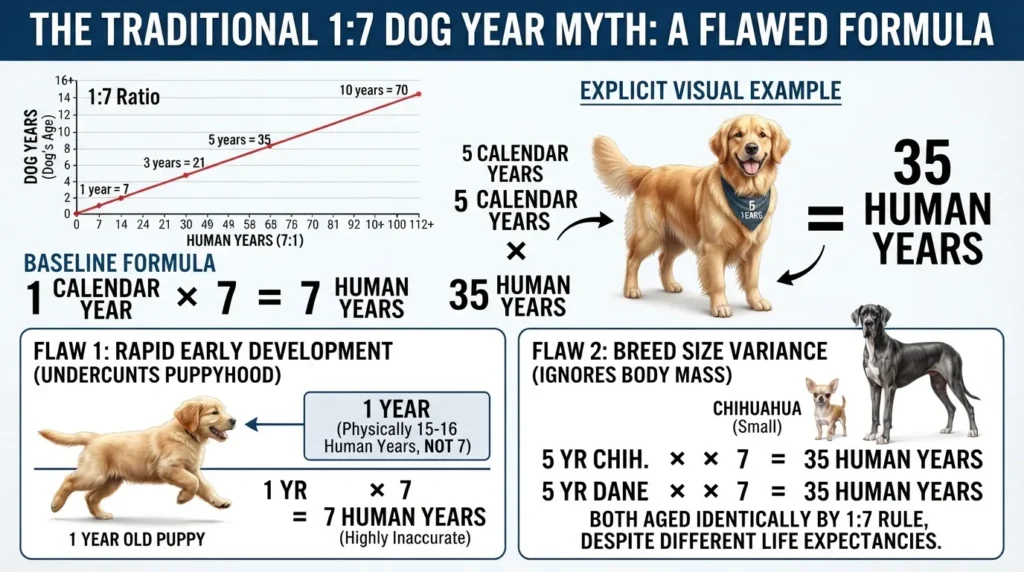
For decades, the standard math was simple: one human year equals seven dog years. While it works as a quick mental shortcut, veterinary science has largely retired this rule because it oversimplifies how canine biology actually works.
How 35 ÷ 7 = 5 is calculated
Under the traditional formula, converting ages is straightforward division or multiplication. If a dog is calculated to be 35 in dog years, you simply divide by 7 to get 5 actual calendar years.
Conversely, if a dog reaches 17 actual years, the old rule multiplies 17 by 7 to claim the dog is 119 in human years. It assumes every single year of a dog’s life accrues aging at the exact same pace, regardless of their life stage or body size.
Why this rule is scientifically inaccurate
Modern veterinary medicine relies on canine life stage guidelines from organizations like the American Animal Hospital Association (AAHA), which show that aging rates fluctuate dramatically across a dog’s lifespan.
Puppies age faster than adults: A dog experiences immense physical and developmental growth in its first 12 to 24 months. A one-year-old dog has already reached the human equivalent of mid-adolescence (roughly 15 years old), meaning they do not age at a flat rate of 7 years per year early on.
Ratio isn’t linear: Aging slows down significantly after a dog reaches physical maturity around age two. The rate of cellular aging shifts from a rapid sprint during puppyhood to a steady, slower curve during the middle adult years.
Breed size ignored entirely: The 7-year rule treats a 6-pound Chihuahua and a 130-pound Mastiff identically. In reality, giant breeds age at an accelerated rate on a cellular level, while small breeds enjoy much longer lifespans and slower physiological decline.
Method 2 — Breed & Size-Based Chart AKC / AVMA / AAHA
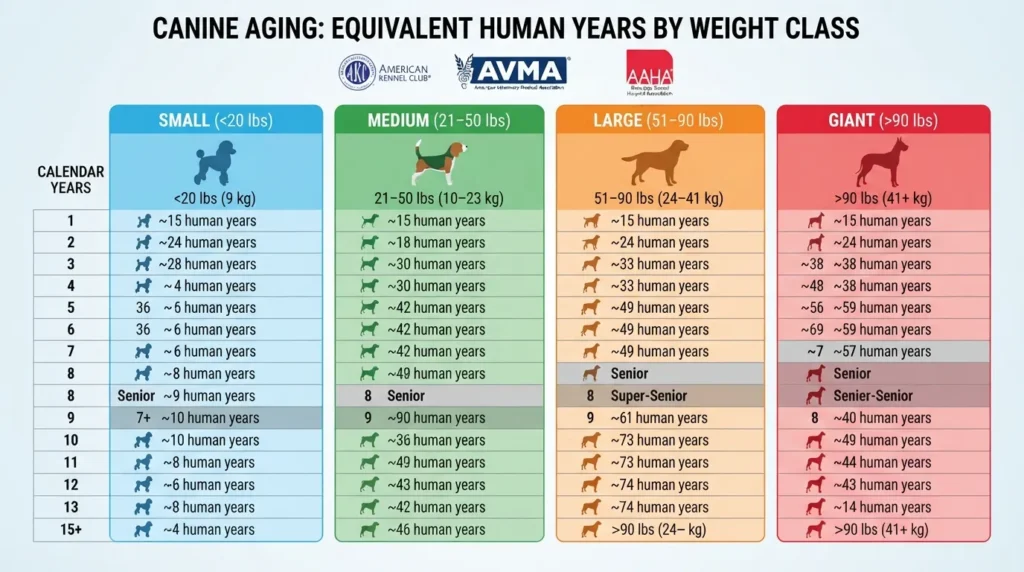
While universal aging formulas offer a great scientific baseline, veterinary organizations like the American Kennel Club (AKC), American Veterinary Medical Association (AVMA), and American Animal Hospital Association (AAHA) emphasize that a dog’s weight class dramatically alters their aging timeline. Small dogs age much slower after early adulthood, while giant breeds experience accelerated physical aging across every stage of life.
To accurately determine when your dog reaches mid-adulthood or senior status, you have to factor in body mass. A medium-sized dog reaching middle age looks vastly different on paper than a giant breed reaching that exact same milestone.
Age each size reaches ~35 human years (single merged table: Small / Medium / Large / Giant)
The following chart shows precisely when each weight class crosses the 35 human years mark based on combined AKC, AVMA, and AAHA aging progression guidelines.
| Dog Size Category | Weight Range | Calendar Age at ~35 Human Years | Life Stage Status |
|---|---|---|---|
| Small Breed | Under 20 lbs | 4.5 to 5 Years | Early Prime Adulthood |
| Medium Breed | 21 to 50 lbs | 4 to 4.5 Years | Prime Adulthood |
| Large Breed | 51 to 90 lbs | 3.5 to 4 Years | Approaching Mature Adult |
| Giant Breed | Over 90 lbs | 3 Years | Fully Mature Adult |
Real Example — “A 4-Year-Old Great Dane Is Already 35” (AKC-cited)
To see this size disparity in action, consider a 4-year-old Great Dane compared to a 4-year-old Chihuahua. According to AKC life stage data, giant breeds like Great Danes, Mastiffs, and Irish Wolfhounds grow at an astonishing rate during their first two years, putting tremendous strain on their metabolic and skeletal systems.
By the time a Great Dane blows out four birthday candles, their biological age is already equivalent to a 35- to 39-year-old human. They have fully transitioned into late maturity, whereas that 4-year-old Chihuahua is biologically sitting around 32 human years and still has more than two-thirds of its lifespan ahead.
This rapid acceleration explains why giant breeds require early joint support, weight management, and proactive veterinary care much earlier in life than their smaller counterparts.
Method 3 — The Scientific DNA Formula UC San Diego Study
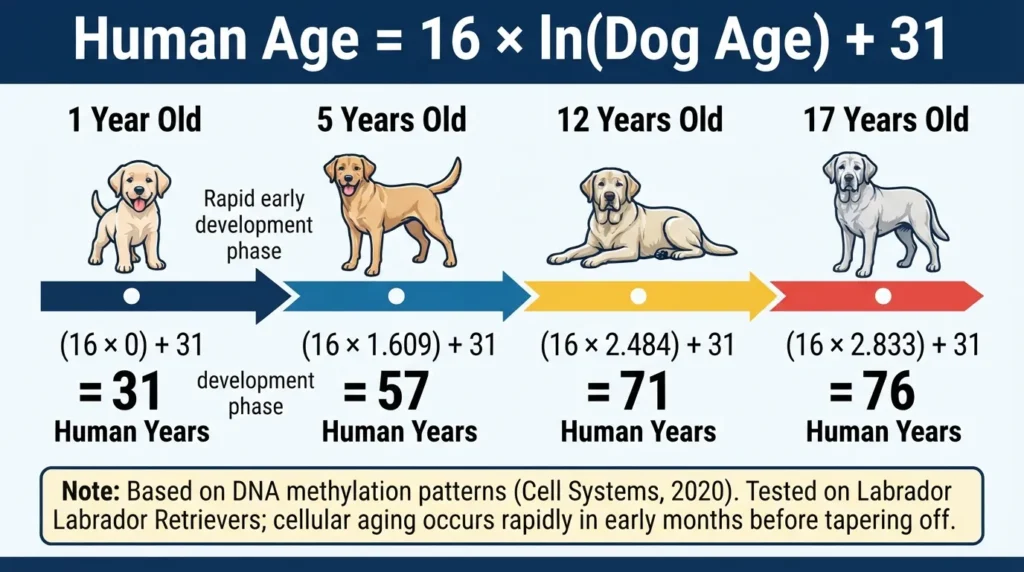
In 2020, researchers at the University of California, San Diego published a groundbreaking study in Cell Systems that changed how we measure canine aging. Instead of tracking physical milestones or rough averages, the team led by Dr. Tina Wang analyzed DNA methylation—chemical marks on a dog’s genome that shift predictably over time.
By comparing these epigenetic patterns between humans and dogs, they mapped aging down to the cellular level. The study produced a precise logarithmic equation for dog-to-human age conversion:
Human Age = 16 × ln(Dog Age) + 31
(In this equation, ln refers to the natural logarithm of your dog’s actual age in calendar years).
1-Year-Old Dog: (16 × 0) + 31 = 31 Human Years
2-Year-Old Dog: (16 × 0.693) + 31 = 42 Human Years
5-Year-Old Dog: (16 × 1.609) + 31 = 57 Human Years
17-Year-Old Dog: (16 × 2.833) + 31 = 76 Human Years
What Real Dog Age Equals 35 Using This Formula?
Plugging numbers into the equation reveals that a dog reaches an equivalent human age of 35 at roughly 1.28 calendar years old (about 15 to 16 months).
This trips up many dog owners because 35 sounds like early middle age in humans. However, epigenetics shows that dogs undergo massive cellular maturation during their first 18 months, reaching adult DNA markers very quickly before their aging rate tapers off.
Limitations of the UC San Diego Study
While this molecular clock provides a fascinating genetic snapshot, it has one major real-world limitation: the entire study was conducted exclusively on Labrador Retrievers. Because different breeds—particularly toy vs. giant dogs—age at drastically different physiological rates after year two, this formula doesn’t account for the unique lifespans of smaller or larger breeds.
Method Comparison — Why Numbers Differ & Which to Trust
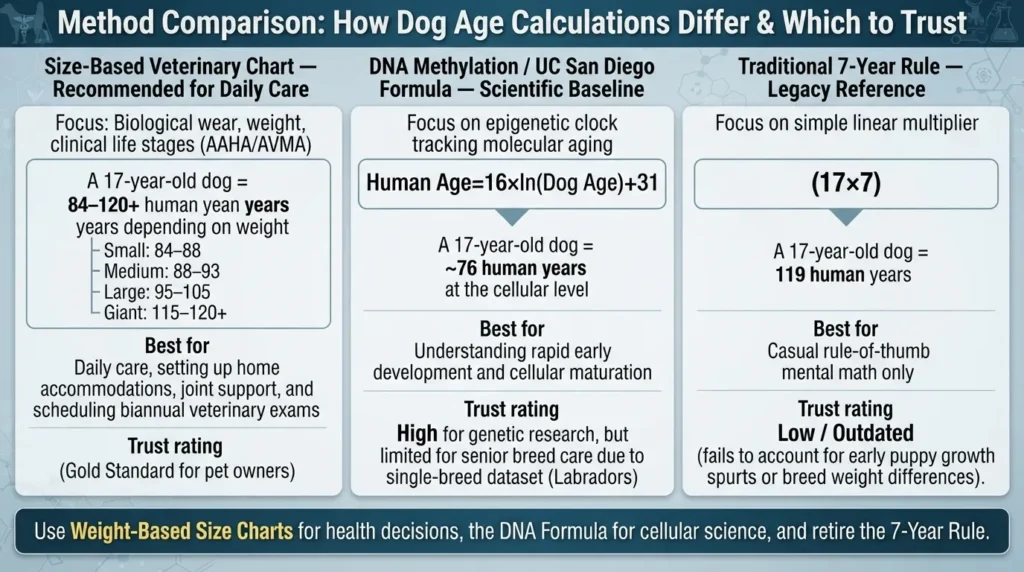
When you search for 17 dog years in human years, you will inevitably spot conflicting numbers. One veterinary calculator claims a 17-year-old dog equals an 84-year-old human, while another states 120+.
These differences do not mean someone is guessing. They simply reflect different scientific methodologies and dataset priorities.
Why AKC, AAHA, and Zoetis Give Slightly Different Numbers at the Same Age
Each major veterinary organization builds its age conversion models around distinct operational goals:
American Kennel Club (AKC): Emphasizes broad breed standards and general owner education. Their models rely heavily on weight-based tiers that smooth out extreme outliers to give a practical, everyday estimate for pet parents.
American Animal Hospital Association (AAHA): Prioritizes clinical life stages over rigid numerical equivalence. According to AAHA canine life stage guidelines, aging is tracked through health markers—classifying dogs as senior or “super-senior”—to help veterinarians tailor preventive care plans like biannual blood panels and joint monitoring.
Zoetis (and Veterinary Pharmaceutical Research): Focuses on biological and metabolic aging curves. Drug developers look closely at organ decline and cellular cellular stress patterns across breeds, which leads to tighter, weight-specific logarithmic formulas used in clinical trials.
Small variance in weight thresholds—such as whether a “medium” dog tops out at 45 or 50 pounds—can shift a 17-year-old dog’s human equivalent by up to 5 to 10 human years on paper.
Our Recommendation — Size-Chart for Daily Use, Formula for Curiosity, 7-Year Rule as Legacy Reference Only
To make sense of the noise without getting bogged down in conflicting math, use this straightforward framework:
Use the Weight-Based Size Chart for Daily Care: Size-based charts (like AAHA guidelines) reflect real-world physiological wear and tear. When monitoring a 17-year-old dog in human years, your dog’s physical weight category gives you the most accurate benchmark for setting up home accommodations, joint support, and veterinary visit schedules.
Use the DNA Methylation Formula for Biological Curiosity: The UC San Diego epigenetic formula (
16 × ln(dog age) + 31) is incredible for understanding cellular maturation, particularly early in life. It offers fascinating insight into genetic aging, even if its single-breed dataset makes it less precise for giant or toy breeds later in life.Keep the “7-Year Rule” strictly as a Legacy Reference: Multiplying by 7 works as a crude party trick, but it completely misses early rapid development and late-life size divergence. Treat it as a piece of pop culture history rather than a reliable pet health tool.
So Is Your Dog Actually "35" Yet? Find Out Exactly
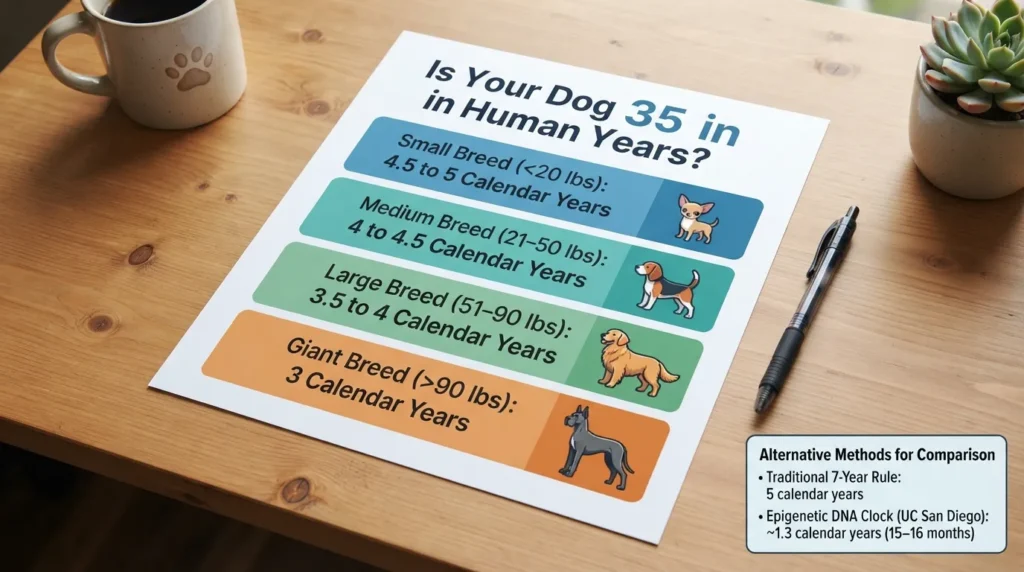
Translating your dog’s age isn’t about rigid formulas—it depends heavily on their breed, body weight, and unique stage of life. To skip the manual math and see where your pup stands on both the traditional veterinary scale and the modern epigenetic clock, head over to our interactive Dog Age Calculator. Plug in their exact birthdate and size to get an instant, custom age conversion tailored to your dog.
What 35 Human Years Means for Your Dog's Life Stage
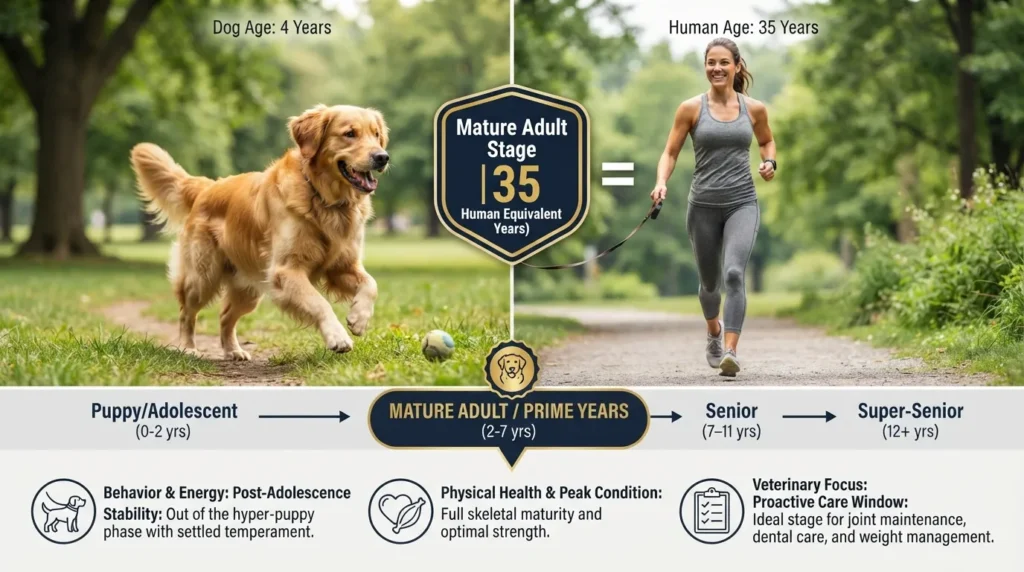
Reaching an equivalent age of 35 human years places your dog squarely in the Mature Adult life stage—roughly 4 to 5 calendar years for most breeds. They have outgrown their energetic adolescent phase and settled into peak physical stability, making this the prime window for proactive health maintenance.
FAQs About 35 in Dog Years
Is 35 in dog years the same for every breed?
No. While a 4-year-old dog of almost any breed lands somewhere near 32 to 36 in human age, their aging paths diverge quickly after this milestone. Small breeds age much slower in adulthood, while large and giant breeds age rapidly. A 4-year-old Great Dane is physiologically closer to senior status than a 4-year-old Toy Poodle.
Is the 7-year rule ever accurate?
It is only a rough baseline for medium-sized dogs during mid-life (around ages 3 to 7). For young puppies or senior dogs, the 7-year multiplier fails completely because it completely ignores the massive spike in cellular and physical development during a dog's first two years of life.
What if my dog is exactly 4 years old — is it 35?
If your dog weighs between 20 and 50 pounds, a 4-year-old dog is approximately 32 to 34 human years old. If they are a large or giant breed, 4 calendar years pushes them much closer to 35 to 38 human years due to their faster rate of cellular aging.
If I'm 35, what am I "in dog years"?
If you are a 35-year-old human, your direct physical counterpart is a dog between 4 and 5 calendar years old. According to the AAHA canine life stage framework, both of you are enjoying prime adult stability—out of adolescence, fully grown, and well before old age sets in.
🐾 Other Age Guides

I built Dogagescalculator.com to give dog owners honest, science-backed answers instead of the outdated "×7" myth. Every figure here is checked against AKC, AVMA, and published veterinary research.
More about the author & this site →
Comments