What Is 8 Dog Years in Human Years? Complete Answer by Size
Quick Answer — 8 Dog Years in Human Years
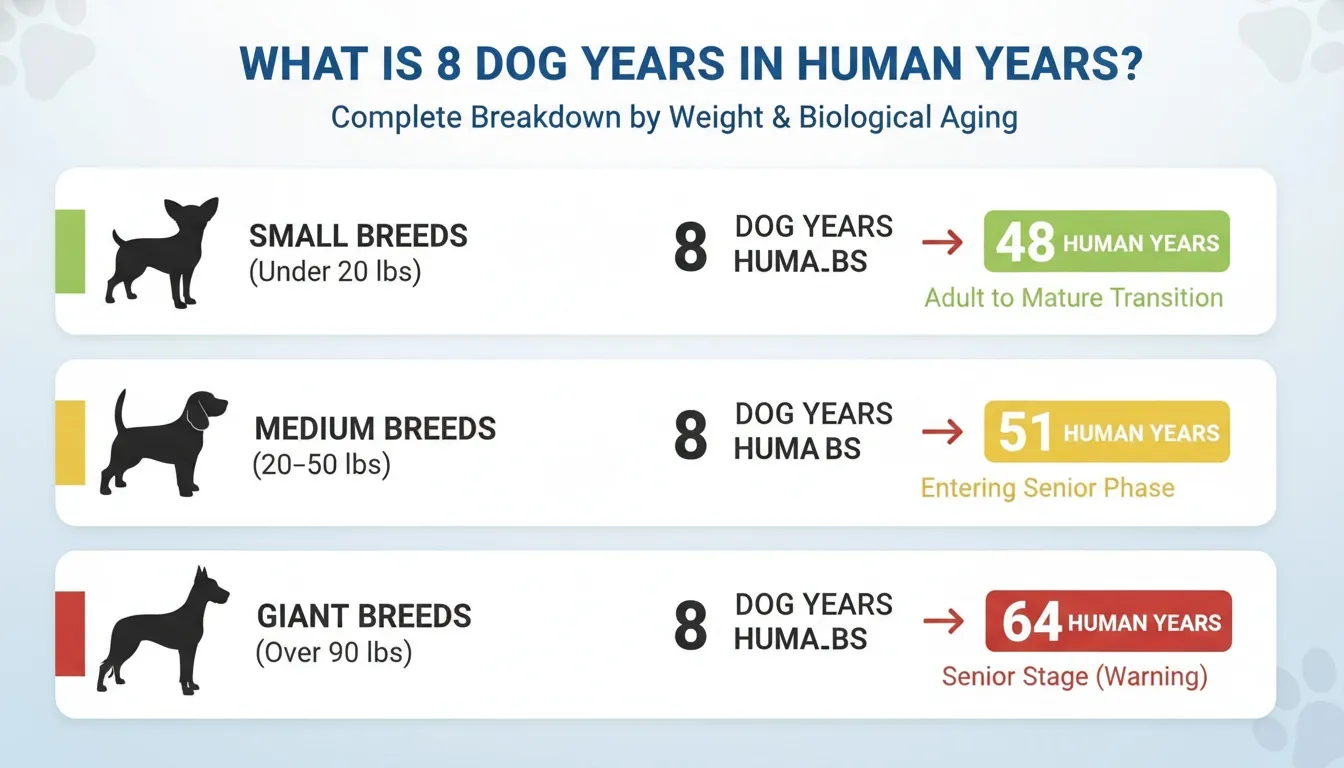
An 8-year-old dog is roughly 48 to 64 human years old, depending on size and breed. Small dogs generally age more slowly and may still be in middle to later adulthood at eight, while large and giant breeds tend to experience age-related changes earlier. This is why there is no single human-age equivalent for every 8-year-old dog.
Size-Wise Human Age at 8 Dog Years
| Dog Size | Estimated Human Age at 8 Years |
|---|---|
| Small (< 10 kg / 22 lbs) | ~48 years |
| Medium (10–25 kg / 23–55 lbs) | ~51 years |
| Large (25–45 kg / 56–99 lbs) | ~55 years |
| Giant (45+ kg / 100+ lbs) | ~64 years |
These figures are estimates rather than exact biological ages. Your dog’s breed, size, genetics, and overall health can all influence how quickly they mature and develop age-related changes.
Why the 7-Year Rule Is Wrong for 8-Year-Old Dogs
The traditional rule that one dog year equals seven human years would make an 8-year-old dog 56 human years old. However, dogs do not age at a constant rate throughout their lives. They mature especially quickly during their first few years, and their aging pattern later varies with factors such as body size and breed.
A 2020 study from researchers at UC San Diego and other institutions used changes in DNA methylation to examine canine aging. The research showed that dogs experience a much faster rate of biological aging early in life, followed by a slower and changing pattern as they grow older. This helps explain why simple multiplication does not accurately represent a dog’s human-equivalent age.
Is an 8-Year-Old Dog Considered Senior?
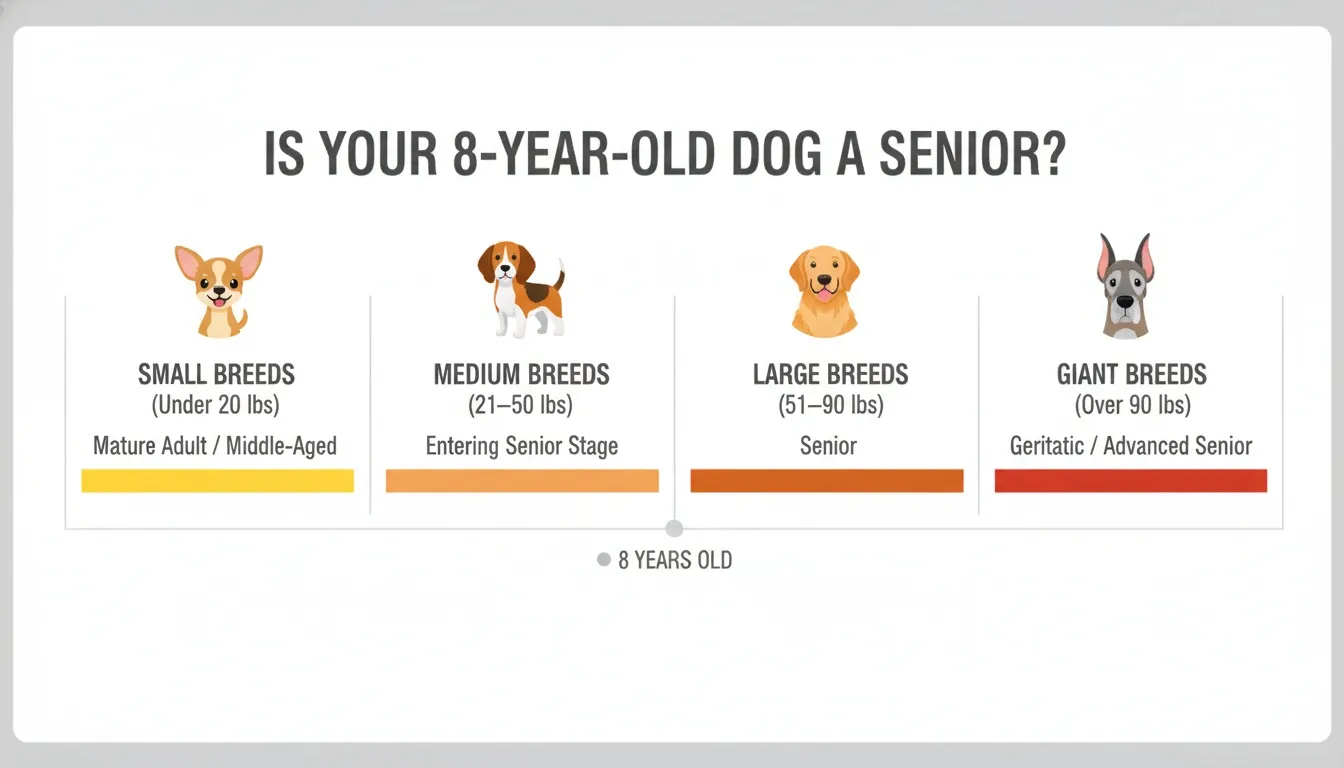
The short answer is: it depends entirely on your dog’s weight. While the old “seven human years for every dog year” rule implies that every 8-year-old dog is roughly 56 and officially a senior, modern veterinary medicine tells a different story. According to the American Veterinary Medical Association (AVMA), a canine companion officially transitions into their senior years when they reach the final 25% of their breed’s estimated lifespan. Because a Chihuahua lives significantly longer than a Great Dane, 8 dog years in human years means something completely different depending on the size of the dog sleeping on your couch.
To understand how dogs age, we have to look at biological stress. Big dogs age at a accelerated metabolic rate compared to smaller pups. This means an 8-year-old Pomeranian is still living in their prime mature adult years, whereas an 8-year-old Boxer has already crossed the threshold into senior territory. Knowing your dog’s specific category helps you tailor their nutrition, exercise, and veterinary care to their actual biological age rather than just a number on a calendar.
Size-Wise Senior Stage Table
| Dog Size | Senior Starts | 8 Years = ? |
|---|---|---|
| Small (under 10 kg) | 10–11 years | ❌ Mature Adult |
| Medium (10–25 kg) | 8–9 years | ✅ Just Entering Senior |
| Large (25–45 kg) | 7 years | ✅ Already Senior |
| Giant (45+ kg) | 5–6 years | ✅ Well Into Senior |
What “Senior” Actually Means Practically
The AVMA guidelines emphasize that reaching the senior dog age milestone is a trigger for proactive health screening, not a reason to panic. Practically, this is the life stage where your vet will likely recommend moving from annual exams to bi-annual checkups, incorporating routine blood panels to catch kidney or thyroid changes early. Think of it as transitioning your dog into a specialized wellness plan designed to protect their joints, vital organs, and cognitive health.
Physical Signs Matter More Than Just Age Number
Your dog’s daily habits offer a more accurate reading of their dog human age equivalent than the calendar does. Keep a close eye on subtle shifts: a slight hesitation before jumping into the car, a cloudy appearance in the lenses of their eyes, or a new reluctance to play long games of fetch. These physical cues and mobility changes often signal the onset of age-related conditions like osteoarthritis well before a dog shows obvious signs of pain.
Vet Assessment is Final Confirmation
While charts provide an excellent baseline for dog aging by size, a hands-on evaluation by your veterinarian is the ultimate gold standard for determining your dog’s true life stage. During a senior wellness exam, your vet will assess body condition score, evaluate joint laxity, and listen closely to the heart for murmurs. This clinical assessment bridges the gap between chronological age and biological reality, ensuring your specific dog gets the exact support they need.
To help you visualize exactly where your dog stands on this biological timeline, let’s break down the specific human age equivalents for each weight class.
Physical Aging Signs in an 8-Year-Old Dog
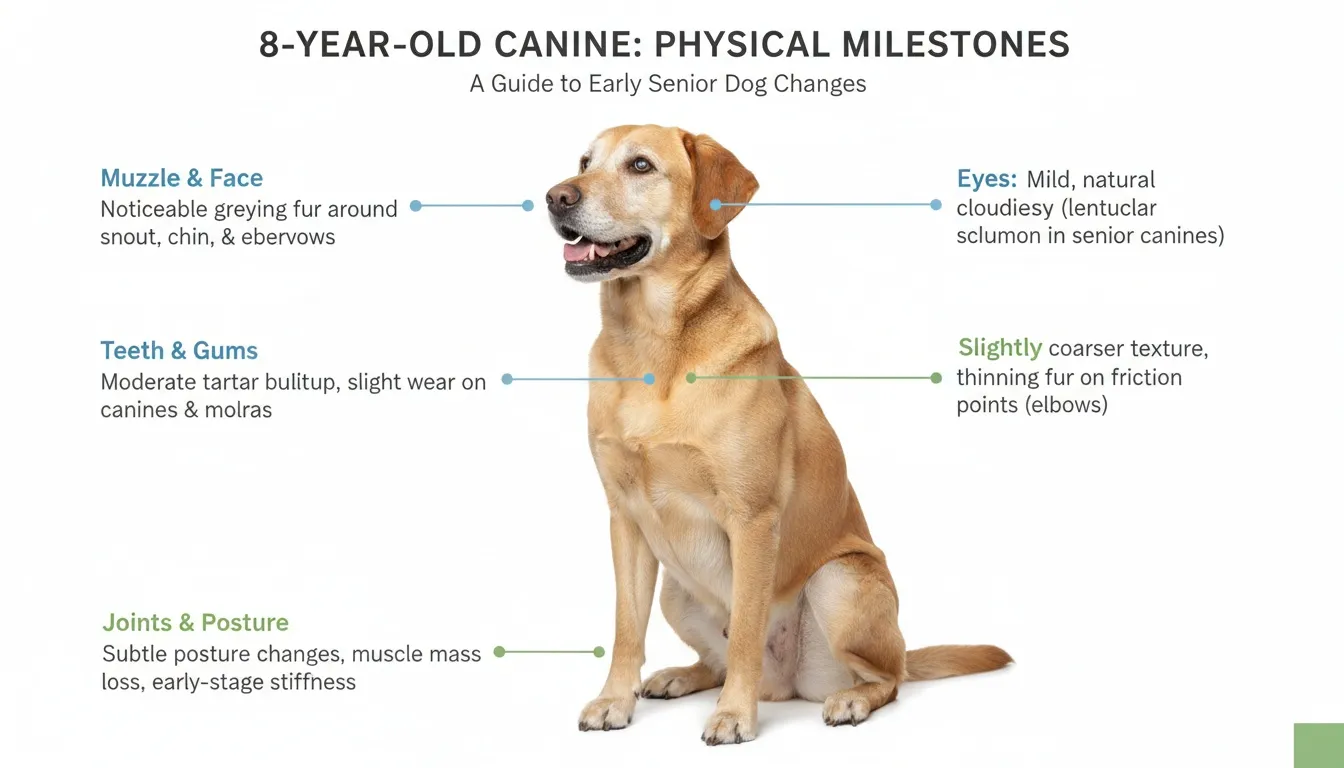
When your companion reaches 8 dog years in human years, they are officially stepping into their senior chapters. While a human at 48 or 55 might just be feeling a few minor aches, how dogs age means an 8-year-old canine experiences deep biological shifts. According to senior pet care standards from the American Veterinary Medical Association (AVMA), most dogs cross the senior threshold around age seven. At eight, their bodies begin to visibly manifest this transition.
It is completely normal to feel a little emotional as you notice these changes, but understanding them helps you provide the best possible care. You might find yourself checking their muzzle a bit closer or wondering if they are just having a lazy day. The key is distinguishing between the gentle, expected elements of dog aging by size and indicators of discomfort. By keeping a close eye on their daily rhythms and physical appearance, you can adapt their routine to keep them comfortable and thriving.
Normal Changes at 8 Years
Muzzle graying: You will likely notice silver or white hairs dusting their muzzle, eyebrows, and chest, which is a completely benign loss of pigment-producing cells.
Slower on walks: Your dog may lag behind a bit on your usual routes or take longer to sniff, as their overall stamina naturally decreases with age.
Mild eye cloudiness: A bluish, hazy sheen in the pupils is usually lenticular sclerosis (nuclear sclerosis), a harmless, normal hardening of the eye lens that the American Kennel Club (AKC) notes does not cause blindness.
More sleep, less rough play: An 8-year-old dog typically trades intense fetch sessions for longer naps, averaging 12 to 14 hours of sleep per day to restore their energy.
Brain Aging — Cognitive Changes to Watch (CCD)
Just like humans, a dog’s brain undergoes structural shifts as it matures. Canine Cognitive Dysfunction (CCD), often compared to dementia in humans, frequently begins to surface in dogs aged 8 and older. While we often focus on physical traits like large dog senior years joint stiffness, mental wellness is just as vital.
The AAHA (American Animal Hospital Association) emphasizes that tracking behavioral changes is essential for senior care. Early detection of cognitive decline allows for highly effective management through specific dietary changes, mental enrichment puzzles, and vet-prescribed support.
Signs of confusion: Your dog may stare blankly at walls, get trapped behind doors, or temporarily forget long-standing household routines.
Getting lost in familiar places: They might wander to the wrong side of a opening door or seem disoriented in their own backyard.
Sleep pattern changes: A classic indicator is a flipped internal clock, where the dog paces or whines at night and sleeps heavily throughout the day.
Warning Signs — Go to Vet Immediately
While general slowing down is part of the standard dog human age equivalent progression, true pain or underlying illness can masquerade as simple old age. You should never assume a drastic health shift is just because your dog is eight. If you notice any of the following red flags, schedule a veterinary evaluation right away to address the root cause.
Sudden weight loss: Dropping pounds rapidly without a change in diet often points to metabolic issues, kidney disease, or underlying gastrointestinal conditions.
Difficulty standing or climbing stairs: If your dog hesitates, trembles, or fails to rise, they may be experiencing significant osteoarthritis pain that requires targeted management.
Excessive drinking or urination: Drastically filling the water bowl more often can be an early warning sign of canine diabetes, Cushing’s disease, or renal insufficiency.
No appetite for 24+ hours: A complete refusal to eat for a full day is a clear distress signal that warrants an immediate professional checkup.
Sudden limping or stiffness: A abrupt change in gait or favoring a specific limb indicates acute injury or severe joint inflammation rather than gradual aging.
Confusion or disorientation: Sudden, severe spatial confusion can occasionally stem from metabolic imbalances or neurological events rather than gradual cognitive decline.
To truly support your companion through these physical and mental transitions, it helps to understand how their specific breed size reshapes this entire timeline.
Popular Breeds at 8 Years — Life Stage + Health Risk
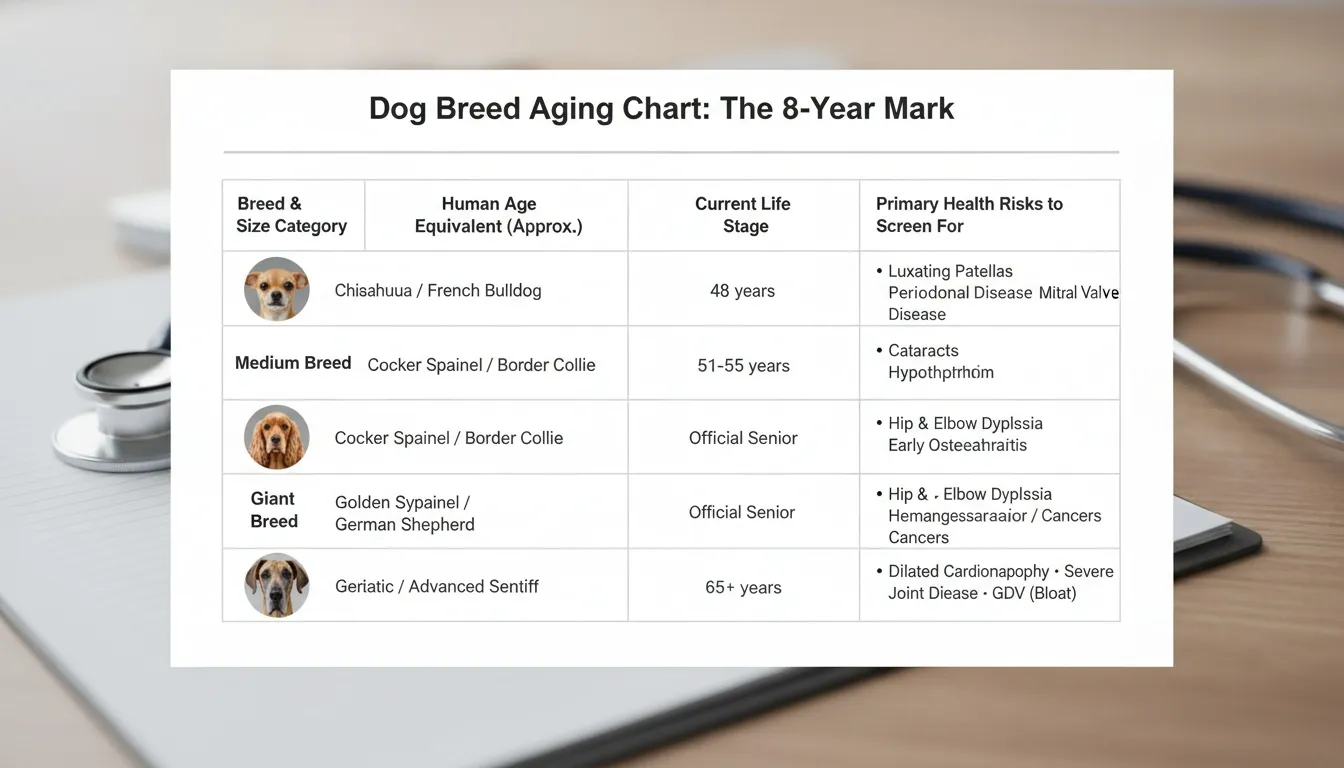
When translating 8 dog years in human years, a single number simply doesn’t fit every dog. Because dog aging by size varies so dramatically, an 8-year-old Chihuahua is living a completely different life stage than an 8-year-old Great Dane. The American Kennel Club (AKC) breed guidelines emphasize that smaller dogs mature faster in their first year but age much slower later in life, whereas giant breeds age rapidly throughout their entire lives.
At chronological age 8, your dog’s human age equivalent can range anywhere from a middle-aged 48 to a geriatric 64. Recognizing this divergence is vital for tailoring their daily care, nutritional needs, and preventative veterinary screenings to their specific biological age.dog age calculator
| Breed | Size | Human Age at 8 | Key Health Risk at 8 |
|---|---|---|---|
| Chihuahua | Small | 48 yrs | Dental disease |
| Yorkshire Terrier | Small | 48 yrs | Tracheal collapse |
| Beagle | Medium | 51 yrs | Obesity, ear infections |
| Cocker Spaniel | Medium | 51 yrs | Ear infections, eye issues |
| Labrador Retriever | Large | 55 yrs | Joint problems, obesity |
| German Shepherd | Large | 55 yrs | Hip dysplasia |
| Golden Retriever | Large | 55 yrs | Cancer screening needed |
| Great Dane | Giant | 64 yrs | Heart issues, near end of lifespan |
| Mastiff | Giant | 64 yrs | Joint pain, comfort care |
Chihuahua
Size: Small
Human Age at 8: 48 yrs
Key Health Risk: Dental disease
Yorkshire Terrier
Size: Small
Human Age at 8: 48 yrs
Key Health Risk: Tracheal collapse
Beagle
Size: Medium
Human Age at 8: 51 yrs
Key Health Risk: Obesity, ear infections
Cocker Spaniel
Size: Medium
Human Age at 8: 51 yrs
Key Health Risk: Ear infections, eye issues
Labrador Retriever
Size: Large
Human Age at 8: 55 yrs
Key Health Risk: Joint problems, obesity
German Shepherd
Size: Large
Human Age at 8: 55 yrs
Key Health Risk: Hip dysplasia
Golden Retriever
Size: Large
Human Age at 8: 55 yrs
Key Health Risk: Cancer screening needed
Great Dane
Size: Giant
Human Age at 8: 64 yrs
Key Health Risk: Heart issues, near end of lifespan
Mastiff
Size: Giant
Human Age at 8: 64 yrs
Key Health Risk: Joint pain, comfort care
Small Breeds Chihuahua, Yorkie at 8 Years Old
For small dogs, reaching 8 calendar years means they are just stepping over the threshold of late middle age. With a small dog lifespan that frequently stretches to 15 or 16 years, these compact companions are often still highly energetic, though they require focused preventative attention on smaller-breed vulnerabilities like severe periodontal disease or weakened tracheal cartilage.
Medium Breeds Beagle, Cocker Spaniel at 8 Years Old
Medium dogs at age 8 are firmly rooted in their senior dog age, roughly matching a human in their early 50s. Data from the American Animal Hospital Association (AAHA) indicates that metabolic rates begin to dip noticeably at this stage, making weight management critical to prevent obesity from compounding age-related joint stress or metabolic issues.
Large Breeds Labrador, German Shepherd, Golden Retriever at 8 Years Old
In large dog senior years, age 8 represents a significant milestone equivalent to a 55-year-old human. According to senior pet care standards, these breeds now require proactive screening for structural wear and tear, meaning your veterinarian will likely recommend baseline blood work and joint supplements to manage conditions like hip dysplasia.
Giant Breeds Great Dane, Mastiff at 8 Years Old
Giant breeds face the most accelerated timeline of how dogs age, making an 8-year-old Mastiff or Great Dane biologically equivalent to a 64-year-old human. Because they are nearing the natural end of their expected lifespan, the clinical focus shifts primarily toward heart function monitoring and advanced palliative comfort care to maintain their quality of life.
Understanding how your specific breed handles this life transition allows you to adjust their daily environment and catch subtle warning signs before they become major health hurdles.
Care Guide for an 8-Year-Old Dog
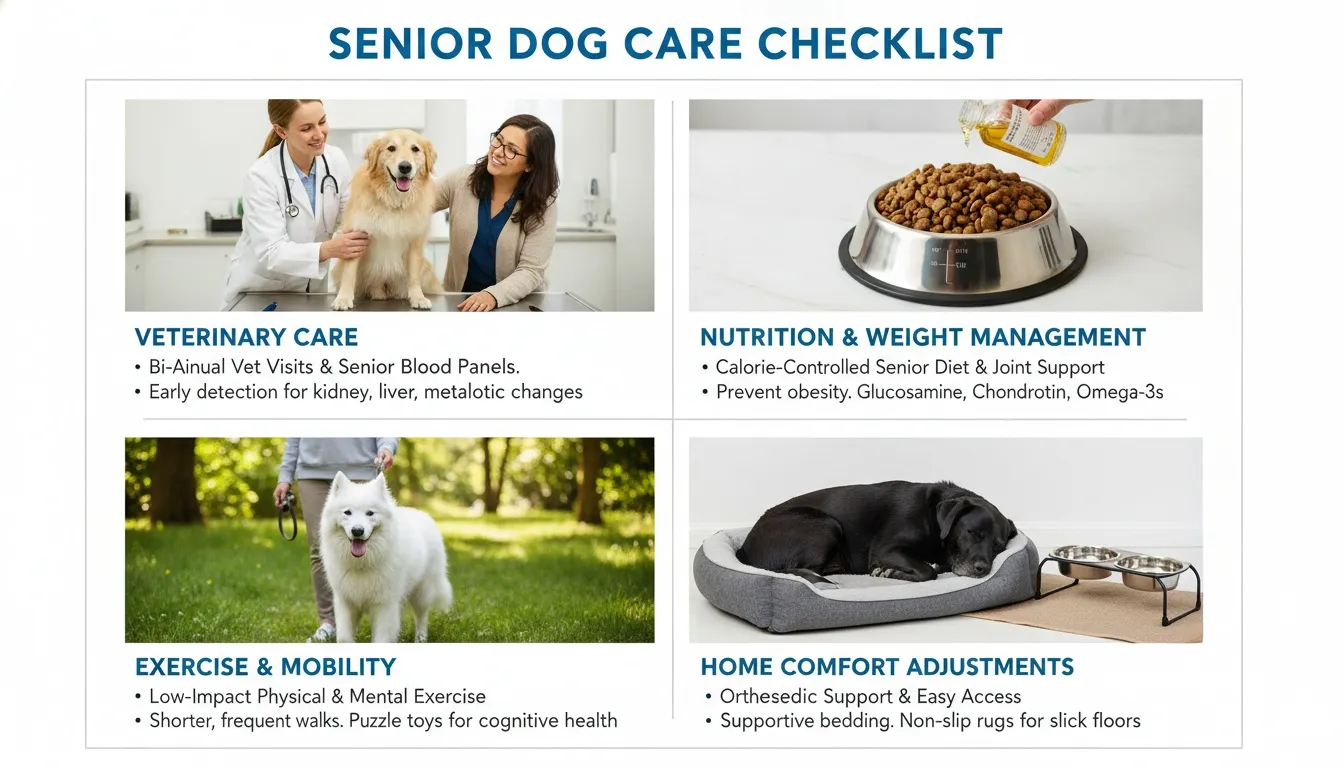
Hitting the 8-year mark is a major milestone in your dog’s life. While it represents a shift into their golden years, how you care for them now directly impacts the quality of their remaining time. At this stage, a one-size-fits-all approach no longer works. The American Animal Hospital Association (AAHA) senior care guidelines emphasize that life-stage transitions depend heavily on your dog’s size, meaning an 8-year-old Chihuahua has vastly different physical needs than an 8-year-old Golden Retriever. Your daily routine needs to evolve from proactive maintenance to targeted senior care, focusing closely on metabolic shifts, joint preservation, and early disease detection to keep your companion thriving.
Nutrition — Size Specific at 8 Years
Dietary needs diverge dramatically at age 8 based on dog aging by size. If you have a small dog, like a Maltese or Shih Tzu, they are technically just entering middle age and might not require a lower-calorie senior formula yet unless they are prone to weight gain. Conversely, for large and giant breeds like Great Danes or Labradors, the American Veterinary Medical Association (AVMA) notes they hit senior status around age 6, meaning their transition to a senior formula should already be complete to protect their organs and joints.
Regardless of size, incorporating therapeutic supplements like Omega-3 fatty acids, glucosamine, and chondroitin is highly recommended to support cartilage health. Above all, strict portion control is critical; canine obesity is the number one accelerator of aging and worsens metabolic and joint issues.
Exercise at 8 Years
Your dog still needs regular physical activity, but the strategy must shift: maintain the frequency of your daily walks, but reduce the intensity. Instead of high-impact fetching, opt for steady, moderate walks that keep muscles toned without overstressing cartilage. For large or giant breeds, swimming is the ultimate joint-friendly exercise, providing excellent cardiovascular conditioning with zero impact on arthritic joints.
Do not overlook mental stimulation; structured “sniff walks” and interactive puzzle feeders keep aging brains sharp and combat cognitive decline. Finally, watch your dog closely after exercise; subtle limping or post-exercise stiffness is a clear joint issue signal that requires a discussion with your veterinarian.
Vet Visits at 8 Years
Once your dog reaches 8 years old, annual checkups are no longer sufficient. Both small and large breeds should transition to veterinary visits every 6 months to catch age-related conditions early. During these semi-annual exams, request a comprehensive senior bloodwork panel and urinalysis annually to screen for early signs of kidney disease, liver dysfunction, or diabetes.
Dental health is equally vital, so schedule professional dental cleanings as recommended, since periodontal bacteria can damage the heart and kidneys. Lastly, ensure your vet performs a thorough joint and mobility exam at every single visit to catch early osteoarthritis.
How Long Do 8-Year-Old Dogs Typically Live?
Understanding your dog’s life expectancy helps you tailor their care to maximize their comfort and joy in the years ahead. This breakdown illustrates how the dog human age equivalent impacts remaining lifespans across different sizes:
| Size | Average Lifespan | Remaining Years at 8 |
| Small (under 20 lbs) | 14–16 years | 6–8 years remaining |
| Medium (21–50 lbs) | 12–14 years | 4–6 years remaining |
| Large (51–90 lbs) | 10–12 years | 2–4 years remaining |
| Giant (over 90 lbs) | 7–10 years | 0–2 years remaining |
Knowing what to expect as your dog moves through this life stage allows you to make the most of every day together.
Dog Age Comparison Table — Ages 6 to 12 All Sizes
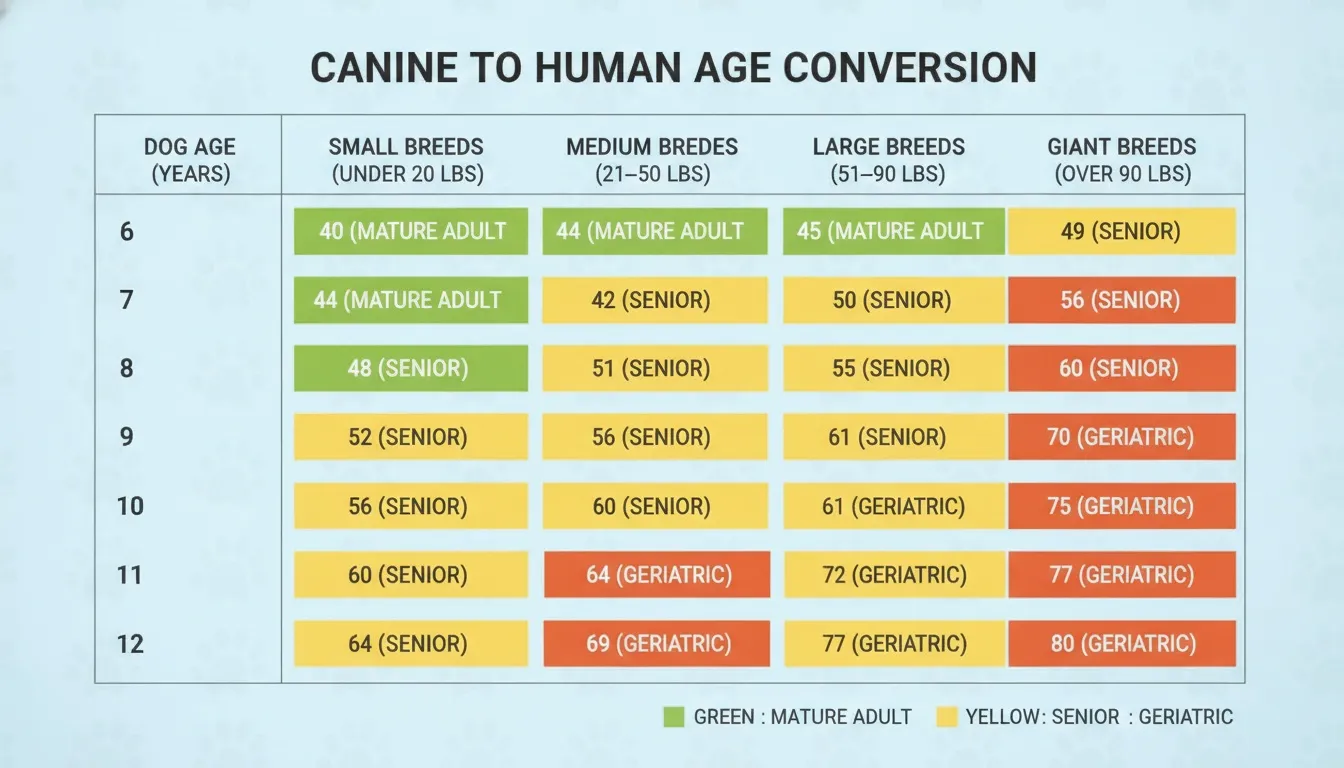
To truly understand your dog’s life stage, we have to look beyond the old “multiply by seven” rule. The American Veterinary Medical Association (AVMA) notes that dog aging by size varies drastically because smaller dogs mature faster initially but age much slower later in life, while giant breeds face a rapidly accelerated aging process after age five.
The chart below shows the dog human age equivalent for pups between 6 and 12 years old. It highlights exactly how an 8-year-old small breed enjoys middle age, while a giant breed of the same chronological age has already entered deep senior years.
| Dog Age | Small (Under 20 lbs) | Medium (21-50 lbs) | Large (51-90 lbs) | Giant (Over 90 lbs) |
|---|---|---|---|---|
| 6 years | 40 | 42 | 45 | 49 |
| 7 years | 44 | 47 | 50 | 56 |
| 8 years | 48 | 51 | 55 | 64 |
| 9 years | 52 | 56 | 61 | 71 |
| 10 years | 56 | 60 | 66 | 79 |
| 11 years | 60 | 65 | 72 | 86 |
| 12 years | 64 | 69 | 77 | 93 |
Dog Age: 6 years
Small (Under 20 lbs): 40
Medium (21-50 lbs): 42
Large (51-90 lbs): 45
Giant (Over 90 lbs): 49
Dog Age: 7 years
Small (Under 20 lbs): 44
Medium (21-50 lbs): 47
Large (51-90 lbs): 50
Giant (Over 90 lbs): 56
Dog Age: 8 years
Small (Under 20 lbs): 48
Medium (21-50 lbs): 51
Large (51-90 lbs): 55
Giant (Over 90 lbs): 64
Dog Age: 9 years
Small (Under 20 lbs): 52
Medium (21-50 lbs): 56
Large (51-90 lbs): 61
Giant (Over 90 lbs): 71
Dog Age: 10 years
Small (Under 20 lbs): 56
Medium (21-50 lbs): 60
Large (51-90 lbs): 66
Giant (Over 90 lbs): 79
Dog Age: 11 years
Small (Under 20 lbs): 60
Medium (21-50 lbs): 65
Large (51-90 lbs): 72
Giant (Over 90 lbs): 86
Dog Age: 12 years
Small (Under 20 lbs): 64
Medium (21-50 lbs): 69
Large (51-90 lbs): 77
Giant (Over 90 lbs): 93
According to data from the American Kennel Club (AKC), small dogs like Chihuahuas often don’t show structural senior changes until age 10 or 11, whereas large dog senior years hit much earlier, turning an 8-year-old Golden Retriever into a distinguished older statesman.
Understanding where your dog lands on this spectrum is the first step in tailoring their daily care, diet, and veterinary schedule to ensure a comfortable life. Let’s look closer at how this shifting timeline impacts your dog’s changing health and lifestyle needs as they cross the 8-year threshold.
Frequently Asked Questions
Absolutely not. For small breeds like Chihuahuas or Maltese, age 8 is merely the gateway to their mature adult years, with a small dog lifespan often stretching to 15 or 16. While large and giant breeds like Golden Retrievers or Great Danes are officially seniors at this stage and require more attentive medical monitoring, they can still enjoy an excellent, vibrant quality of life. Longevity depends heavily on proactive care, weight management, and routine vet screenings rather than the number on the calendar.
If you share your home with a large or giant breed, you should definitely transition them to a senior formulation now. The American Animal Hospital Association (AAHA) notes that larger dogs experience metabolic changes earlier, meaning they benefit from senior diets with lower calories to prevent obesity and added glucosamine for joint support. However, small and medium dogs may not need to switch just yet; consult your veterinarian to evaluate your dog's current body condition score before changing their kibble.
Once a dog hits age 8, they should visit the veterinarian at least every six months. Because dogs age faster than humans, a semi-annual exam allows your vet to catch age-related conditions like kidney disease or osteoarthritis early. For large and giant breeds who are firmly in their senior dog age bracket, these six-month checkups should ideally include comprehensive senior bloodwork, a urinalysis, and blood pressure monitoring to establish a baseline for their vital organ functions.
Adopting an 8-year-old dog is an incredibly rewarding choice. These dogs are typically past the chaotic puppy phases, fully house-trained, and possess calmer temperaments, making them ideal for quieter households or less active owners. If you adopt a small breed at age 8, they likely still have 6 to 8 wonderful years ahead of them. You skip the destructive chewing stages and gain a grateful, loyal companion who is ready to fit perfectly into your daily routine.
The health needs at this age are dictated entirely by dog aging by size. At 8, a small dog is a mature adult requiring standard preventative care, with a primary clinical focus on dental cleanings to prevent periodontal disease. Conversely, a large dog is an established senior needing intensive joint monitoring and screening for cardiac issues. Giant breeds at age 8 are considered advanced seniors, where the medical focus shifts completely toward pain management, comfort, and maximizing daily quality of life.
To find the dog human age equivalent using traditional veterinary math, count the first year as 15 human years and the second year as 9 human years (equal to 24). For the remaining 6 years, multiply by a size-specific aging rate: 4 for small dogs ($24 + 24 = 48$), 4.5 for medium dogs ($24 + 27 = 51$), 5.5 for large dog senior years ($24 + 33 = 57$), and 7 for giant breeds ($24 + 42 = 66$).
To cut out the manual math and get a precise calculation tailored to your dog's specific breed genetics, head over to our custom calculator tool on the main page.
🐾 Other Age Guides

Gulfam Haider Mehdi
Founder & Developer
I built Dogagescalculator.com to give dog owners honest, science-backed answers instead of the outdated "×7" myth. Every figure here is checked against AKC, AVMA, and published veterinary research.
More about the author & this site →📌 Featured Guides
is purina dog chow a good dog food
→
how old should a puppy be to take home
→
What Is 5 Dog Years in Human Years
→
how long does a miniature australian
→
Dog Age in Months to Human Years
→
what is the lifespan of an english bulldog
→
What Is 17 Dog Years in Human Years
→
How Long Do Boston Terriers Live
→
how to find out what your dog is mixed with
→
when do dogs start going grey
→
Comments