
What Is 10 Dog Years in Human Years?
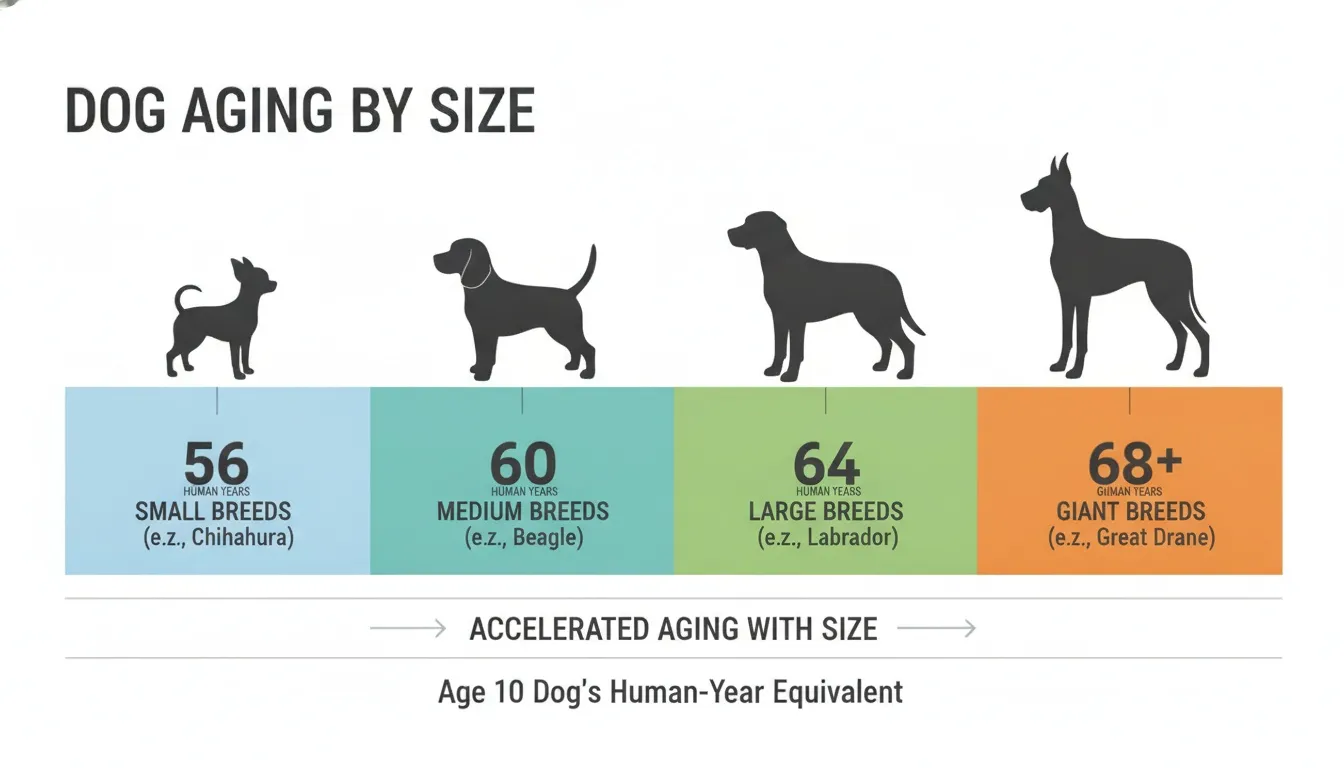
Quick Summary: The Human-Age Equivalent of a 10-Year-Old Dog
10-year-old dog: Approximately 56–68 human years, depending on size and breed.
Small breeds: Generally fall toward the younger end of the range.
Medium breeds: Typically fall around the middle of the range.
Large and giant breeds: Generally fall toward the older end because they tend to experience age-related changes earlier.
Key factor: Your dog’s size and breed are important when estimating their human-equivalent age.
A 10-year-old dog is generally considered to be in the senior stage of life, although the exact timing varies by breed and individual health. Calculating 10 dog years in human years is not as simple as multiplying by seven. Dogs mature much faster during their early years, and their aging patterns change as they grow older.
For many dogs, age 10 is roughly comparable to a human in their late 50s or 60s. Smaller breeds often remain active and healthy for longer, while large and giant breeds may show age-related changes earlier. This difference is one reason a size-based estimate is more useful than applying the same conversion to every dog.
At this stage, pay attention to changes in your dog’s energy, mobility, weight, appetite, dental health, vision, hearing, and behavior. Regular veterinary checkups can help identify age-related changes early and ensure that nutrition, exercise, and preventive care continue to match your dog’s needs.
"10 Dog Years" — Clearing the Confusion
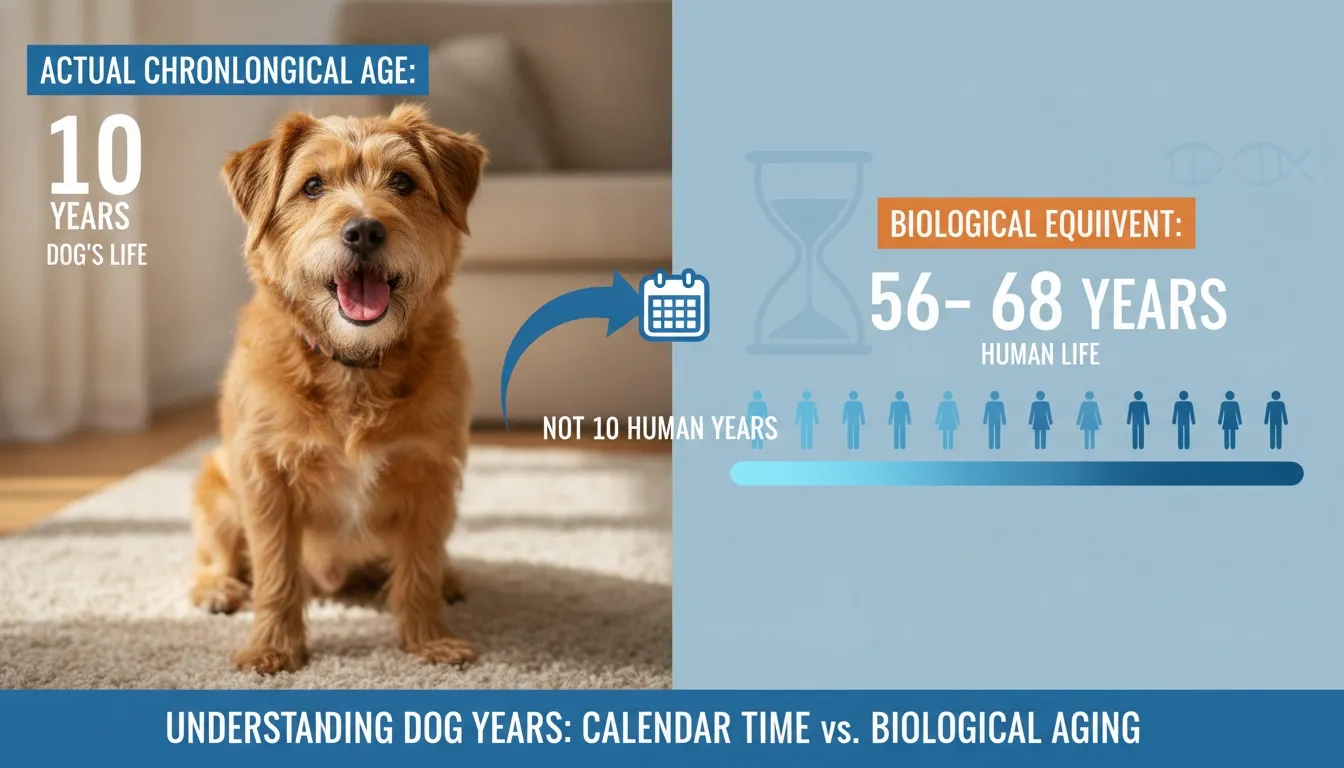
When you ask about “10 dog years in human years,” it is easy to get tangled in the old “one dog year equals seven human years” myth. If your pup is 10 years old chronologically, they aren’t necessarily a 70-year-old human. Modern veterinary science, specifically the epigenetic aging research from UC San Diego, shows us that dogs age rapidly in their first two years and then level off into a more gradual pace.
A 10-year-old dog in human years is typically equivalent to a human in their early to mid-60s. Instead of using a flat multiplier, veterinarians look at the dog’s life stage. By the time a dog reaches age 10, they are officially considered a senior, regardless of their breed.
Think of it this way: their bodies have been through a lot of “living” in those 10 calendar years. If your Labrador is suddenly slower on walks or your terrier seems to take longer to wake up from a nap, these are normal signs of this life stage.
Small Breeds: Often equivalent to 56–60 human years.
Medium Breeds: Generally sit around 60–65 human years.
Large/Giant Breeds: Can be equivalent to 70+ human years due to their faster biological aging process.
When you look at your 10-year-old dog, remember that they are entering their golden years. This is the time to prioritize semi-annual wellness exams rather than annual ones. According to AAHA life-stage guidelines, these frequent check-ups help catch age-related changes—like early arthritis or subtle shifts in kidney function—while they are still easily managed.
Why the 7-Year Rule Is Wrong & The Real Science-Backed Formula
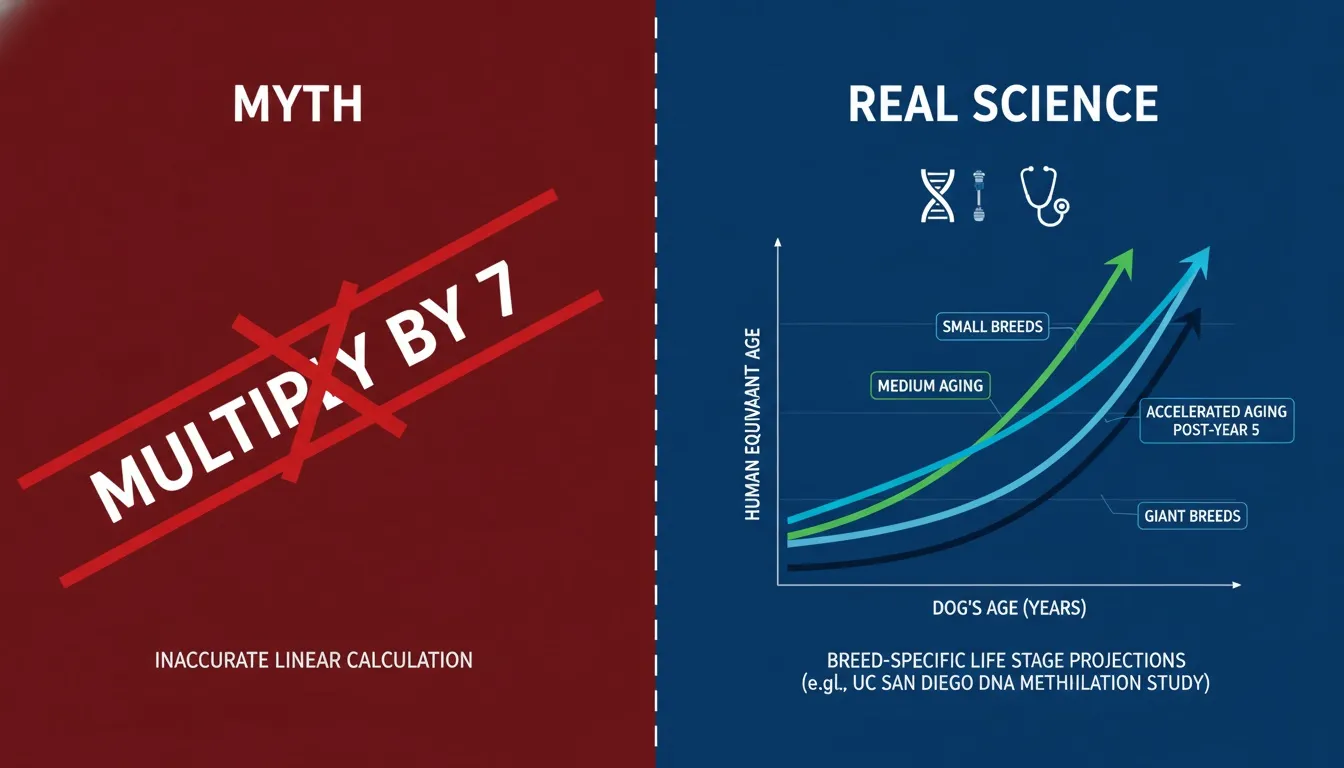
Where the 7x Myth Came From
The common belief that one human year equals seven dog years is a mathematical oversimplification that likely originated in the mid-20th century. It appears to have been popularized as a simple way to convince owners to bring their pets in for annual veterinary exams. While well-intentioned, this “1:7” ratio ignores the reality that dogs reach sexual maturity within their first year and experience significantly different aging trajectories compared to humans.
AVMA’s More Accurate Formula
The American Veterinary Medical Association (AVMA) suggests a more nuanced approach than the linear 7-year rule. According to their guidelines, a medium-sized dog is roughly 15 human years old at the end of their first year. By year two, they have reached approximately 24 human years. From that point forward, each subsequent year roughly equates to about 4 human years, though this varies significantly based on breed size and metabolic rates.
The DNA Methylation Formula UC San Diego Study
For a more precise biological benchmark, researchers at the UC San Diego School of Medicine developed a formula based on DNA methylation. This study analyzed chemical markers on DNA that change as we age, known as the “epigenetic clock.” Unlike the simple 7x multiplier, this formula accounts for the rapid development of puppies and the slower aging process in adulthood. It uses a logarithmic scale to map a dog’s biological age against human physiological development, providing a far more accurate representation of their life stage.
Example Calculation for Age 10
When calculating 10 dog years in human years using modern veterinary standards, the result is rarely a flat number. Using the logarithmic DNA methylation model, a 10-year-old dog typically corresponds to a human in their mid-60s to early 70s.
To give you a better idea of how this applies to your companion, consider these rough approximations for 10-year-old dogs in human years:
Small/Toy Breeds: Approximately 56–60 human years (these dogs often retain more youthful metabolic activity).
Medium Breeds: Approximately 64–66 human years.
Large/Giant Breeds: Approximately 70–75+ human years (these dogs often reach senior status earlier, meaning a 10-year-old Great Dane is biologically much older than a 10-year-old Pug).
If your Labrador is suddenly slower on morning walks or your Terrier is less interested in fetch, remember that they are experiencing the mid-60s or beyond. Recognizing this helps you shift from expecting “puppy energy” to managing the specific healthcare needs of a senior dog.
10 Dog Years in Human Years by Size & Breed
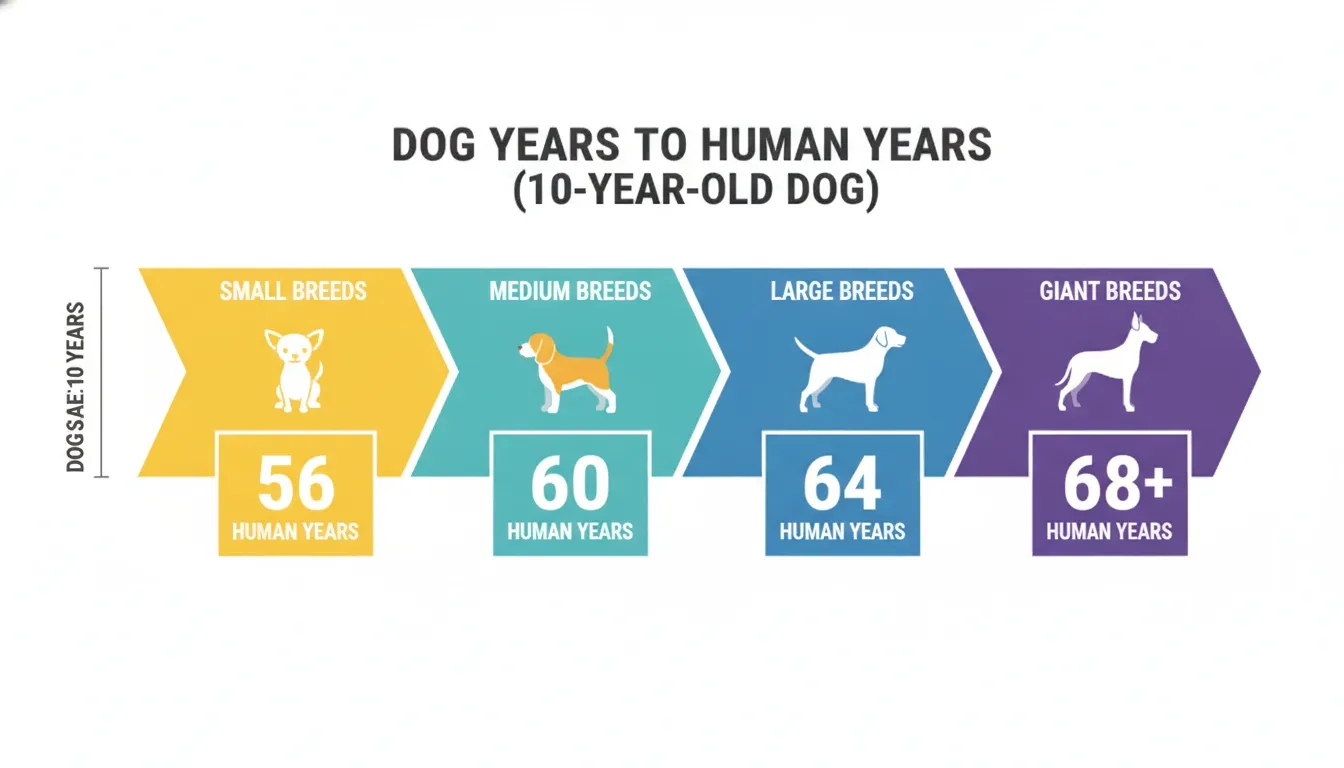
Calculating 10 dog years in human years depends heavily on your dog’s size and breed, as smaller dogs typically have much slower metabolic aging rates than their giant-breed counterparts. While the traditional “1 dog year equals 7 human years” myth has been largely debunked, modern veterinary science, including research using DNA methylation clocks, shows that a 10-year-old dog roughly corresponds to a human in their late 50s to mid-70s depending on their stature.
Small Breeds under 20 lbs
For a small breed like a Chihuahua or a Toy Poodle, age 10 is considered the “senior” threshold, but they often remain spry and active. At this stage, your small companion is roughly equivalent to a human in their mid-50s. Their internal biological clock is ticking slower than larger breeds, which is why many toy breeds comfortably reach their mid-teens.
Medium Breeds 21–50 lbs
When you look at the human years for a 10 year old dog of medium stature, such as a Beagle or a Cocker Spaniel, you are looking at a pet that is physiologically comparable to a person in their early 60s. You might notice them choosing a cozy spot on the rug over a vigorous game of fetch, signaling that their joints need a little more support than they did a few years ago.
Large Breeds 51–90 lbs
Large breeds, including Golden Retrievers and German Shepherds, experience a more accelerated aging process. A 10-year-old dog of this size is essentially equivalent to a human in their late 60s or early 70s. These dogs often face more significant mobility challenges, and you may find they appreciate shorter, more frequent walks rather than one long, taxing hike.
Giant Breeds 90+ lbs
Giant breeds like Great Danes or Mastiffs have much shorter lifespans, meaning they reach their senior years much faster. At age 10, a giant breed is in its twilight, biologically equivalent to a human in their late 70s or even early 80s. These gentle giants require proactive veterinary care to manage the wear and tear that decades of supporting such a large frame have placed on their systems.
Mixed Breed Dogs
If your pup is a “Heinz 57” mix, the best way to estimate their age is by looking at their size and physical build. The American Animal Hospital Association (AAHA) suggests using the weight category that most closely matches your dog’s current size. Since mixed breeds often benefit from “hybrid vigor,” they may avoid some of the breed-specific genetic health issues, but their biological aging still follows the size-based curve.
| Breed Size | Approximate Human Age at 10 Years |
|---|---|
| Small (<20 lbs) | ~56 years |
| Medium (21–50 lbs) | ~62 years |
| Large (51–90 lbs) | ~68 years |
| Giant (90+ lbs) | ~75+ years |
Try Our Free Dog Age Calculator
Finding the precise 10 dog years in human years equivalent can be tricky because biology isn’t linear. While the old “one human year equals seven dog years” rule was a simple shorthand, modern veterinary research—including the groundbreaking 2019 epigenetic clock study from UC San Diego—shows that dogs age much faster in their first two years and then stabilize.
For a 10-year-old dog in human years, you are generally looking at a range of 56 to 65 in human terms, depending heavily on their breed and size. Large breeds often experience accelerated aging compared to their smaller counterparts, placing their physiological status closer to a human in their mid-60s or even 70s.
Use our interactive dog age calculator below to get a more accurate estimate based on your specific dog’s breed and weight.
Small breeds (under 20 lbs): Often equivalent to 56 human years.
Medium breeds (21–50 lbs): Typically align with 58–60 human years.
Large/Giant breeds (over 50 lbs): Can be equivalent to 65+ human years.
If you’ve noticed your senior dog is a little stiffer when getting off the couch or sleeping longer than they used to, these numbers help put those changes into perspective. Seeing them as a “senior citizen” helps you shift from puppy-proofing your home to making their golden years more comfortable with orthopedic bedding and perhaps a ramp for the car. Knowing the specific human years for a 10 year old dog helps you have more productive conversations with your vet about proactive blood work and mobility support.
Is 10 Years Old for a Dog? Life Stage & Lifespan Context
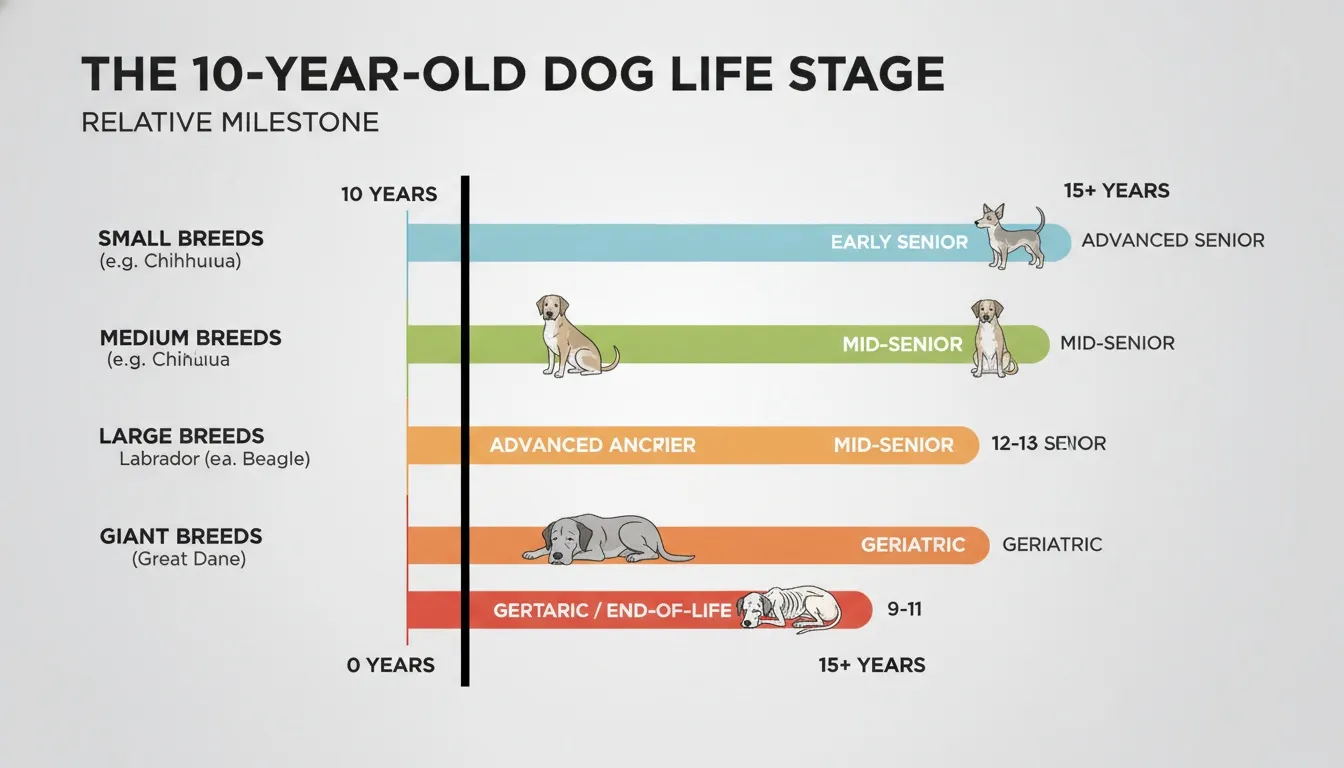
At 10 years old, your dog has officially entered the senior life stage. While the old “one human year equals seven dog years” rule is a popular myth, modern veterinary science—including research from the UC San Diego School of Medicine on DNA methylation—shows that aging isn’t a linear process. By age 10, your dog is likely in their mid-to-late 60s in human years, though this varies significantly depending on their breed and genetics.
Senior Status by Size
Size is the most significant factor in determining where your dog falls on the aging spectrum. According to American Animal Hospital Association (AAHA) life-stage guidelines, small-breed dogs often reach senior status later than their larger counterparts.
Toy and Small Breeds (e.g., Chihuahua, Shih Tzu): These dogs are usually considered “mature” at 10, with many still maintaining active lifestyles.
Medium Breeds (e.g., Beagle, Border Collie): By age 10, most medium-sized dogs are well into their senior years.
Large and Giant Breeds (e.g., Golden Retriever, Great Dane): These dogs are often considered geriatric at 10. Their bodies have worked harder to support their size, and they typically require more specialized supportive care at this age.
Average Dog Lifespan Comparison
When you look at 10 dog years in human years, it helps to consider the average lifespan relative to size. A 10-year-old Great Dane is a medical rarity compared to a 10-year-old Toy Poodle.
| Category | Life Expectancy | Status (10 Yrs) |
|---|---|---|
| Toy / Small | 14–17 years | Senior |
| Medium | 10–13 years | Late Senior |
| Large / Giant | 7–10 years | Geriatric |
This disparity is why your veterinarian might recommend more frequent wellness exams, blood panels, and organ function screenings for a large-breed dog than for a smaller dog of the same age.
Signs of Aging Physical & Behavioral
Whether you are looking at a 10-year-old dog in human years or chronological time, physical and behavioral changes often become more pronounced at this stage. If your Labrador is suddenly slower on walks or your terrier starts struggling with stairs, these are common markers of the senior transition.
Mobility Changes: You may notice joint stiffness, especially in the mornings or after a nap, often linked to osteoarthritis.
Cognitive Shifts: Subtle changes like restlessness at night, disorientation, or decreased responsiveness to commands can indicate Canine Cognitive Dysfunction (CCD).
Sensory Decline: Cloudy eyes (nuclear sclerosis) or a reduced startle reflex to loud noises often accompany this age.
Metabolic Needs: A 10-year-old dog often requires a shift in caloric intake to prevent weight gain, as their metabolism slows down, or an increase in high-quality protein to prevent muscle wasting.
Health & Care Tips for a 10-Year-Old Dog
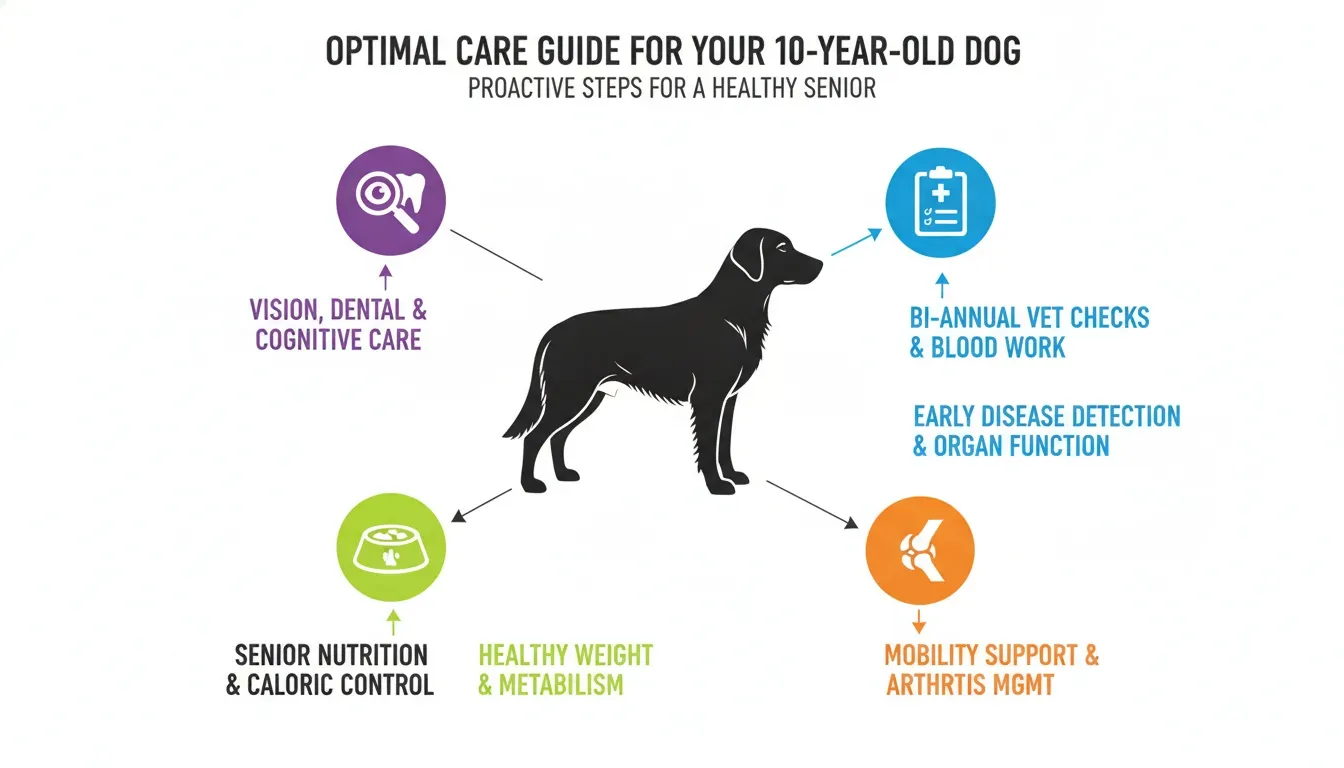
Reaching the milestone of 10 dog years in human years means your companion is officially entering their senior stage. By most veterinary standards, this is the time when metabolic changes and cumulative wear-and-tear necessitate a shift in your daily management routine to keep them comfortable and happy.
Diet Adjustments
When thinking about a 10-year-old dog in human years, remember that their metabolism is likely slower than it was at age four or five. Many seniors require fewer calories to maintain a healthy weight, which is critical to minimizing stress on aging joints. Switch to a high-quality senior formula that features increased fiber for digestive health and lower phosphorus levels to support kidney function. If your dog is getting picky, consider warming their wet food slightly or adding a topper of low-sodium bone broth to encourage appetite.
Joint & Mobility Care
Age-related arthritis is common for a dog at this stage of life, regardless of breed. You might notice they are slower to rise after a nap or hesitant to jump into the car, which are clear signs their joints need extra support. Discuss a multimodal approach with your vet, such as starting a high-quality glucosamine and chondroitin supplement or switching to an omega-3-rich diet to manage inflammation. Simple environmental changes, like placing rugs on slippery hardwood floors or using orthopedic memory foam beds, can make a world of difference for their daily comfort.
Vet Checkup Frequency
While younger dogs can often get away with an annual visit, the human years for a 10-year-old dog warrant a transition to bi-annual wellness exams. Every six months, your veterinarian should perform a “senior screen,” which typically includes blood work to monitor liver and kidney enzymes, thyroid levels, and a comprehensive physical exam. Catching subtle changes in these markers early allows for interventions that can significantly improve your dog’s quality of life.
Behavioral Changes to Watch For
Monitor your dog closely for signs of Cognitive Dysfunction Syndrome (CDS), which is the canine equivalent of dementia. If you notice your dog wandering aimlessly at night, staring at walls, or having accidents in the house after years of being house-trained, schedule a vet appointment immediately. Keep in mind that some behavioral shifts—like increased barking or irritability—can also be triggered by chronic pain, so it is vital to rule out physical discomfort before assuming it is purely cognitive.
A note on your dog’s specific age: These calculations are helpful estimates based on averages, but they don’t replace clinical expertise. Your veterinarian’s assessment of your dog’s specific body condition, medical history, and genetic factors will always provide a more accurate picture of your pet’s biological age than any general formula.
Frequently Asked Questions
Yes, a 10-year-old dog is widely considered a senior by veterinary standards. According to the American Animal Hospital Association (AAHA) life-stage guidelines, most dogs are entering their senior years by age 7 to 10, depending on their breed and size. At this milestone, you may notice your companion moving a bit slower on morning walks or showing more gray fur around the muzzle, signaling that their metabolism and immune function have transitioned into a mature phase.
The human years for a 10-year-old dog vary significantly based on breed size, as smaller dogs generally enjoy a longer lifespan than their larger counterparts. While the traditional "1 dog year equals 7 human years" rule is largely considered a myth, modern research provides a more nuanced view:
Small Breeds (e.g., Chihuahua, Yorkie): At 10 years, these dogs are roughly equivalent to a human in their mid-50s.
Medium Breeds (e.g., Beagle, Cocker Spaniel): These dogs typically equate to a human in their early-to-mid 60s.
Large/Giant Breeds (e.g., Labrador, Great Dane): A 10-year-old dog of this size is often equivalent to a human in their 70s or even 80s, reflecting their accelerated aging process.
Yes, giant and large breeds have a significantly accelerated aging process compared to small breeds. Evolutionary biologists believe this is due to a trade-off where rapid growth and large body size come at the expense of cellular repair mechanisms, causing them to reach their senior life stages much earlier. If you own a Great Dane or a Mastiff, you are likely already managing age-related health conditions that a 10-year-old Chihuahua might not experience for several more years.
The old "7-year rule" is scientifically inaccurate because it assumes dogs age linearly, which contradicts how they actually mature. A more modern approach, popularized by the UC San Diego School of Medicine, uses DNA methylation—a method of tracking chemical changes to DNA over time—to map canine aging more precisely. This research suggests that dogs age very rapidly during their first few years of life and then slow down as they reach adulthood. While the 7-year rule might give you a rough ballpark for middle-aged dogs, the newer, science-backed formulas are far more accurate for assessing the true physiological state of a 10-year-old dog in human years.
🐾 Other Age Guides

Gulfam Haider Mehdi
Founder & Developer
I built Dogagescalculator.com to give dog owners honest, science-backed answers instead of the outdated "×7" myth. Every figure here is checked against AKC, AVMA, and published veterinary research.
More about the author & this site →📌 Featured Guides
Nova Scotia Duck Tolling Retriever vs Golden Retriever
→
How Long Do Boston Terriers Live
→
yorkie dog years to human years
→
21 in dog years
→
Australian Cattle Dog Blue Heeler Labrador Retriever mix
→
Dog years to human years converter
→
Dog Years for Small Dogs
→
how many types of mastiff dogs are there
→
what is the lifespan of a basset hound
→
dog breed chinese shar-pei
→
Comments