How to Tell If Your Dog Is a Pitbull Complete Identification Guide
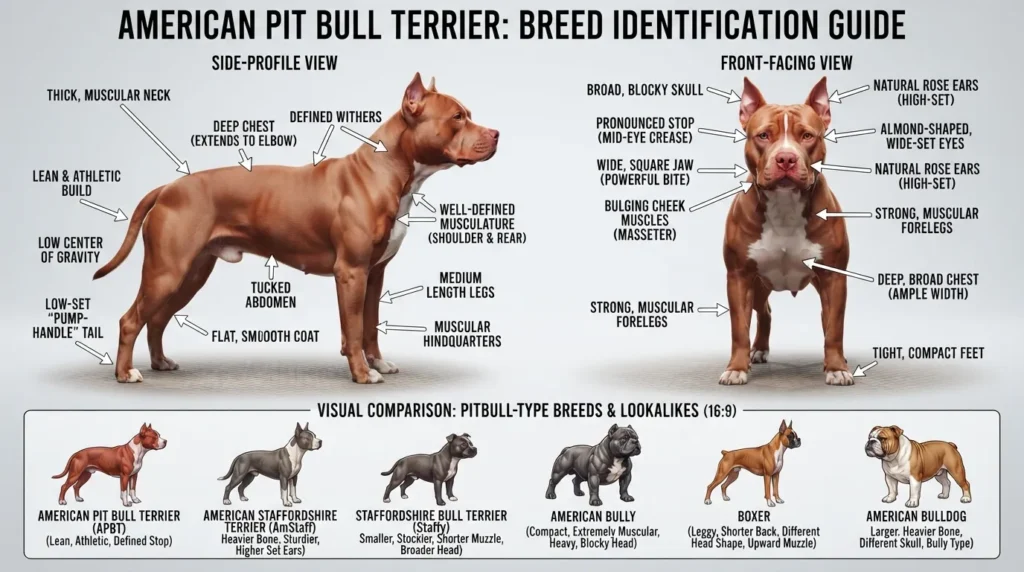
Trying to figure out whether your dog is a Pitbull? Start by looking at the overall combination of physical traits—not just the shape of the head, ears, or tail. Pitbull-type dogs can have broad heads, muscular bodies, short coats, deep chests, and distinctive facial features, but these characteristics can also appear in other breeds and mixed-breed dogs.
The term “Pitbull” can refer to several different breeds or Pitbull-type dogs depending on the context, including the American Pit Bull Terrier, American Staffordshire Terrier, Staffordshire Bull Terrier, and American Bully. Because of these differences, identifying a dog by appearance alone can be difficult, particularly when the dog is a mixed breed or still a puppy.
In this guide, you’ll learn how to identify common Pitbull physical characteristics, including head shape, muzzle, facial features, body shape, bone structure, chest, stance, coat, and tail shape. We’ll also explain what to look for in Pitbull puppies, how Pitbull-type dogs compare with similar-looking breeds, and why visual identification cannot reliably determine a dog’s exact breed ancestry.
If you need to know your dog’s genetic ancestry, a reputable canine DNA test can provide additional information beyond what physical appearance can tell you.
What Does "Pitbull" Actually Mean?
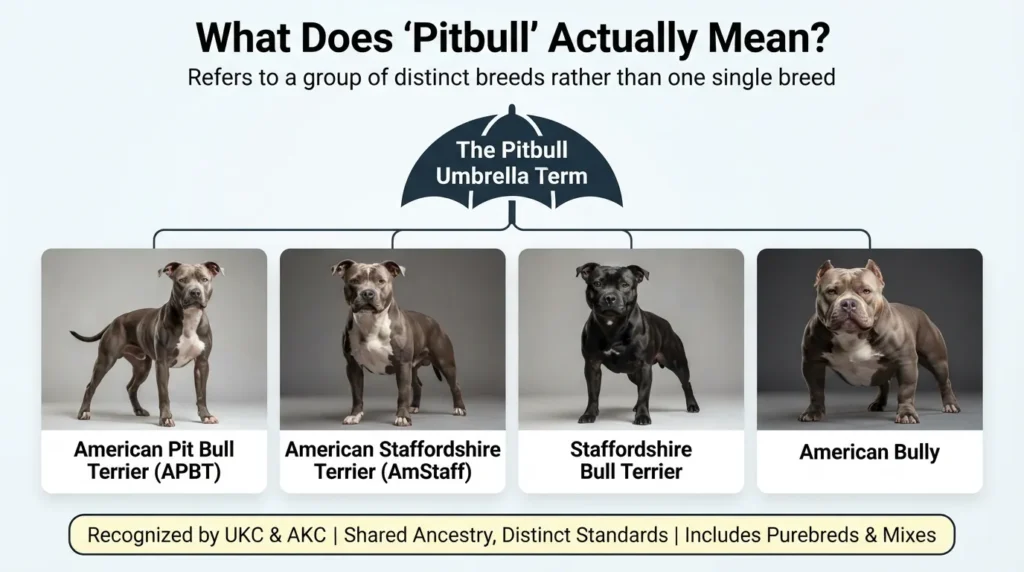
When people use the word “pitbull,” they are rarely referring to a single, specific dog breed. In reality, “pitbull” is an umbrella term used to categorize several distinct purebred dogs—and their mixes—that share a similar athletic ancestry, muscular frame, and broad head structure.
While shelters and general public often treat “pitbull” as a single breed name, kennel clubs and veterinary experts recognize four specific breeds that fall under this label:
American Pit Bull Terrier (APBT): Recognized by the United Kennel Club (UKC), this is the classic athletic breed known for its lean muscle, agility, and medium frame.
American Staffordshire Terrier (AmStaff): Recognized by the American Kennel Club (AKC), this breed shares strong historic roots with the APBT but features a stockier build, heavier bones, and a wider chest.
Staffordshire Bull Terrier: A smaller, highly compact breed originating from the UK and recognized by both the AKC and UKC, characterized by a shorter stature and broad skull.
American Bully: A modern extension of pitbull lineage bred specifically for a broader, lower-slung body, massive shoulders, and a distinct blocky head shape.
Physical Characteristics of a Pitbull
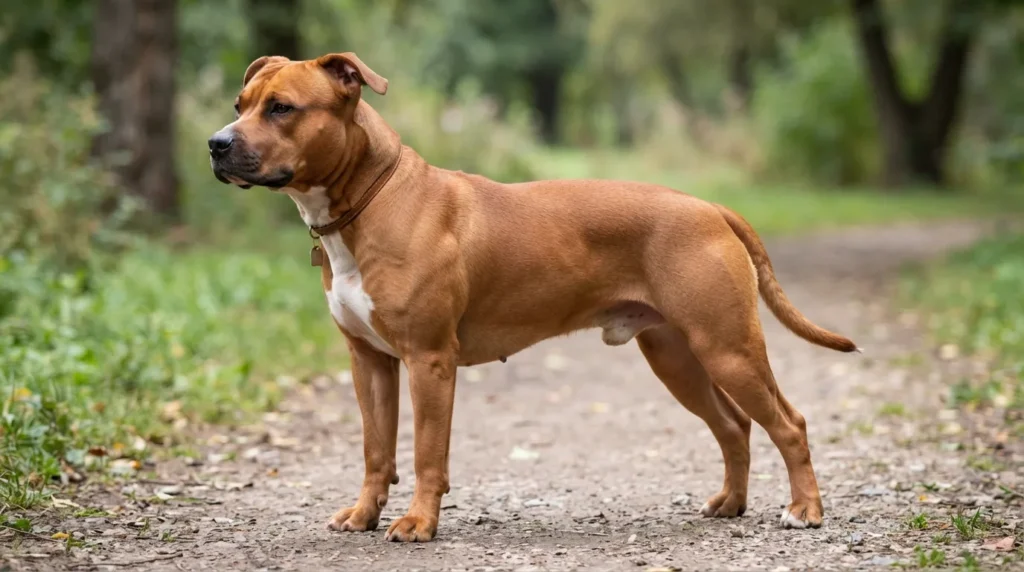
Identifying a pitbull starts with evaluating a distinct combination of physical traits rather than looking at a single feature. Because these dogs were historically bred for athletic endurance and strength, their physical structure reflects power, agility, and balance across their entire frame.
Head & Skull Shape
The broad, blocky head is the single most recognizable feature of a pitbull-type dog. When viewed from the front, the skull is wide between the ears and tapers down toward a broad, deep muzzle.
A prominent groove runs down the center of the skull between the eyes (the stop), giving the forehead a distinct, structured appearance. Highly developed cheek muscles—known as masseter muscles—bulge noticeably along the sides of the face, reinforcing the breed’s wide, powerful jawline.
Ears (Rose-shaped)
In their natural state, pitbull ears are small to medium-sized and set high on the skull. The standard signature fold is known as a rose ear, where the ear leather drops backward and outward, exposing part of the inner ear canal.
Some dogs carry semi-pricked ears that fold forward at the tip, while cropped ears stand upright. Natural rose ears remain one of the cleanest visual markers separating pitbulls from floppier-eared hound or retriever mixes.
Coat Type & Common Colors
A pitbull’s coat is short, stiff, and smooth to the touch, resting flat against tight skin without a soft, dense undercoat beneath it. This single coat makes grooming straightforward, though it offers minimal insulation against freezing temperatures or harsh sun exposure.
Coloring in pitbulls spans nearly every pattern in the canine spectrum. You’ll frequently see solid coat shades, brindle stripes, piebald patches, red noses, and blue/gray coats, with pure white markings often accenting the chest and paws.
Body Build & Muscle Tone
The torso of a pitbull is built for explosive power, featuring a deep chest that extends down to the elbow and a thick, muscular neck sloping into wide shoulders. The back is short and strong, slightly arching over the loin to support a firm, low-center-of-gravity stance.
Unlike heavily blocky giant breeds, a true pitbull displays lean athletic muscle rather than bulky mass. Their hindquarters are well-angled and muscular, providing the torque and movement that give these dogs their springy, confident gait.
Tail Shape
The tail sits low on the spine as a natural extension of the topline, tapering down to a fine point near the hock joint. It is often described as a “pump-handle” tail due to its sturdy base and low-carrying position.
When the dog is relaxed, the tail hangs loosely with a slight upward curve at the tip. When excited, it remains level with the spine or slightly raised, but it should never curl tightly over the back like a Spitz or Husky tail.
Average Weight & Height Chart
Because the pitbull umbrella covers four distinct registry breeds, proportions vary considerably across different bloodlines and standards.
| Breed Type | Height (Inches) | Weight (Lbs) | Build Profile |
|---|---|---|---|
| American Pit Bull Terrier | 17 – 21 in | 35 – 60 lbs | Lean, leggy, highly athletic |
| American Staffordshire Terrier | 17 – 19 in | 50 – 70 lbs | Heavy-boned, stocky, broad-chested |
| Staffordshire Bull Terrier | 14 – 16 in | 24 – 38 lbs | Compact, low-slung, dense muscle |
| American Bully | 13 – 20 in | 70 – 120+ lbs | Extremely wide, heavy-set frame |
How to Tell If a Puppy Is a Pitbull
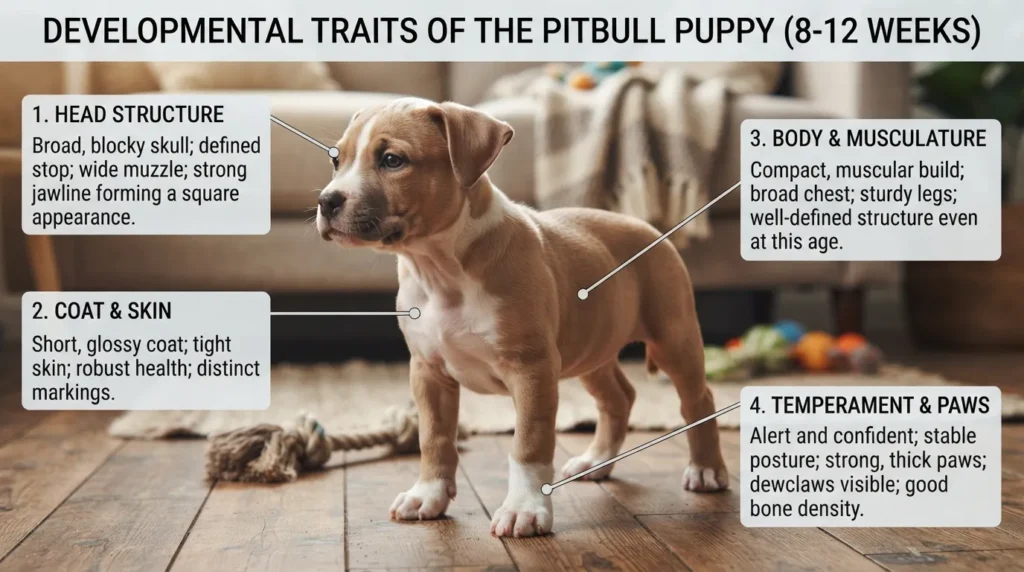
Spotting a pitbull puppy requires looking for a few distinct physical cues, though visual identification in very young dogs is notoriously tricky. Early on, you can look for a noticeably broad head with a subtle center groove, a short, stiff single-layer coat, and wide-set front legs. They also tend to have surprisingly stocky, thick paws relative to their body size, giving away their heavy-boned lineage before their muscles fully develop.
However, adult physical traits take time to fully lock in. A pitbull puppy’s signature wide jawline, pronounced cheek muscles, and deep chest usually don’t clearly display until they reach sexual and physical maturity between 12 and 18 months of age.
Head and Muzzle: Look for a slightly square skull that is broad between the ears, paired with a short, wide muzzle rather than a narrow or pointed one.
Coat Texture: The fur should feel smooth or slightly bristly to the touch, lacking the soft, dense undercoat typical of breeds like Labradors or Shepherds.
Stance and Paws: Even at 8 to 12 weeks, these pups often stand with a broad front base and feature thick, solid paws that hint at a broad, athletic frame.
Because many puppy breeds look remarkably similar during their first few months, early visual guesses often change drastically as the dog grows.
Breeds Often Confused With a Pitbull
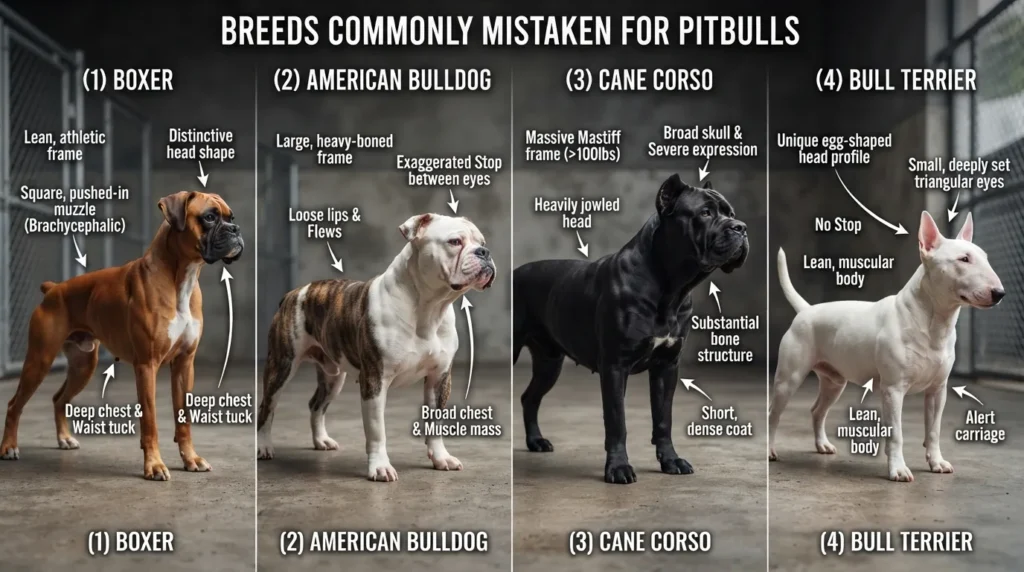
Because the term “pitbull” is so widely used, many distinct breeds are routinely misidentified as one simply because they share a muscular frame, short coat, or wide jaw. Understanding how to spot the subtle differences in bone structure, size, and body proportions makes identifying these lookalike breeds much easier.
Pit Bull vs American Staffordshire Terrier
The American Pit Bull Terrier (APBT) and the American Staffordshire Terrier (AmStaff) share a close evolutionary history, but selective breeding has given them noticeable differences. APBTs are generally bred for athleticism and work, resulting in a leaner, more agile body with slightly longer legs relative to their frame. They typically weigh between 35 and 60 pounds.
In contrast, AmStaffs are recognized by the AKC with a standard focused heavily on symmetry and substance. They are noticeably stockier, heavier-boned, and wider through the chest than an APBT of the same height. An AmStaff often weighs between 50 and 70 pounds, displaying a broader skull, more pronounced jaw line, and a lower center of gravity.
Pit Bull vs American Bulldog (is an American Bulldog a Pit Bull?)
An American Bulldog is not a pitbull, though the two are frequently confused. While both belong to the larger bully family, the American Bulldog is a substantially larger, heavier working breed with distinct facial features.
American Bulldogs typically weigh anywhere from 60 to over 100 pounds, making them noticeably taller and thicker than a standard American Pit Bull Terrier. Visually, American Bulldogs have shorter, flatter muzzles with loose upper lips (flews) and a much deeper, more defined stop between the eyes. Their skin around the face and neck is often looser, and they frequently exhibit white-dominated coats with dark patches, unlike the wide color variety seen in pitbulls.
Pit Bull vs American Bully
The American Bully was developed as a distinct breed during the 1990s by crossing American Pit Bull Terriers and American Staffordshire Terriers with other bulldog breeds. The goal was to create a companion dog with an exaggerated, heavy-set physical structure.
While an APBT is built for lean athleticism and speed, an American Bully is built for extreme blockiness and mass. Bullies feature exceptionally wide, low-slung bodies, massive chest spreads, and thick, heavy bone structure. Their heads are dramatically broad and square, making them look significantly wider and shorter-legged than a classic pitbull.
Other Lookalikes
Several other short-coated, blocky-headed breeds are regularly mistaken for pitbulls:
Boxer: Often confused with pitbull mixes due to their short coat and athletic chest, but Boxers have a distinctly square, brachycephalic (pushed-in) muzzle, longer legs, and a lean tuck-up at the waist.
Cane Corso: Features a large blocky head and short fur, but is a giant Italian Mastiff breed weighing between 90 and 120+ pounds with heavy jowls and a much larger frame.
Bull Terrier: Shares part of its ancestral name, but is instantly recognizable by its egg-shaped head, flat profile from forehead to nose, and small, triangular eyes.
Presa Canario: A massive Spanish livestock guardian dog with a square head and thick neck, weighing upwards of 100 to 130 pounds—far larger than any standard pitbull terrier.
How to Tell If Your Dog Is a Pitbull Mix
Identifying a pitbull mix visually is notoriously tricky because mixed-breed dogs rarely inherit physical traits in a neat 50/50 split. A dog can inherit a pitbull’s broad head structure while carrying the long coat or floppy ears of a completely different parent breed. However, a close look at subtle combinations of physical features and physical proportions can offer strong clues.
Signs of Mixed Parentage
When a dog has pitbull heritage combined with another breed, specific “hybrid” traits tend to stand out. Here are the most common physical indicators that suggest a dog is a pitbull mix:
Diluted Skull Features: A head that is wider than average with defined cheek muscles, but slightly longer or narrower than a purebred American Pit Bull Terrier’s distinct blocky shape.
Mixed Coat Characteristics: A short, single-layer coat that feels slightly softer or denser than typical pitbull fur, or a coat with unique feathering around the tail, chest, or legs.
Variable Ear Expressions: Natural ears that do not sit in a classic rose fold, such as oversized floppy hound ears or fully upright prick ears paired with a stocky body.
Unusual Frame Ratios: A body built lower to the ground with a long spine (suggesting a dachshund or corgi cross), or elongated legs paired with a wide, muscular chest.
Common Mix Combinations
Certain pitbull crossbreeds appear frequently in shelters and rescues, each leaving a distinct visual footprint:
Labrador Retriever & Pitbull Mix (Labrabull / Pitador): Often inherits the classic blocky head and muscular chest of a pitbull, but paired with the slightly longer muzzle, softer coat, and water-repellent undercoat of a Lab.
Boxer & Pitbull Mix (Pitoxer): Known for a very athletic, high-waisted body with a broad chest. They typically display a slightly shortened muzzle, expressive brow furrows, and prominent cheek muscles.
German Shepherd & Pitbull Mix (German Sheppit): Usually features a stockier frame and wider jaw than a purebred Shepherd, often inheriting upright or partially folded ears alongside a denser double coat.
Husky & Pitbull Mix (Pitsky): Frequently displays striking light-colored eyes (blue or heterochromia) set into a broad, blocky skull, combined with a plush coat and a lean, muscular build.
How Reliable Is Visual Identification? DNA Test vs Eyeballing
If you are relying purely on sight to guess your dog’s breed, the odds are surprisingly stacked against you. What a dog looks like on the outside rarely tells the full story of what is written in their DNA. Visual identification often relies on broad physical traits—like a short coat or a square jaw—that appear across dozens of completely unrelated canine bloodlines.
While eyeballing a dog is fast and free, it routinely fails under scientific scrutiny. Comparing visual guesses against genetic testing reveals a massive gap between what we think we see and what a dog actually is.
The 90% Misidentification Problem
Visual breed identification is notoriously inaccurate, even when done by experienced shelter staff, animal control officers, and veterinarians. A landmark study led by Dr. Julie Levy at the University of Florida found that shelter staff correctly identified pitbull-type breeds only a fraction of the time. When DNA results came back, dogs visually labeled as “pitbulls” actually lacked any pitbull-type heritage up to 90% of the time depending on the specific breed mix.
This visual bias happens because a handful of dominant physical traits—like a broad skull or a muscular chest—easily overpower other genetic features. A dog can inherit a blocky head from a tiny fraction of its lineage, leading people to label it a pitbull mix even if 80% of its DNA comes from Golden Retrievers, Boxers, or Labradors.
DNA Testing — Pros & Cons
Commercial canine DNA testing (such as Embark or Wisdom Panel) has transformed how we identify dog breeds, shifting the process from subjective guessing to genetic sequencing. However, like any tool, it comes with clear advantages and limitations.
Pro: High Genetic Accuracy. Modern DNA panels compare your dog’s genome against tens of thousands of reference markers, easily detecting purebred, designer, and complex multi-generational mixed heritage.
Pro: Health Insights. Most comprehensive DNA tests screen for genetic health risks (such as degenerative myelopathy or MDR1 drug sensitivity), allowing you to tailor proactive medical care.
Con: Cost. Quality genetic kits typically range between $80 and $160, which can be an unexpected expense for a newly adopted dog.
Con: Visual Disconnect. DNA tests reveal genetic ancestry, not guaranteed physical traits. Owners are sometimes confused when a test reveals a high percentage of a breed their dog looks nothing like.
Why Some Authorities Reject DNA Test Results
Despite the scientific precision of genetic panels, certain municipalities, insurance providers, and apartment complexes refuse to accept DNA test results for Breed-Specific Legislation (BSL) or housing exemptions. Understanding why comes down to legal definitions rather than biological science.
Many local ordinances and policy documents define a “pitbull” strictly by visual conformation—how the dog looks—rather than its genetic lineup. Because these regulations were written around physical appearance and perceived risk, property owners and enforcement agencies often rely on their own visual assessment checklists. If a dog fits their visual description of a pitbull, a DNA test proving 0% American Pit Bull Terrier ancestry may still be turned down in court or during a lease review.
Why Identification Matters Legal & Insurance
Knowing whether your dog is considered a pitbull isn’t just about satisfying curiosity—it has huge real-world implications for housing, financial protection, and local laws. Because breed labels carry heavy regulatory weight, an inaccurate guess on a vet record or shelter form can suddenly limit where you can live or affect your insurance coverage.
Breed-Specific Legislation (BSL): Certain cities, counties, and military bases enforce strict BSL rules that restrict or completely ban pitbull-type dogs regardless of individual behavior.
Homeowners and Renters Insurance: Many major insurance providers maintain breed exclusion lists that deny liability coverage or raise premiums if a pitbull breed lives on the property.
Rental and HOA Restrictions: Landlords, apartment complexes, and home associations frequently enforce weight limits and strict breed bans, making official identification critical during property applications.
Step-by-Step Checklist: How to Tell If Your Dog Is a Pitbull
If you want to evaluate your dog at home, run through this practical checklist step-by-step. Keep in mind that having just one or two of these features doesn’t make a dog a pitbull, but checking off most of them points strongly toward pitbull-type heritage.
1. Inspect the Head and Muzzle
Check the skull width: Is the top of the head broad and flat between the ears?
Look for the forehead groove: Can you see or feel a distinct crease (stop) running down between the eyes?
Feel the cheek muscles: Are the cheeks noticeably broad, rounded, and bulging outward when the dog chews or panting?
Evaluate the muzzle: Is the muzzle blocky and square, roughly equal in length to the depth of the skull rather than long and pointed?
2. Examine the Ears and Eyes
Observe the ear shape: Are the ears naturally rose-shaped (folding inward and back) or semi-pricked (half-standing and folding forward)?
Check eye placement: Are the eyes set low, wide apart, and deep within the skull?
3. Assess the Body Structure
Look at the chest: Does your dog have a deep, broad chest that gives them a wide, sturdy front stance?
Examine the neck: Is the neck thick, heavily muscled, and widening as it meets the shoulders?
Check overall posture: Does the dog have a low center of gravity with compact, lean muscle definition along the hindquarters?
4. Feel the Coat and Skin
Examine coat length and layer: Is the fur short, stiff to the touch, and single-layered without a dense, woolly undercoat?
Check the skin fit: Does the skin fit snugly across the body without excessive loose folds or heavy jowls around the jawline?
When to Consult a Vet or Professional Breed Assessor
While checking physical traits gives you a solid starting point, visual guessing has clear limits. If you need a formal answer for legal, insurance, or housing reasons—or if your dog’s mix is simply too complex to figure out on your own—it’s time to move beyond DIY methods and bring in a professional.
When DIY Identification Falls Short
Eyeing your dog’s jawline or chest width works fine for satisfy casual curiosity, but visual identification fails when real-world stakes are involved:
Housing and Landlord Compliance: Property managers and HOA boards often enforce strict breed restrictions and won’t accept an owner’s personal word or photo comparison.
Insurance Policies: Certain homeowner and renter insurance coverage options require verified documentation regarding breed makeup.
Breed-Specific Legislation (BSL): If you live in or travel through an area with local breed laws, an informal assessment won’t protect your dog from legal scrutiny.
Complex Mixed Breeds: When a dog carries genetic traits from three or four different breed groups, physical traits blend unpredictably, making visual assessment almost completely inaccurate.
Professional Identification Options
If you need an authoritative, documented opinion, two primary experts can help evaluate your dog:
Licensed Veterinarians: A vet can perform a physical conformation evaluation and record their professional assessment in your dog’s official medical file. Furthermore, they can swab your dog for a clinical-grade DNA panel (such as Embark or Wisdom Panel), which provides a legal, paper-backed genetic breakdown that holds weight with housing authorities and insurers.
Certified Breed Assessors and Animal Control Officers: In regions governed by breed-specific policies, certified breed assessors use standard canine point systems to evaluate physical measurements. They examine specific skeletal proportions, muzzle ratios, and bite alignment to determine whether a dog legally meets the definition of a pitbull-type breed.
Frequently Asked Questions
How to Tell If Your Dog Is a Pitbull Without DNA Testing?
You can look for a combination of physical traits like a wide, blocky head, pronounced cheek muscles, a deep chest, and a short, smooth single coat. However, visual identification is famously unreliable because many non-pitbull breeds share these exact physical features.
How Much Does a Pitbull DNA Test Cost?
A reliable dog DNA test generally costs between $80 and $150, depending on the brand and level of genetic detail provided. Tests from established companies like Embark or Wisdom Panel give you a full percentage breakdown of pitbull breeds in your dog's ancestry.
Can Two Non-Pitbull Parents Produce a Pitbull-Looking Puppy?
Yes, absolutely. Mixed-breed dogs can inherit specific dominant physical traits—like a wide skull or short coat—from non-pitbull ancestors such as Boxers, Labradors, or American Bulldogs. This genetic combination can make a puppy look strikingly like a pitbull even when it carries zero pitbull genetics.
Is My Landlord Allowed to Ask for Breed Proof?
In most regions, landlords and property managers can legally request proof of your dog's breed or veterinary records before approving your lease, especially if the property has specific breed restrictions or insurance policies.
Can I Register My Dog's Breed Without Papers?
Major registries like the American Kennel Club (AKC) require verified lineage papers to register a dog as a purebred. However, organizations like the United Kennel Club (UKC) offer single-registration options based on physical inspection, and services like AKC Canine Partners allow mixed-breed dogs to register for competitions and official identification.
🐾 Other Age Guides

I built Dogagescalculator.com to give dog owners honest, science-backed answers instead of the outdated "×7" myth. Every figure here is checked against AKC, AVMA, and published veterinary research.
More about the author & this site →
Comments