
What Is 12 Human Years in Dog Years?
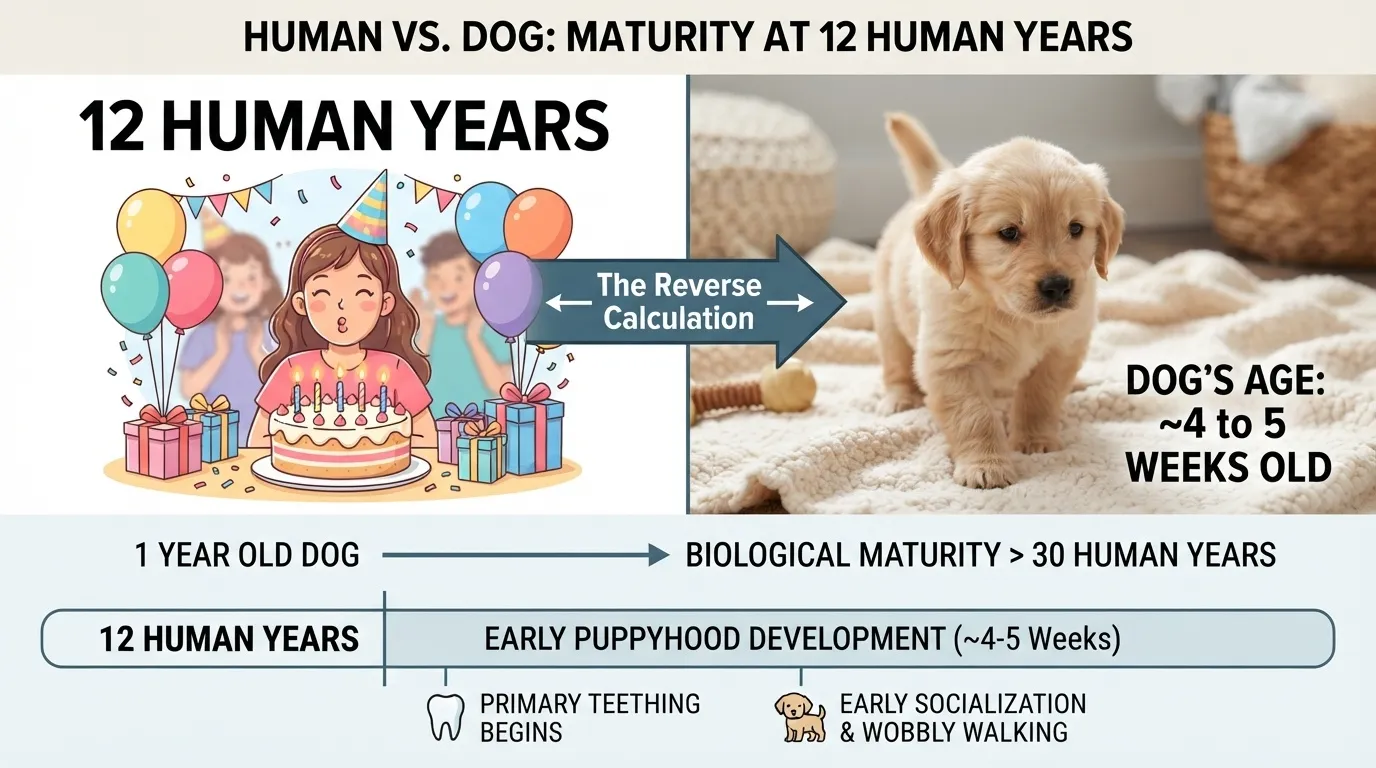
What is 12 human years in dog years? If you’re converting 12 human years into dog years, the answer is not as simple as dividing by seven. Dogs develop much faster during their early life, so human-to-dog age comparisons depend on developmental stage rather than a fixed ratio.
For a rough developmental comparison, 12 human years falls around the early puppy stage, but there is no scientifically precise calendar conversion because puppies mature at different rates depending on breed and size.
It is also important to distinguish 12 human years in dog years from a 12-year-old dog in human years. These are reverse calculations and produce very different results. A 12-year-old dog is a senior, while 12 human years represents only a small portion of a dog’s early developmental timeline.
H2: What Is 12 Human Years in Dog Years?
The first year of a dog’s life contains an enormous amount of physical and behavioral development. This is why the traditional 7-year rule can be misleading, especially when trying to convert a human age into puppy age.
| Human Age | Approx. Dog Development | Life Stage |
|---|---|---|
| 1–3 years | Very early puppy | Newborn/early development |
| 12 years | Early puppy stage | Rapid development |
| 15 years | Around 1 dog year | Adolescent/young adult |
| 24 years | Around 2 dog years | Adult |
Why 12 Human Years Isn't a Full Dog Year
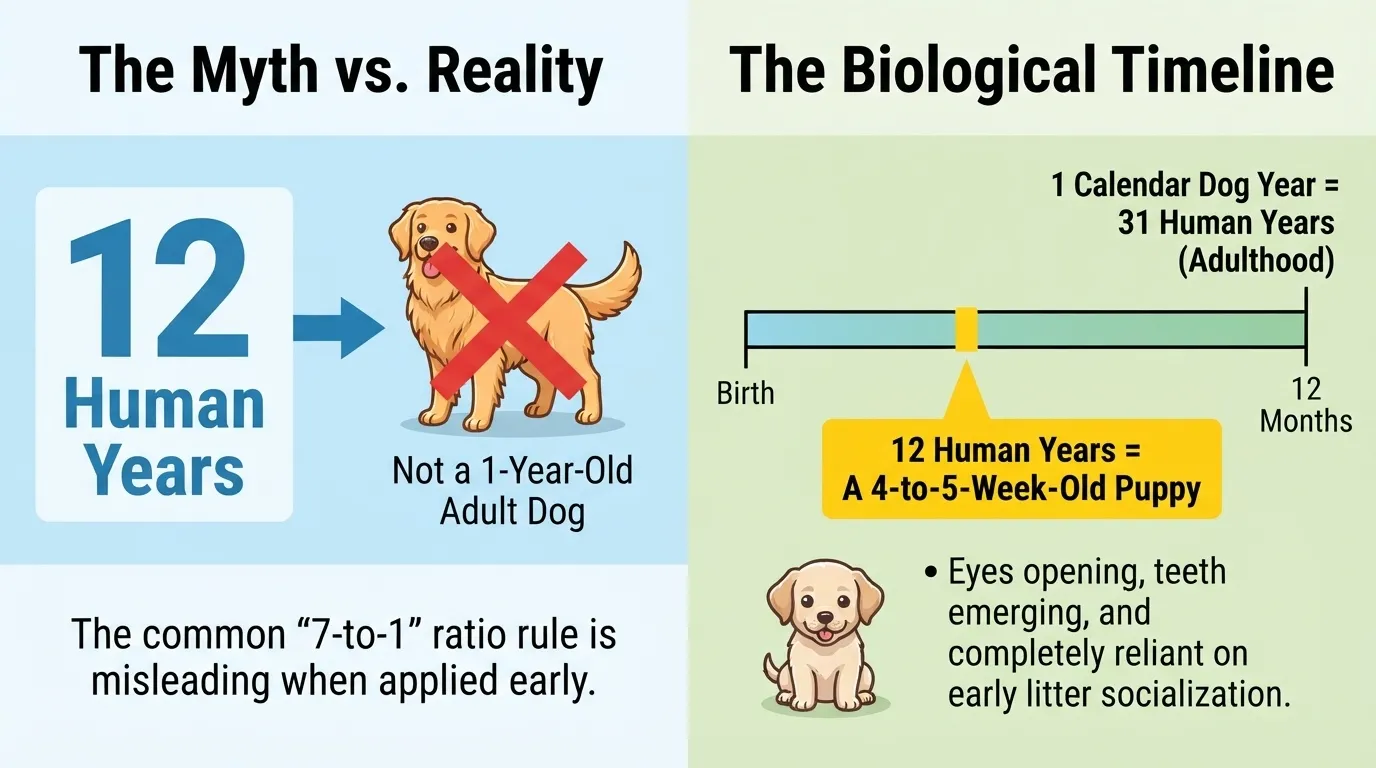
The ÷7 Myth Method Quick Math, But Inaccurate Here
If you use the traditional “multiply or divide by 7” rule, calculating what is 12 human years in dog years seems straightforward. You would simply divide 12 by 7, which gives you roughly 1.7. Under this old math, 12 human years would equal about a 1.7-year-old dog—an adolescent canine entering adulthood.
While that simple division is quick, it is completely misleading for this specific age. The 7-year rule assumes dogs age at a perfectly steady, linear rate throughout their entire lives. Science shows us that canine biology does not work that way, especially during the very first few months of growth.
The Real Reason — A Dog’s First Year Alone Covers 15-31 Human Years
Dogs do not age at a constant pace; their development is highly non-linear. A puppy grows at a massive, accelerated rate during its first year of life, packing decades of human-equivalent development into a matter of months. Depending on the specific scientific model or breed size you look at, a dog’s very first year of life actually equates to anywhere from 15 to 31 human years.
Because 12 human years sits far below that first-year threshold, it cannot equal a full dog year. Instead of a one-year-old adolescent dog, 12 human years actually translates to a very young puppy that is only a few weeks or months old. The rapid biological shifts in early canine DNA mean that those first few human years are crossed in a flash during a puppy’s earliest days at home.
How Old Is a Puppy at "12 Human Years"? Weeks/Months Breakdown
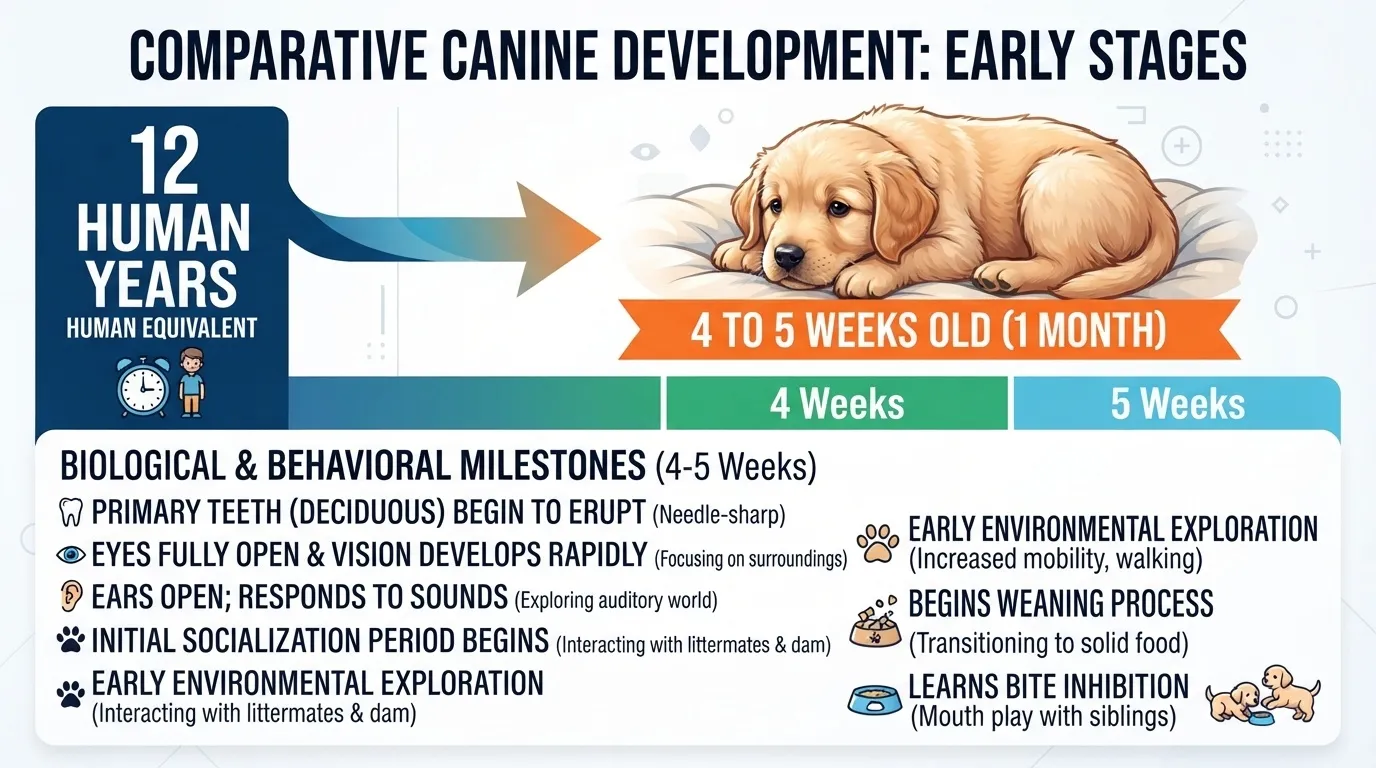
When we reverse the aging timeline to find what is 12 human years in dog years, we land squarely in the early weeks of a puppy’s life. Because a dog’s first year encompasses the entire journey from infancy to sexual maturity, their early development happens at a breakneck pace. Twelve human years does not even equal a one-year-old dog; instead, it translates to a vulnerable, rapidly growing puppy that is just a few months old.
Estimating Puppy Age Using Proportional Growth
To find the exact age in weeks or months, we look at proportional growth relative to early milestones. According to modern veterinary aging models, the first full year of a dog’s life equals roughly 15 to 31 human years, depending on the specific scientific formula used.
If we use a linear growth approximation for the very first stage of life, a dog reaches the emotional and physical equivalent of 12 human years at approximately 3 to 4 months of age (roughly 12 to 16 weeks). At this stage, a puppy is equivalent to a pre-teen human. They are fully weaned, rapidly learning social boundaries, and losing their razor-sharp puppy teeth.
Does Breed Size Slightly Change This?
While all puppies develop incredibly fast in the beginning, breed size introduces minor variations in how these early weeks calculate:
Small Breeds (e.g., Chihuahuas, Toy Poodles): These dogs sprint through their early development. They hit physical maturity faster, meaning a 3-month-old small breed might already behave like a slightly older human child.
Large and Giant Breeds (e.g., German Shepherds, Great Danes): Large dogs have a much longer growth runway. They remain skeletal and behavioral “children” for longer, meaning 12 human years aligns closer to the 4-month mark for them.
The Science Behind the Calculation
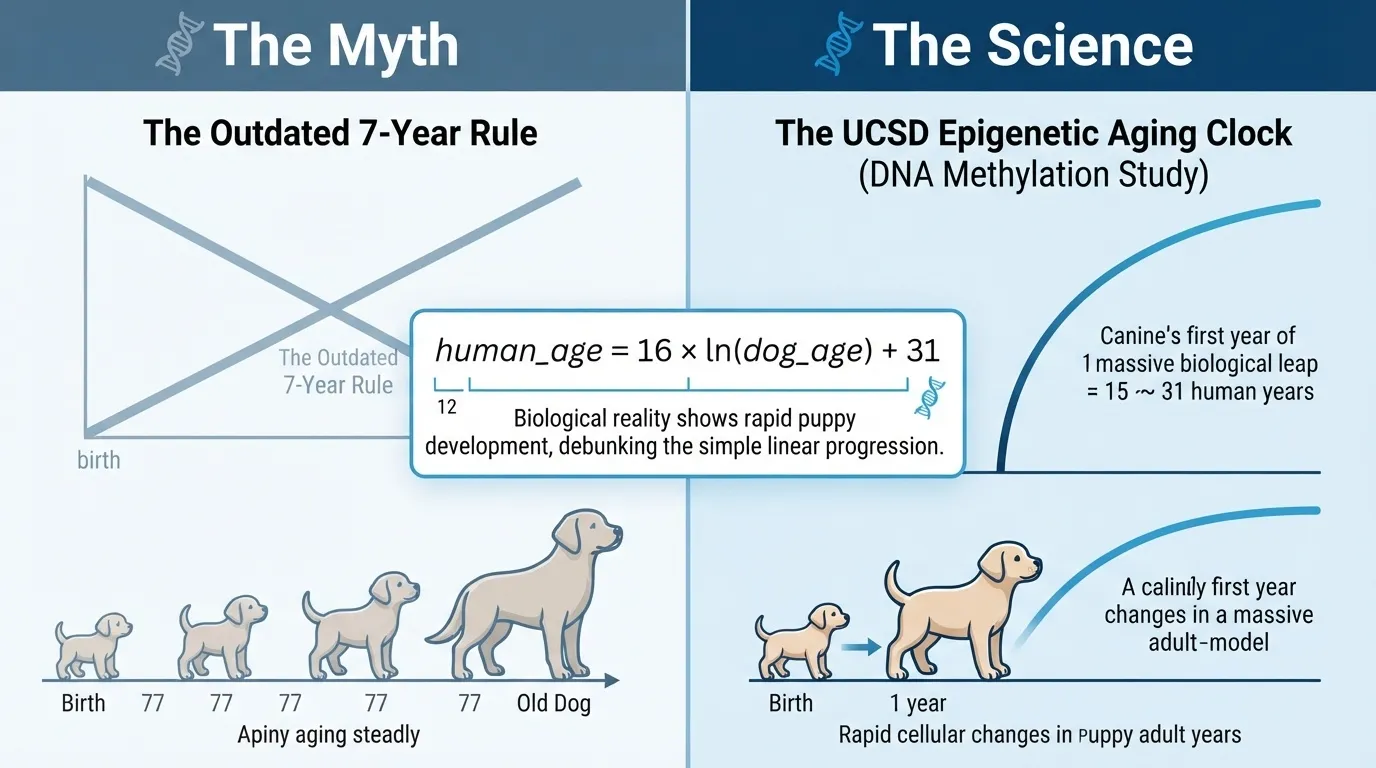
The DNA Methylation Formula
Forget the old “multiply by seven” rule. Modern veterinary science relies on epigenetics—specifically, how chemical modifications to a dog’s DNA change as they age. Researchers at the University of California, San Diego (UCSD) published a groundbreaking study in Cell Systems that tracks these changes, known as DNA methylation, to map canine aging directly to human aging.
The researchers developed a logarithmic formula to match the aging clocks of humans and dogs:
Human Age = 16 × ln(Dog Age) + 31
To answer a reverse question like “what is 12 human years in dog years,” we have to flip that formula mathematically to solve for the dog’s age:
Dog Age = e^((Human Age – 31) / 16)
However, if you plug 12 into this reverse equation, the math breaks down for a living animal. Because the baseline of the UCSD formula starts at 31 human years—the mathematical equivalent of a 1-year-old dog—any human age below 31 results in a negative exponent.
For 12 human years, the formula yields an impossibly small fraction that doesn’t align with real-world puppy development. The formula simply wasn’t designed to calculate the earliest weeks of a dog’s life, which is where a value as low as 12 human years actually sits.
Human Years to Dog Years — Reverse Conversion Table
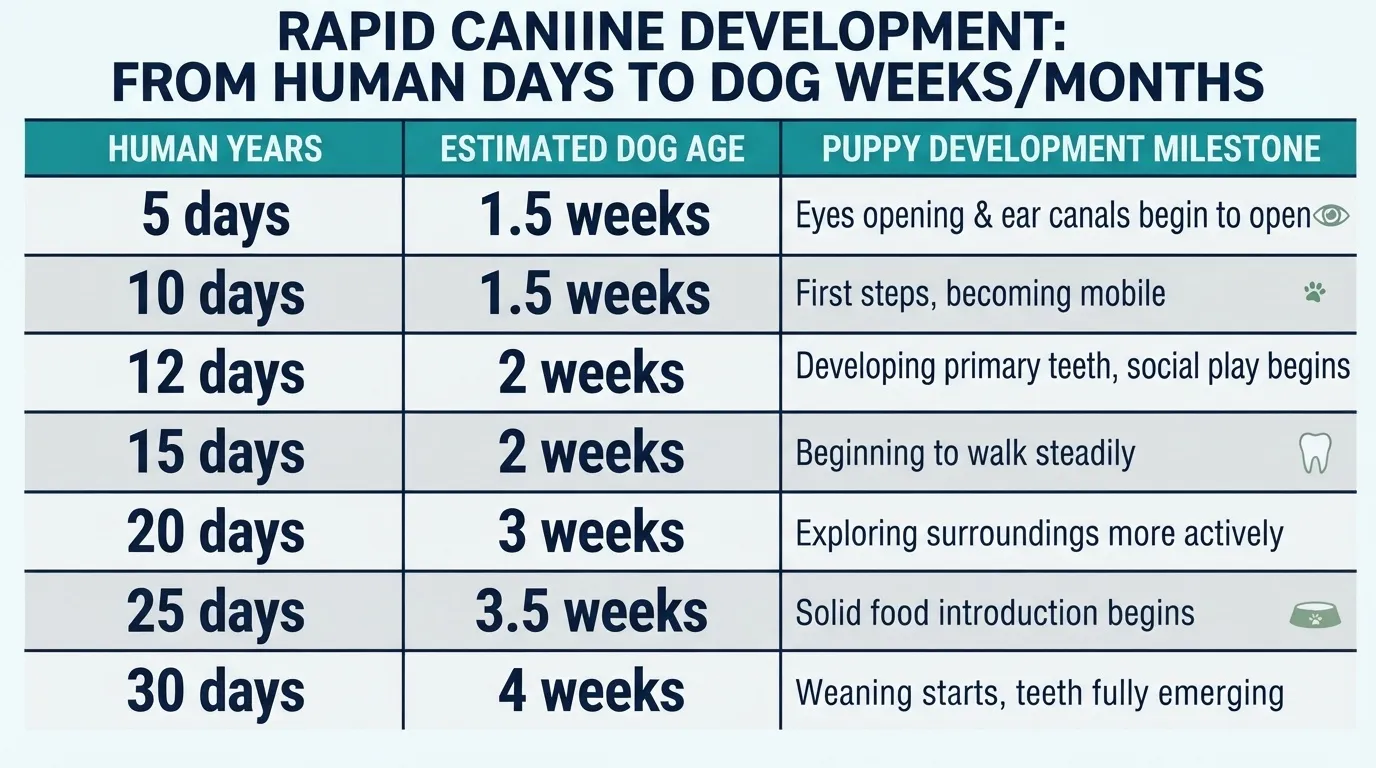
Table: 5, 10, 12, 15, 20, 25, 30 Human Years → Dog Years Equivalent
To find out what these early human years mean for a dog, we have to look at the rapid development that happens in a puppy’s first few months. Because a dog reaches the biological equivalent of a 31-year-old human by their first birthday, these lower human milestones translate to a very young puppy’s age in weeks or months.
The table below provides the estimated dog age equivalents for these specific human years, based on real-world canine developmental milestones and veterinary aging charts.
| Human Years | Estimated Dog Age Equivalent | Development Milestone |
|---|---|---|
| 5 human years | ~1.5 to 2 weeks | Eyes and ears just beginning to open; completely dependent on mother. |
| 10 human years | ~3 to 4 weeks | Transitioning to solid food; starting to walk and socialize with littermates. |
| 12 human years | ~4 to 5 weeks | Developing primary teeth; highly curious and exploring immediate surroundings. |
| 15 human years | ~6 weeks | Weaning process is nearly complete; rapid brain development and social play. |
| 20 human years | ~8 weeks (2 months) | Typical age for adoption; ready for basic training and socialization. |
| 25 human years | ~4 to 6 months | Juvenile stage; losing puppy teeth and experiencing rapid physical growth. |
| 30 human years | ~9 to 11 months | Approaching sexual maturity; adolescent phase right before reaching full adulthood. |
As the data shows, 12 human years doesn’t mean a dog is a pre-teen or a 1-year-old adult. Instead, it places them right at the heart of their early socialization period—a critical 4-to-5-week-old puppy who is just beginning to discover the world.
Try Our Free Canine Age Tool
Ready to instantly reverse the math for any age? Instead of guessing the biological math or wrestling with logarithmic exponents, you can use our interactive canine age conversion tool to switch between human and dog lifespans seamlessly.
Frequently Asked Questions
A puppy ages incredibly fast during their first year of life compared to a human. By the time a puppy reaches 1 calendar year of age, they are biologically equivalent to a 15-to-31-year-old human, depending on their breed size and the scientific aging model used.
In the reverse calculation, 20 human years equals roughly an 8-week-old (2-month-old) puppy. This is the classic age when puppies finish weaning, experience rapid brain development, and are typically ready to leave their mother for their new forever homes.
The traditional "multiply by 7" rule assumes dogs age at a completely linear rate throughout their entire lives, which is biologically incorrect. Dogs mature rapidly in their first year and then their aging slows down; because a 1-year-old dog is already physically comparable to a human in their late teens or twenties, a small number like 12 human years can only map backward to a puppy that is just a few weeks old.
🐾 Other Age Guides

Gulfam Haider Mehdi
Founder & Developer
I built Dogagescalculator.com to give dog owners honest, science-backed answers instead of the outdated "×7" myth. Every figure here is checked against AKC, AVMA, and published veterinary research.
More about the author & this site →📌 Featured Guides
can a large dog breed with a small dog
→
how long do corgis live in human years
→
What Is 13 Human Years in Dog Years
→
What Is 10 Dog Years in Human Years
→
how to tell if your dog is a pitbull
→
What Is the Lifespan of a Miniature Poodle?
→
Dog Age in Months to Human Years
→
dog breed chinese shar-pei
→
What Is 3 Dog Years in Human Years
→
What Is 4 Human Years in Dog Years
→
Comments