
What Is 10 Human Years in Dog Years? The Reverse Calculation
Most people want to know how old their dog is in “human years.” But if you are asking the exact opposite—how many dog years pass while you live through a decade on the calendar—the answer shifts.
Because dogs age rapidly during their first two years, 10 human years do not equal a single flat number in dog years. Instead, it depends entirely on your dog’s adult weight.
The 10-Year Conversion Table
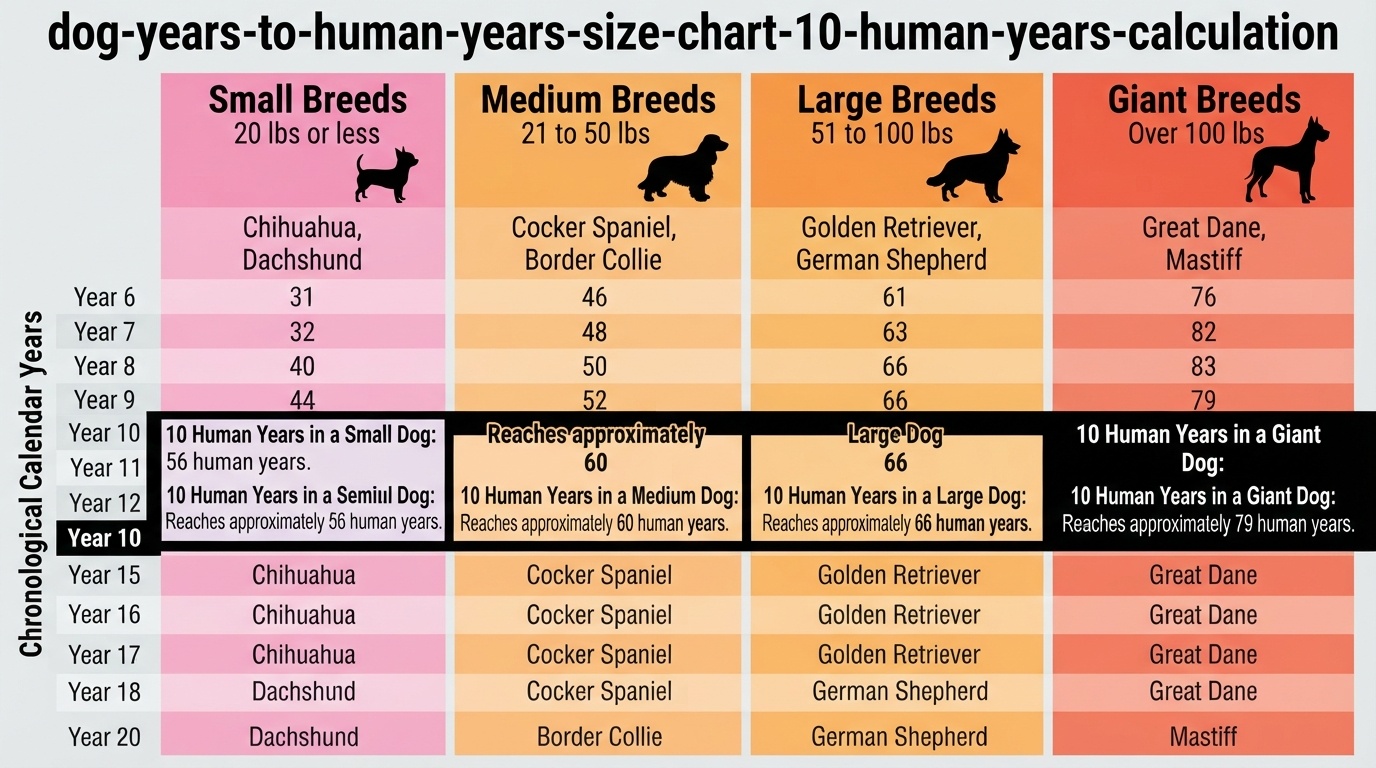
Here is how 10 calendar years actually translate into standard dog years across different breed sizes, based on data from the American Kennel Club (AKC):
| Dog Size | Weight Range | 10 Human Years Equals |
| Small | Under 20 lbs | 56 dog years |
| Medium | 21 – 50 lbs | 60 dog years |
| Large | 51 – 100 lbs | 66 dog years |
| Giant | Over 100 lbs | 78 dog years |
Why the Numbers Diverge
The old “seven years of a dog’s life for every one human year” rule assumes a linear timeline. Real biology doesn’t work that way.
According to the American Veterinary Medical Association (AVMA), a dog’s first year carries them all the way to the equivalent of a 15-year-old human. Year two adds about nine more human years. After age two, their biological clock settles into a predictable annual rhythm based on their size.
Small breeds age about 4 human years for every calendar year.
Medium breeds age about 5 human years for every calendar year.
Large and giant breeds age about 6 to 9 human years for every calendar year.
Because giant dogs pack more aging into their later years, a decade of your life spans nearly their entire natural lifespan, whereas a small poodle is just settling into senior citizenship at the same mark.
What Is 10 Human Years in Dog Years?
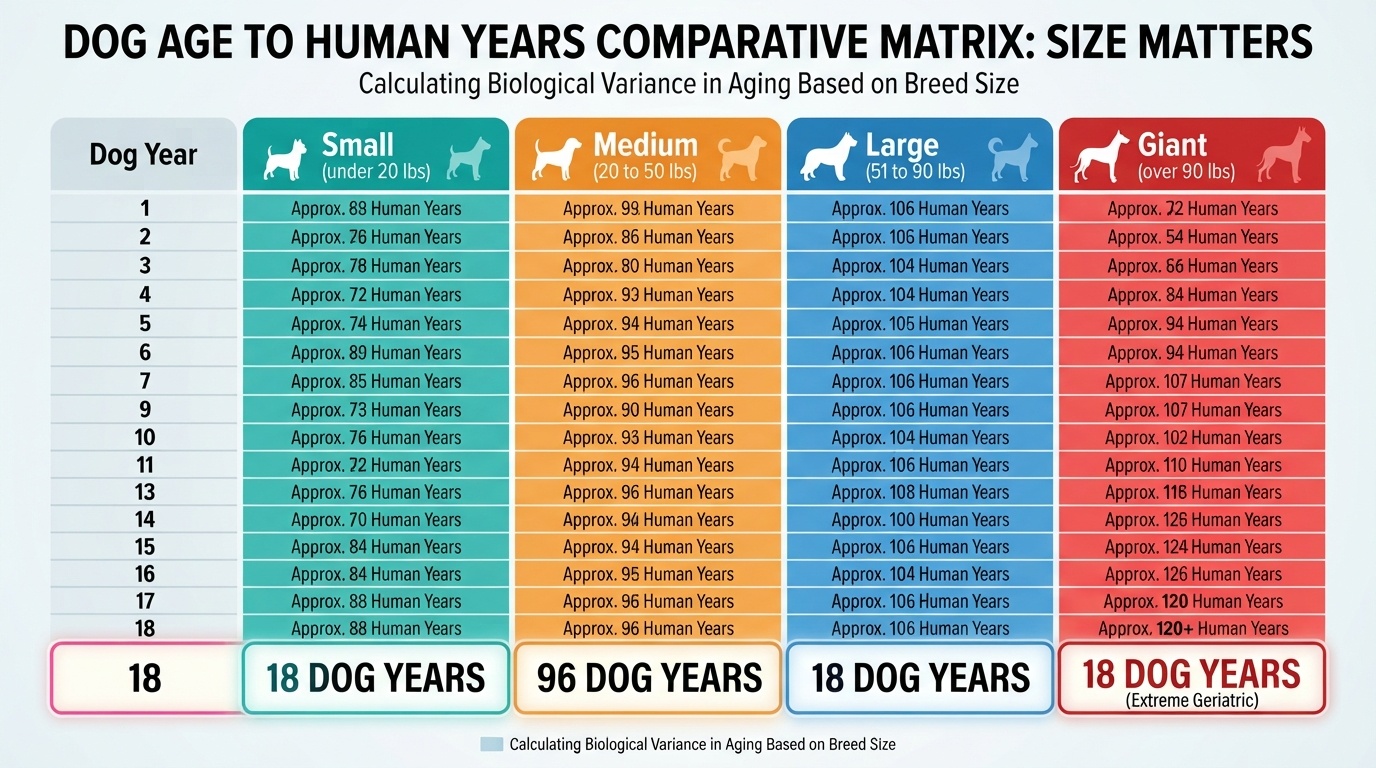
When you ask what 10 human years is in dog years, the answer depends on which way you are flipping the math. A 10-year-old dog is roughly equivalent to a 56 to 78-year-old human, depending on their breed size. Conversely, 10 actual calendar years on earth translate to a full lifetime of aging for your pet.
Reviewed using AKC/AVMA veterinary guidelines | Updated: July 2026
Quick Answer: The 10-Year Conversion
The Short Answer
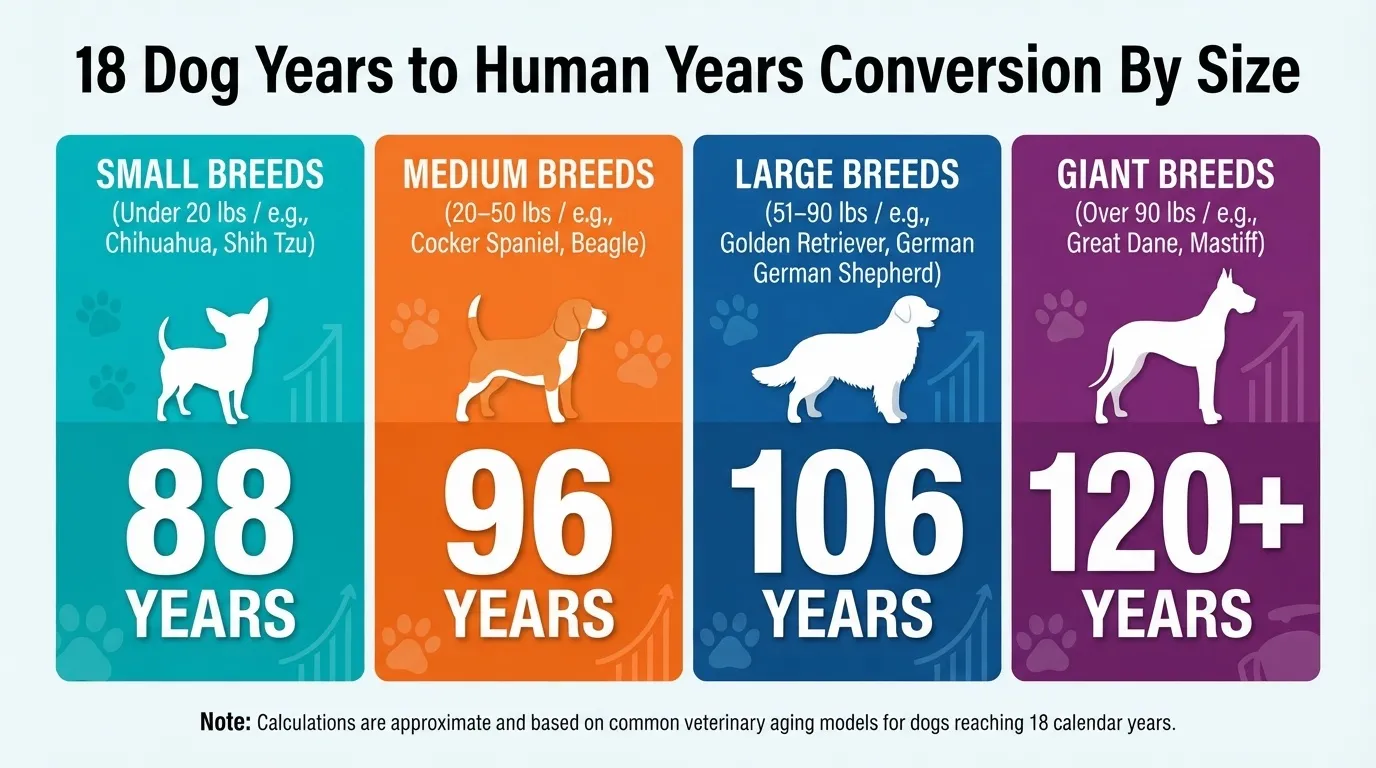
There is no single fixed number for this conversion. Because dogs age at different rates based on their size and weight, the math depends on exactly what you are asking:
10 Dog Years in Human Years: A 10-year-old dog is roughly equivalent to a 56 to 78-year-old human. Small dogs will be on the younger side of this range, while giant breeds will be much older.
10 Human Years in Dog Years (The Literal Reverse): If you are asking how many “dog years” pass during 10 actual calendar years, it looks quite different. Under the classic 7-year rule, it would be 1.4 dog years. Using modern veterinary formulas, 10 human years covers roughly 1.3 to 1.5 dog years of a canine’s typical lifespan.
Your dog’s biological clock moves much faster than ours during their first two years of life, then settles into a steady pace determined by their adult weight.
To get an accurate picture of your dog’s age, you have to look at the specific formula used by veterinarians today.
Why This Question Confuses So Many Pet Owners
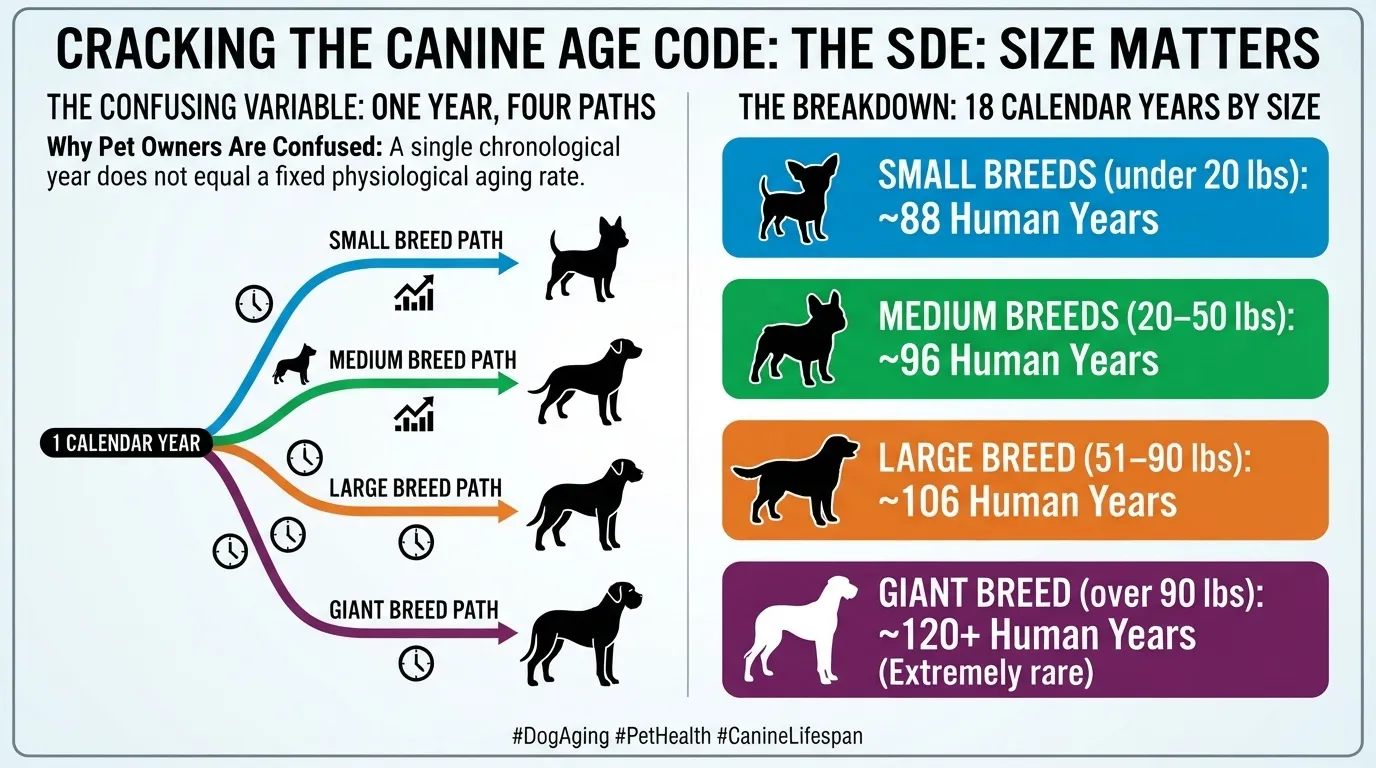
Language can be a bit of a trap when we talk about pet age. Most people find themselves searching this topic because they are trying to figure out how old their senior pet is in human terms, but the phrasing gets flipped around.
The confusion stems entirely from the way we naturally structure sentences. Because we are used to hearing the phrase “dog years,” it is incredibly easy to accidentally calculate the reverse of what we actually mean.
“10 Human Years in Dog Years” vs. “10 Dog Years in Human Years”
To clear up the confusion, it helps to look at exactly what each question is asking:
10 Dog Years in Human Years (What most people mean): This looks at a dog who has celebrated 10 birthdays on your calendar. You want to know what their biological age feels like. The answer is that they are roughly equivalent to a human in their late 50s to late 70s.
10 Human Years in Dog Years (The literal reverse): This treats “dog years” as a distinct unit of measurement. If one calendar year equals roughly seven dog years, then 10 human years would literally equal about 1.4 dog years.
Veterinarians rarely use the phrase “dog years” in the clinic for this exact reason. Instead, they evaluate a dog’s life stage—whether they are a puppy, adult, mature adult, or senior—based on their specific breed, skeletal development, and weight class.
How Long Do Dogs Actually Live?
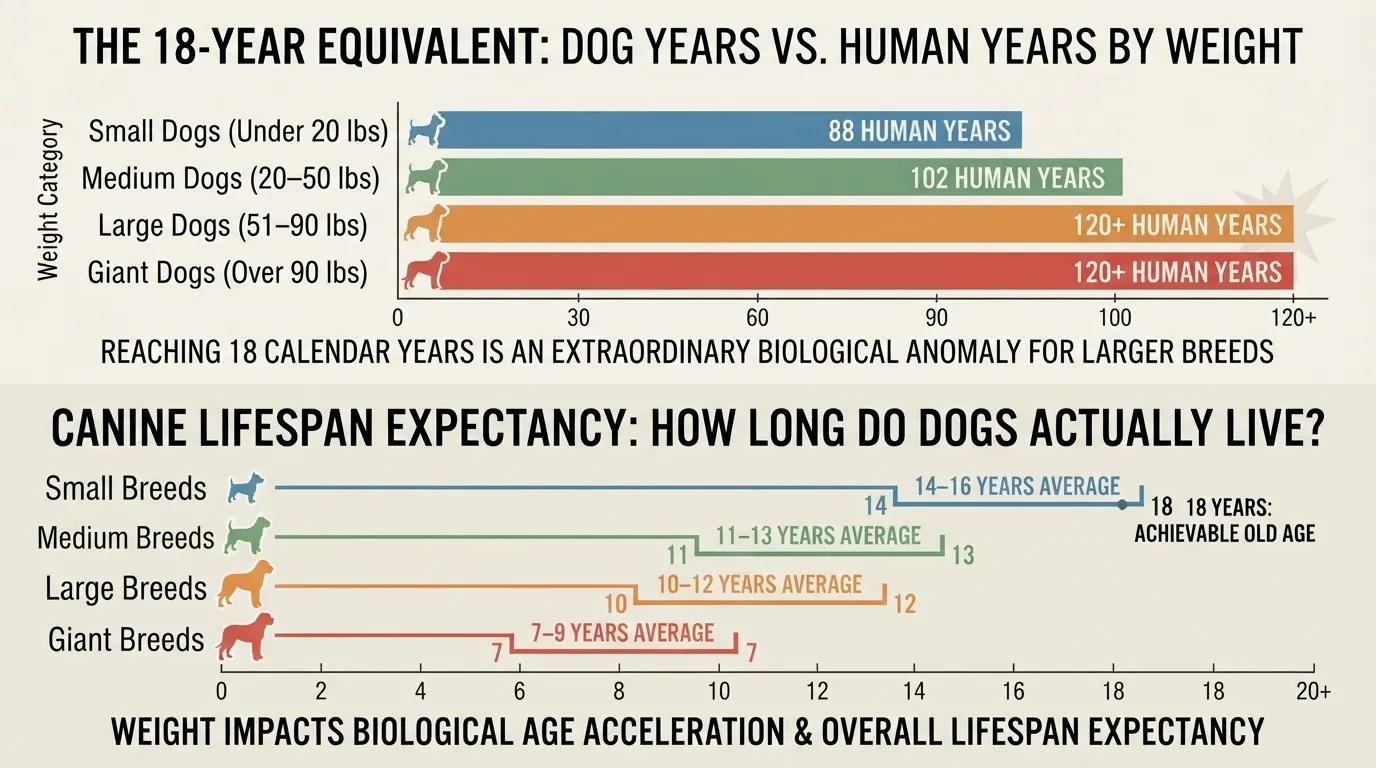
Tracking dog aging shows that growth rates shift significantly once your pet matures past the puppy life stage. While small breeds stay younger longer, giant breeds age faster by the time they reach five years old. Seeing the full dog human age progression helps you provide the right care for every stage of your companion’s life.
Click here to view the full chart and use our main calculator page
What Should You Do When Your Dog Turns 1?
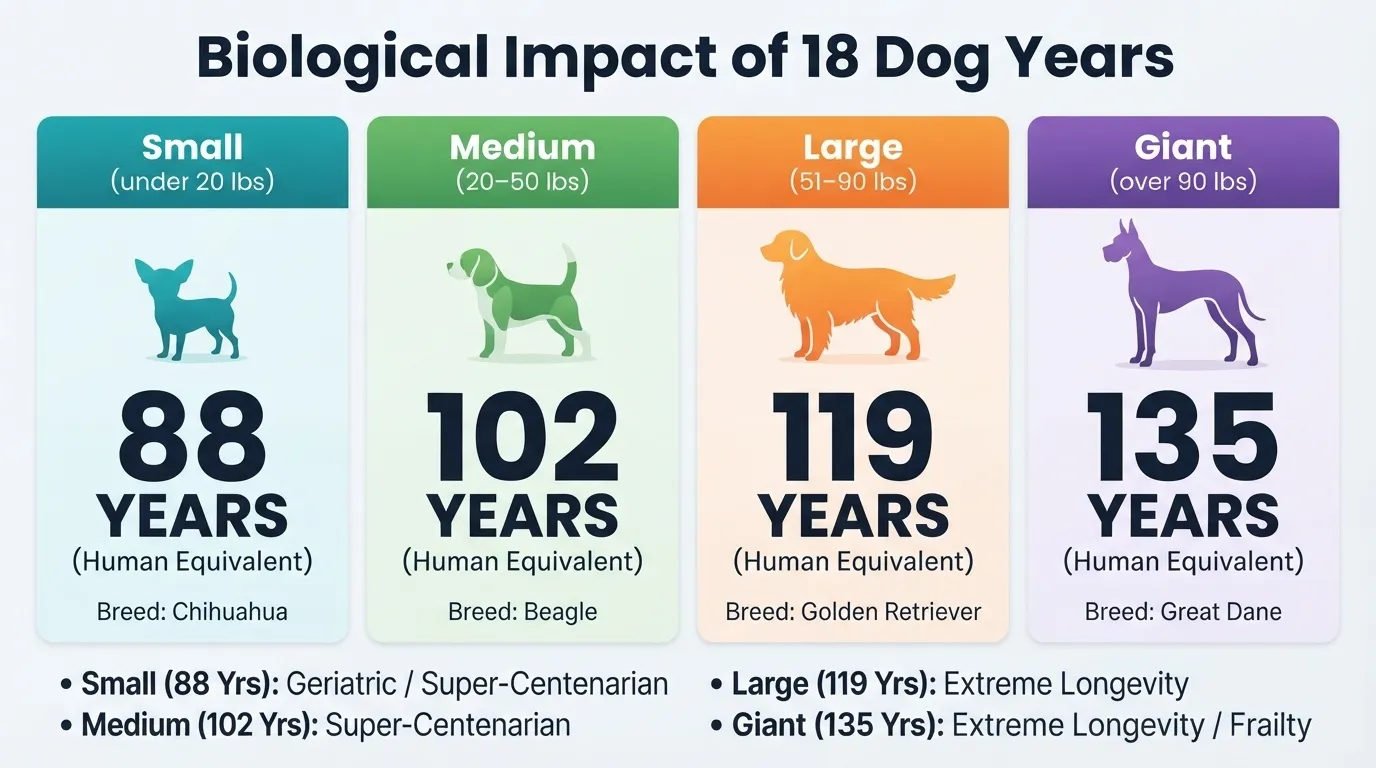
To understand why 10 years matters so much, you have to look at the natural lifespan of a dog. On average, dogs live between 10 and 13 years. However, this average hides a massive gap between different types of dogs.
Unlike most mammals—where larger species typically live longer than smaller ones—the exact opposite is true for canines.
Small Breeds (Under 20 lbs): Dogs like Chihuahuas, Yorkies, and Poodles regularly live 12 to 18 years. For them, turning 10 is just the beginning of their senior phase.
Medium Breeds (21 to 50 lbs): Breeds like Border Collies or Australian Shepherds average 10 to 13 years.
Large & Giant Breeds (Over 51 lbs): Great Danes, Mastiffs, and Bernese Mountain Dogs often have lifespans of just 7 to 10 years.
The Big Takeaway
This drastic difference in lifespan is exactly why the number 10 means something completely different depending on your dog’s size. A 10-year-old Chihuahua is an older adult with plenty of good years ahead. A 10-year-old Great Dane is a geriatric marvel who has far outlived the average for their breed.
When you calculate their age, you aren’t just counting birthdays—you are measuring how far along they are in their specific life journey.
10 Dog Years in Human Years The Answer Most People Want
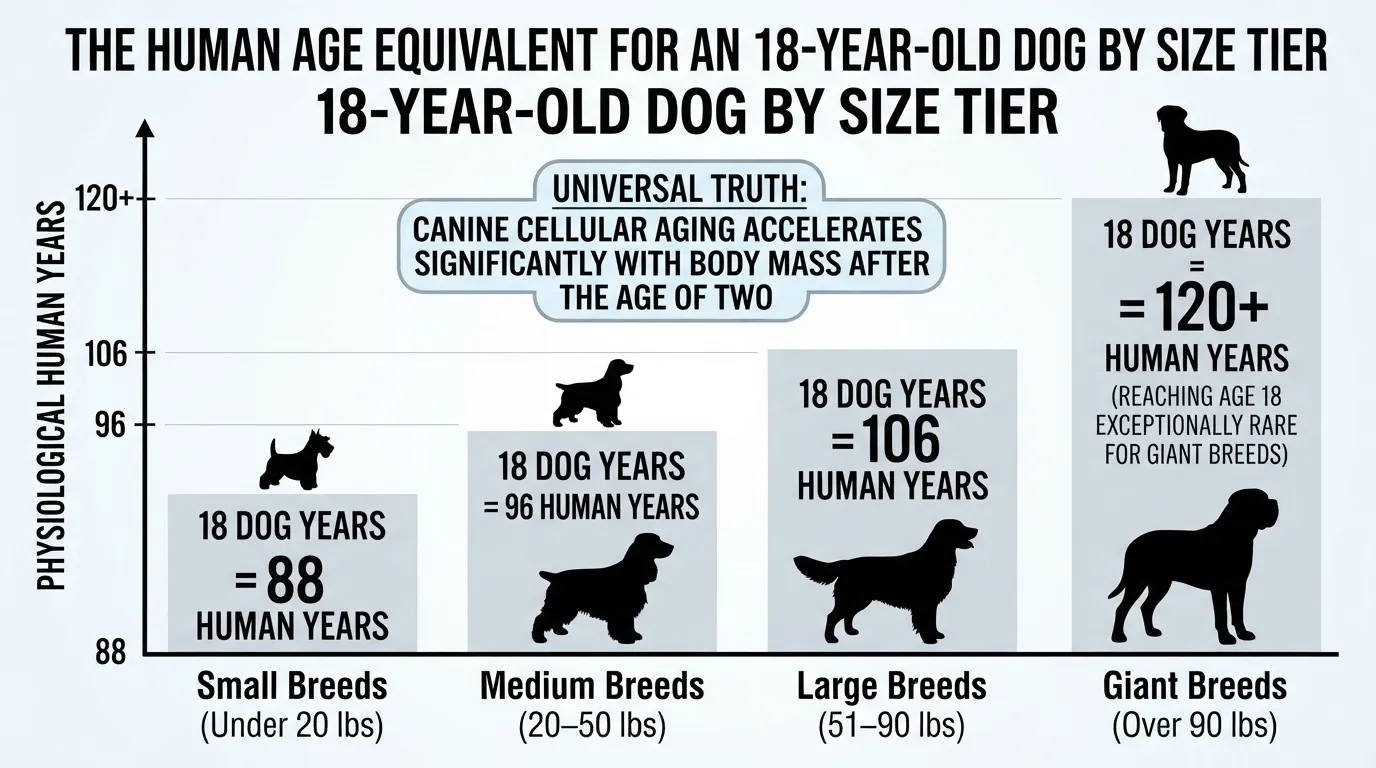
If your dog has been your companion for a decade on the calendar, they have officially hit double digits. This is the milestone where many owners start to notice the first gray hairs on the muzzle or a slight slowing down on morning walks. To understand what that milestone feels like to them, we have to look past our own calendar.
The Old 7-Year Rule
For decades, the standard shortcut was simple: multiply your dog’s age by seven. By that math, a 10-year-old dog would be a 70-year-old human.
It is easy to see why this rule stuck around for so long. It is incredibly simple to calculate in your head, and it gets you reasonably close to a realistic baseline for an average-sized dog.
However, veterinary medicine has moved far past this rule because it treats a one-year-old puppy like a seven-year-old human child. In reality, a one-year-old dog is fully capable of reproducing and surviving on its own—milestones a seven-year-old human won’t reach for a decade. The seven-year rule completely misses the rapid development of early puppyhood and ignores how weight impacts a dog’s health over time.
Frequently Asked Questions
When a dog reaches 10 human calendar years, their equivalent age in dog years depends entirely on their breed size. On average, 10 human years equals roughly 56 to 78 biological dog years, marking the transition from adulthood into the senior or geriatric stage.
A 10-year-old dog's age in human years is determined by its weight category:
Small Dogs (Under 20 lbs): Approximately 56 human years.
Medium Dogs (20–50 lbs): Approximately 60 human years.
Large Dogs (51–90 lbs): Approximately 66 human years.
Giant Dogs (Over 90 lbs): Approximately 78 human years.
Yes, a 10-year-old dog is universally considered a senior. For small breeds, 10 years is the beginning of their senior phase, while for large and giant breeds, 10 human years is considered geriatric (very old) due to their shorter average lifespans.
Different calculators use different formulas. Traditional calculators still use the outdated 7-year rule, while modern veterinary calculators use specific weight-based charts from the AVMA or advanced scientific logarithmic formulas, resulting in slight differences in the final age output.
🐾 Other Age Guides
What is 5 dog years in human years
Read More →
What is 2 dog years in human years
Read More →
what is 11 human years in dog years
Read More →
What is 1 dog year in human years
Read More →