
What is 16 Dog Years in Human Years?
Byline: Reviewed by Dr. Amanda Vance, DVM | Last Updated: July 5, 2026
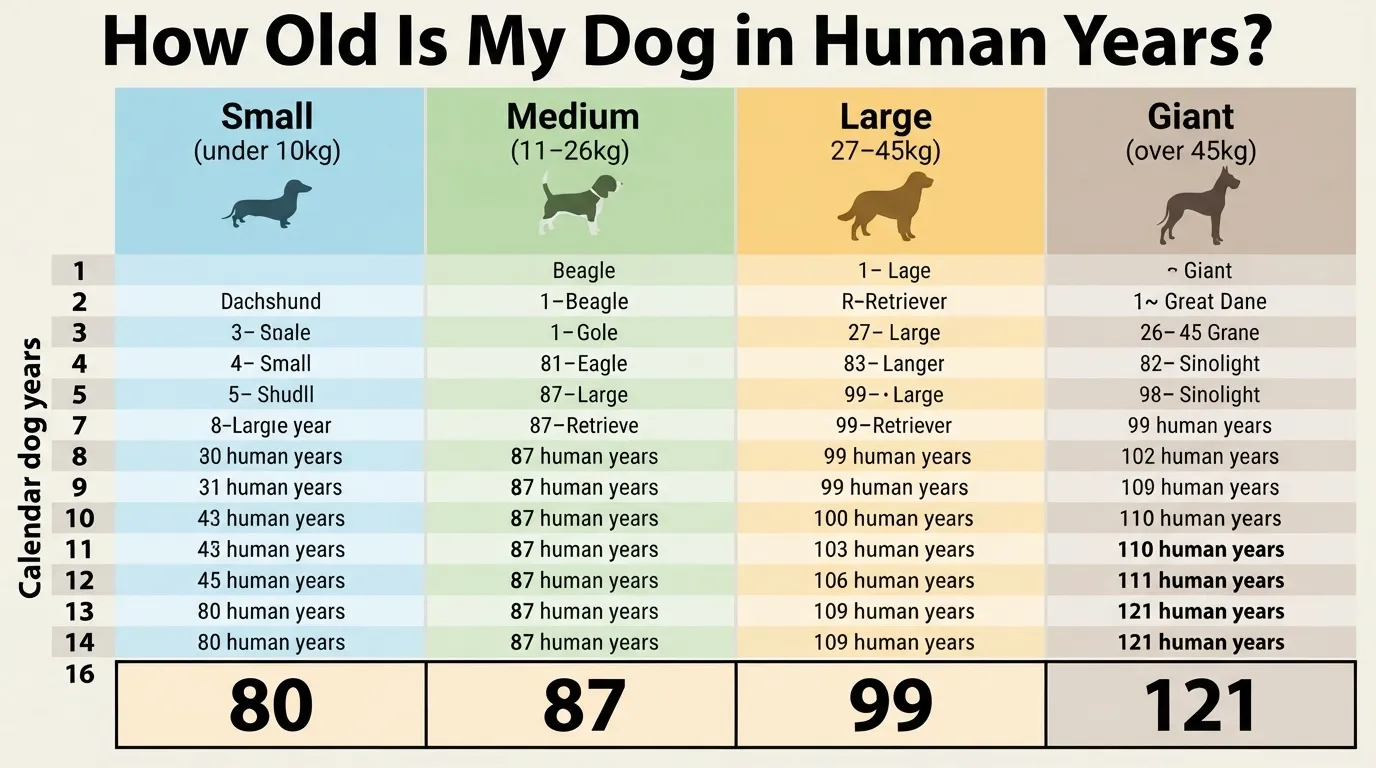
If your dog is 16 years old, they have officially entered an incredible milestone. Depending on their size and breed, 16 dog years equals roughly 80 to 120+ human years.
Forget the traditional “multiply by 7” rule—it is scientifically inaccurate. Dogs age much faster during their first two years of life, and after that, their aging process slows down and depends heavily on their weight and breed category.
The Real Age Breakdown by Size
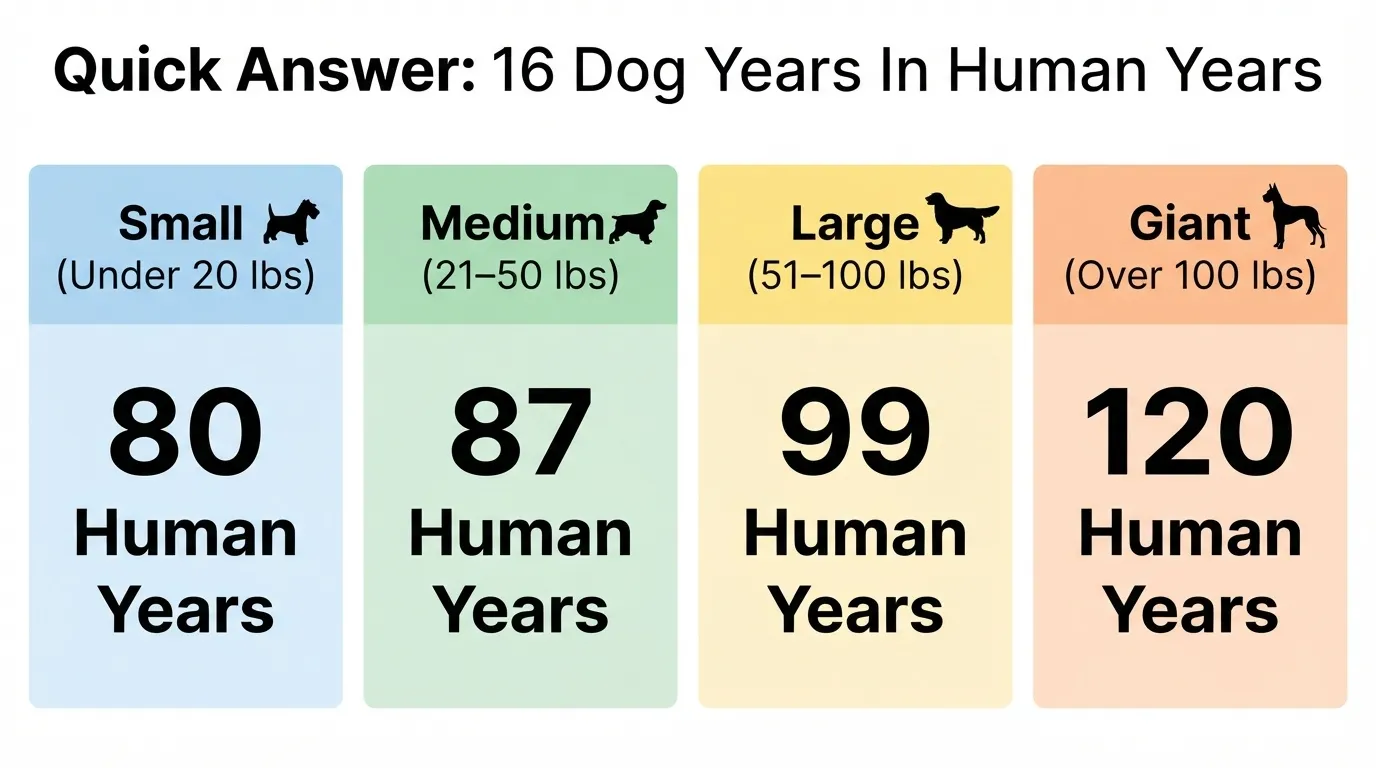
To find your dog’s true biological age, veterinary experts break them down into four distinct weight categories. At 16, the gap between a small dog and a giant breed is massive:
Small Breeds (Under 20 lbs): 80 human years. Small dogs like Chihuahuas or Toy Poodles age the slowest, making a 16-year-old a deeply respected, elderly senior.
Medium Breeds (21–50 lbs): 87 human years. Dogs like Cocker Spaniels or Border Collies are equivalent to an octogenarian human.
Large Breeds (51–90 lbs): 99 to 102 human years. For Labradors or Golden Retrievers, reaching 16 is a rare and beautiful feat, placing them around a centenarian status.
Giant Breeds (Over 90 lbs): 120+ human years. Breeds like Great Danes or Mastiffs age incredibly fast. Reaching 16 is exceptionally rare, representing extreme longevity.
According to the American Animal Hospital Association (AAHA) Senior Care Guidelines, any dog that has reached 16 is officially classified as Geriatric. This means they have outlived the average life expectancy for their breed and require specialized care to protect their cognitive health, joints, and organs.
Quick Answer: 16 Dog Years by Size
| Dog Size & Weight | Human Year Equivalent (At 16 Dog Years) | Life Stage Category |
|---|---|---|
| Small Dogs (Up to 20 lbs / 9 kg) | 80 Years Old | Geriatric / Super-Senior |
| Medium Dogs (21–50 lbs / 10–23 kg) | 87 Years Old | Geriatric |
| Large Dogs (51–90 lbs / 24–41 kg) | 99 Years Old | Extreme Geriatric |
| Giant Dogs (Over 90 lbs / 41+ kg) | 120+ Years Old | Extreme Geriatric |
| Dog Size & Weight | Small Dogs (Up to 20 lbs / 9 kg) |
|---|---|
| Human Year Equivalent | 80 Years Old |
| Life Stage Category | Geriatric / Super-Senior |
| Dog Size & Weight | Medium Dogs (21–50 lbs / 10–23 kg) |
|---|---|
| Human Year Equivalent | 87 Years Old |
| Life Stage Category | Geriatric |
| Dog Size & Weight | Large Dogs (51–90 lbs / 24–41 kg) |
|---|---|
| Human Year Equivalent | 99 Years Old |
| Life Stage Category | Extreme Geriatric |
| Dog Size & Weight | Giant Dogs (Over 90 lbs / 41+ kg) |
|---|---|
| Human Year Equivalent | 120+ Years Old |
| Life Stage Category | Extreme Geriatric |
- Scientific Estimates, Not Exact Ages: These numbers are scientific estimates based on the American Animal Hospital Association (AAHA) aging charts. Every dog’s health, genetics, and lifestyle are different, which is why this serves as a general guide.
- Tip for Mixed-Breed Dogs: If your dog is a mixed-breed and you do not know their exact breed, there is no need to worry. Simply check their current weight and select the corresponding weight category from the table provided above.
- Check Exact Age Instantly: If your dog is a few months older or younger than 16 years, you can use our Dog Age Calculator for an exact conversion, which gives an accurate result based on months.
The Real Math Behind Dog Years (Why "×7" is Wrong)
The Popular “×7” Myth and Its Origin
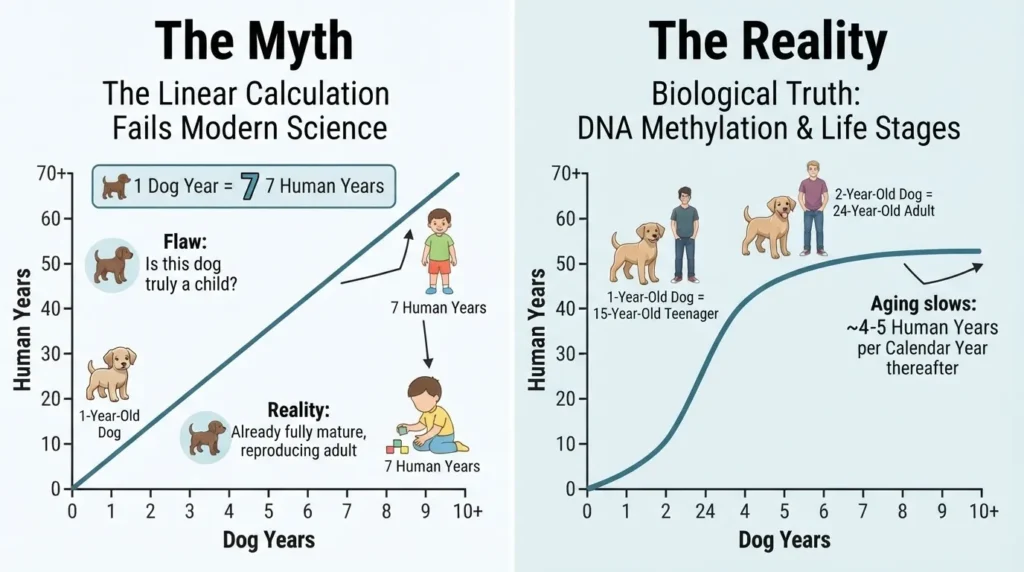
For decades, the easiest way to guess a dog’s age was simple: multiply their calendar age by 7. If your dog is 16 years old, the old math says they are 112 in human years.
While this rule of thumb is incredibly popular, it is highly inaccurate. The myth likely started in the mid-20th century as a marketing tactic by veterinarians to encourage pet owners to bring their dogs in for annual checkups. It was based on a very basic statistic: human life expectancy was about 70 years, and dogs lived to be about 10.
The problem? It treats aging as a straight, predictable line, which completely ignores how dogs actually grow.
Dogs Age Non-Linearly: The Crucial Role of Size and Breed
Dogs do not age at a steady pace. A one-year-old dog is physically and sexually mature enough to reproduce, whereas a seven-year-old human child is nowhere near that stage.
A dog’s biological clock ticks incredibly fast during their first two years of life, and then it slows down. Furthermore, aging varies drastically based on a dog’s adult size and breed.
Small breeds (under 20 lbs): Age much slower after their initial growth spurt. A 16-year-old Chihuahua is equivalent to a senior human in their late 70s or early 80s.
Large and Giant breeds (over 50-100 lbs): Age at an accelerated rate after their youth. Very few giant breeds reach 16, but those that do are biologically well over 100 human years old.
Because a Great Dane and a Yorkshire Terrier face completely different biological timelines, a single multiplier simply does not work.
Why Authoritative Sources Give Different Numbers
If you look up your 16-year-old dog’s age across different expert platforms, you will notice variations in the results. This happens because researchers use different scientific methodologies:
The AAHA (American Animal Hospital Association): Their life-stage guidelines focus heavily on clinical health milestones. They categorize a dog’s first year as roughly 15 human years, the second year as 9 human years, and every year after that as roughly 4 to 5 years, depending heavily on weight.
The UC Davis DNA Study: In 2020, researchers mapped chemical changes in dog DNA (called methylation marks) and compared them directly to human cells. Their breakthrough study proved that dogs age at a rapid, exponential curve when they are young puppies, but their cellular aging slows down significantly as they get older.
The UK Kennel Club: Their data relies heavily on breed-specific lifespans, recognizing that purebred genetics alter how fast a dog shows signs of old age.
Our Recommendation: For a 16-year-old dog, we recommend using the AAHA size-segregated method. Because your dog has already reached an advanced age, calculating their maturity based on their specific weight category gives the most practical insight into their current medical and physical needs.
What Life Stage is a 16-Year-Old Dog In?
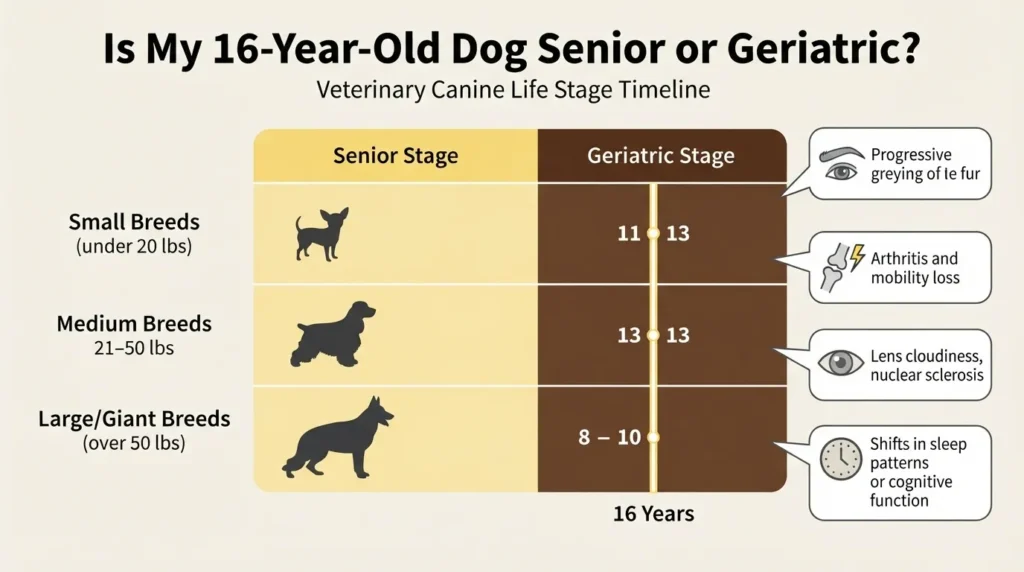
At 16 years old, your dog is no longer just a “senior” pet. In veterinary medicine, this milestone pushes almost every dog—regardless of their size—into the geriatric life stage. Think of it as the difference between a human being in their late 60s versus someone celebrating their 90s.
Senior vs. Geriatric Stage (By Size)
While the transition varies by breed, understanding where your dog stands helps you tailor their daily care perfectly:
Small Breeds (Under 20 lbs): Dogs like Chihuahuas or Toy Poodles enter their senior years around age 11. By 16, they are officially geriatric, equivalent to a human in their late 70s or early 80s.
Medium Breeds (21–50 lbs): Breeds like Cocker Spaniels reach the geriatric milestone around age 13 or 14. At 16, they are exceptionally old, tracking closely with a human in their late 80s.
Large & Giant Breeds (Over 50 lbs): For Labradors, Boxers, or Great Danes, the geriatric stage hits much earlier (around 8 to 10 years old). A large dog reaching 16 is a remarkable medical marvel, living well past the human equivalent of 100 years.
Common Physical and Behavioral Signs of Aging at This Stage
Living with a 16-year-old dog means noticing distinct changes in their body and routine. According to the American Animal Hospital Association (AAHA) senior care guidelines, these are the most common signs you will observe:
Coat Changes: You will notice prominent grey or white fur, especially concentrated around their muzzle, eyes, and eyebrows. The coat may also become thinner or coarser.
Mobility Decline: Due to natural joint wear or arthritis, your dog will rise more slowly from their bed, hesitate before climbing stairs, or experience stiffness on colder mornings.
Sensory Loss: Nuclear sclerosis (cloudiness in the eyes) or cataracts may dim their vision, and progressive hearing loss might make them startle easily when approached from behind.
Cognitive Shifts: You might notice behavioral changes such as altered sleep patterns (sleeping more during the day and pacing at night) or occasional confusion, which are classic signs of Canine Cognitive Dysfunction (CCD).
A Rare Milestone: Reaching 16 is an extraordinary feat for larger dogs; to put this in perspective, the oldest recorded dog in history, Bluey, lived to be 29 years old, but for modern large breeds, making it to 16 is the canine equivalent of hitting a record-breaking supercentenarian status.
Health & Care Tips for a 16-Year-Old Dog
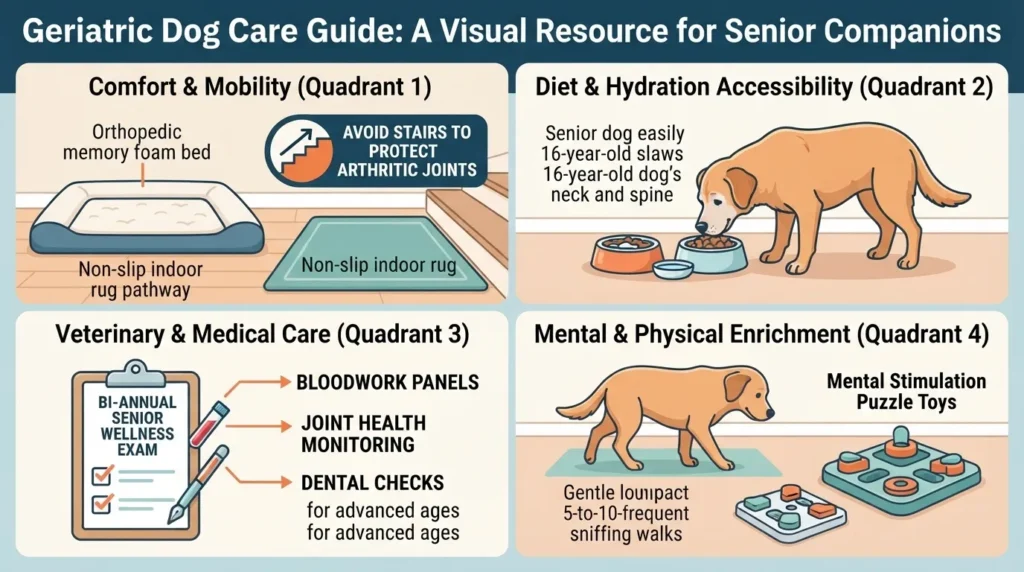
Caring for a 16-year-old geriatric dog requires shifting your focus from active maintenance to comfort, preservation, and high quality of life. At this advanced age, small adjustments to their daily routine can make a massive difference in how they feel.
Diet & Nutrition Adjustments
As dogs reach their mid-teens, their metabolism slows down, and their ability to absorb nutrients decreases. To support their aging bodies, consider the following dietary tweaks:
High-Quality, Easily Digestible Protein: Senior dogs actually need highly digestible protein to prevent muscle wasting (sarcopenia). Look for foods explicitly formulated for senior or geriatric dogs where whole meat is the first ingredient.
Caloric Management: Monitor their weight closely. Some 16-year-old dogs become prone to obesity due to inactivity, which strains arthritic joints. Conversely, many geriatric dogs lose interest in food and drop weight too fast.
Hydration and Texture: Kidney function often declines at this stage. Adding warm water, bone broth (low sodium), or transitioning to wet food can boost their hydration and make chewing much easier on sensitive older teeth.
Vet Checkup Frequency (Senior/Geriatric Dogs)
When a dog reaches 16, waiting a full year between veterinary visits is equivalent to a 90-year-old human avoiding a doctor for nearly a decade.
The Semi-Annual Rule: You should transition to veterinary checkups at least every six months.
What These Visits Focus On: These bi-annual appointments aren’t just for routine vaccines. Your vet will focus on comprehensive blood screenings to monitor liver and kidney function, checking for early signs of arthritis pain, and screening for cognitive dysfunction.
Early Detection: Because health issues can escalate rapidly in a geriatric dog, catching a subtle shift in lab work during a 6-month checkup can easily add months or years of comfortable life to your dog’s timeline.
Mobility & Comfort Support (Joint Care & Bedding)
Physical comfort is the single most important factor in maintaining your 16-year-old dog’s happiness. Chronic joint wear affects almost every dog at this milestone.
Orthopedic Bedding: Ditch the standard poly-fill pet beds. Your dog needs a true, high-density memory foam orthopedic bed. This supports their aching joints, prevents painful pressure sores from forming on their hips and elbows, and makes it physically easier for them to stand up.
Home Environment Tweaks: Prevent dangerous slips by placing non-skid rugs, yoga mats, or interlocking foam tiles over hardwood, laminate, or tile floors. If your dog still likes to join you on the couch or bed, invest in sturdy pet ramps to prevent joint-jarring jumps.
Targeted Joint Support: Consult your veterinarian about introducing joint supplements containing Glucosamine, Chondroitin, and Omega-3 fatty acids (like green-lipped mussel or high-quality fish oil) to reduce inflammation. For advanced stiffness, ask your vet about targeted senior pain management options to keep them moving comfortably.
Frequently Asked Questions
Yes, 16 is considered very old even for small breeds. While toy and small dogs live the longest, a 16-year-old small dog has comfortably entered its geriatric years, which is roughly equivalent to a human in their late 70s or early 80s.
The official world record for the oldest dog belongs to an Australian Cattle Dog named Bluey, who lived to be 29 years and 5 months old. For modern household pets, reaching anywhere between 15 to 20 years is generally considered the upper limit of canine longevity.
Absolutely. Breed directly dictates a dog's adult size and genetic predispositions, which alters their biological timeline. For example, smaller breeds like Chihuahuas mature quickly but age much slower, whereas larger breeds like Mastiffs mature slower initially but face accelerated cellular aging later in life.
Online calculators are great estimates, but they are not 100% precise. While modern size-based calculators are much more accurate than the old "multiply by 7" rule, they cannot factor in your specific dog's genetics, individual lifestyle, diet, and history of medical care
🐾 Other Age Guides
What Is 6 Dog Years in Human Years
Read More →
What Is 14 Dog Years in Human Years
Read More →
What Is 7 Dog Years in Human Years
Read More →
What Is 3 Human Years in Dog Years
Read More →