
At What Age Is a Golden Retriever Full Grown? Complete Growth Timeline
Golden Retrievers typically reach their full adult height between 12 and 14 months of age, but they aren’t fully physical adults just yet. Most Goldens need 18 to 24 months to fill out completely, broadening in the chest, building thick muscle mass, and growing their full adult coat.
If your 10-month-old pup looks like a leggy, lanky teenager right now, don’t panic. That awkward phase is a completely normal part of their biological development. The exact timeline always varies depending on your dog’s sex, genetics, and whether they come from a field-bred or show-bred line.
Golden Retriever Growth Stages Puppy to Full Adult
A Golden Retriever goes through four distinct development phases before reaching full physical maturity at around two years old. Tracking these growth milestones helps you provide the right nutrition and exercise levels at every stage.
0–3 Months — Newborn to Early Puppy Stage
This stage is marked by explosive growth. A Golden Retriever puppy usually gains around 1 to 2 pounds per week during this period, starting from a tiny 1-pound newborn to a playful 15 to 25-pound puppy by week 12.
Soft bones and developing joints: Your puppy’s growth plates are wide open and extremely soft. High-impact jumping or long walks on hard surfaces can cause permanent joint damage. Keep playtime gentle on carpet or grass.
Frequent feeding schedule: Because their stomachs are small and their metabolic rate is fast, 8-to-12-week-old puppies need three to four small meals a day of high-protein puppy food.
Real-world sign: If your 10-week-old Golden looks clumsy, with paws that seem way too big for its body, that is completely normal. The limbs often grow faster than the torso during this initial spurt.
3–6 Months — Fastest Growth Spurt Phase
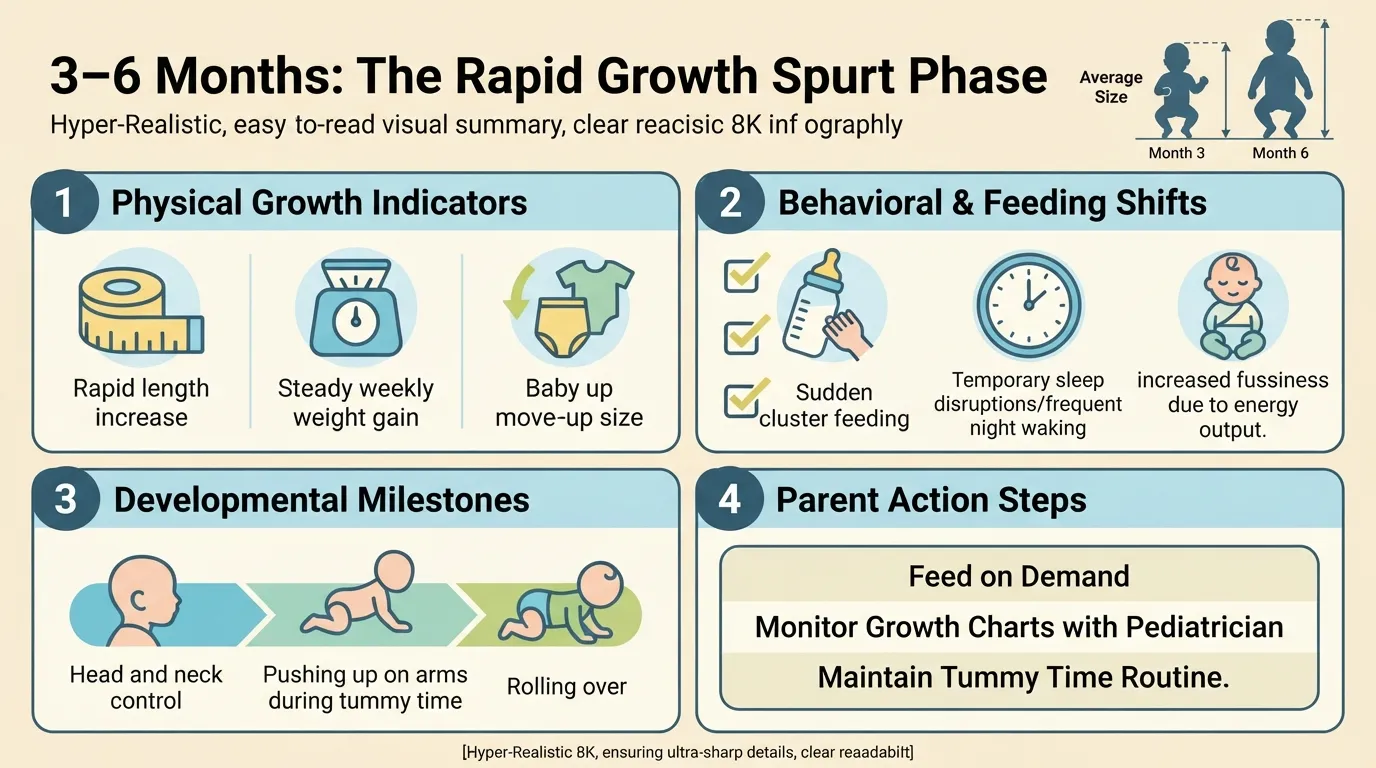
Golden retriever puppies is age bracket mein rocket ki tarah badhte hain. Aapko lagta hoga ke aapne kal hi to usko feed kiya tha, aur aaj woh phir se bhookha hai aur thoda lamba lagne laga hai. Yeh woh phase hai jahan bone growth sabse tezi se hoti hai, isliye is waqt unka lanky ya thoda awkward dikhna bilkul normal hai. Unke paon bade lagte hain kyunki body abhi catch up kar rahi hoti hai.
Isi dauran unke baby teeth gir kar adult daant aana shuru ho jate hain. Aap notice karoge ke woh har cheez chabane ki koshish karta hai, isliye chew toys ready rakho warna aapke joote khatre mein hain. Saath hi, unka soft puppy coat dheere-dheere badalna shuru hota hai aur thoda dense outer coat aane lagta hai.
Height is dauran sabse rapidly badhti hai. Agar aapko lage ke aapka pup ekdum se lamba ho gaya hai, to aapka andaza bilkul theek hai. Bas yaad rakho ke is fast growth phase mein unke joints par zyada stress mat dalne do, jaise unhe hard pavement par lambi daud lagane ya high jumps karne se roko taaki unka skeletal system healthy rahe.
12–18 Months — Near-Adult Height
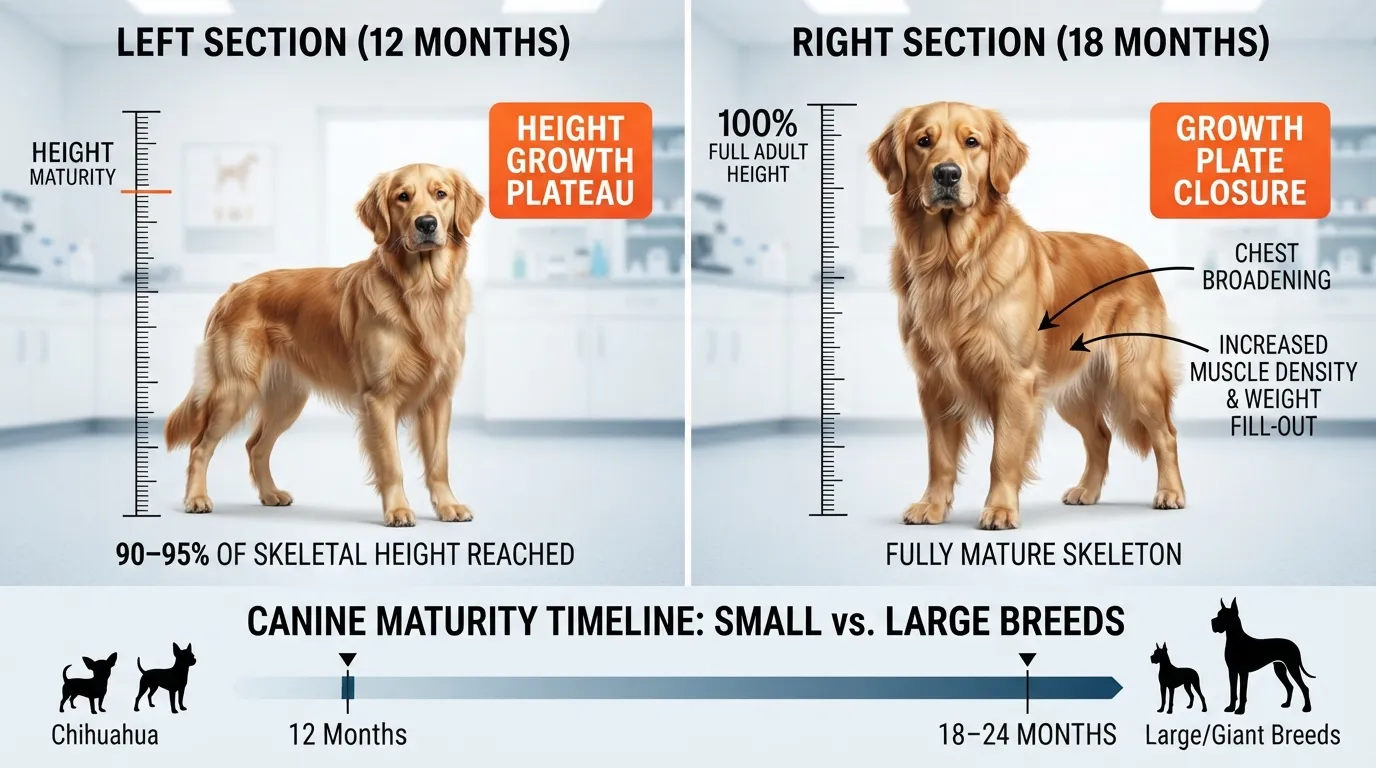
By the time your Golden Retriever hits 12 months, they’ve usually reached about 90% to 95% of their full adult height. Stand them next to a fully mature dog, though, and you’ll immediately notice they still look a bit lean or lanky. That typical “awkward teenager” phase is completely normal at this age.
Between 12 and 18 months, vertical growth slows down significantly while physical filling-out takes over:
Height completion: Males usually settle around 23–24 inches at the shoulder, while females cap out around 21.5–22.5 inches.
Chest expansion: The chest deepens and broadens, and muscle mass develops across their shoulders and hindquarters.
Coat transition: The soft, fuzzy puppy fluff fully sheds out to make way for a denser, water-resistant adult double coat with longer feathering on the legs and tail.
If your 14-month-old Golden still looks thin despite eating well and staying active, don’t rush to increase their food portions. Frame size stops expanding first; the muscle density and broad chest frame simply take another few months to catch up naturally.
18–24 Months — Full Physical Maturity
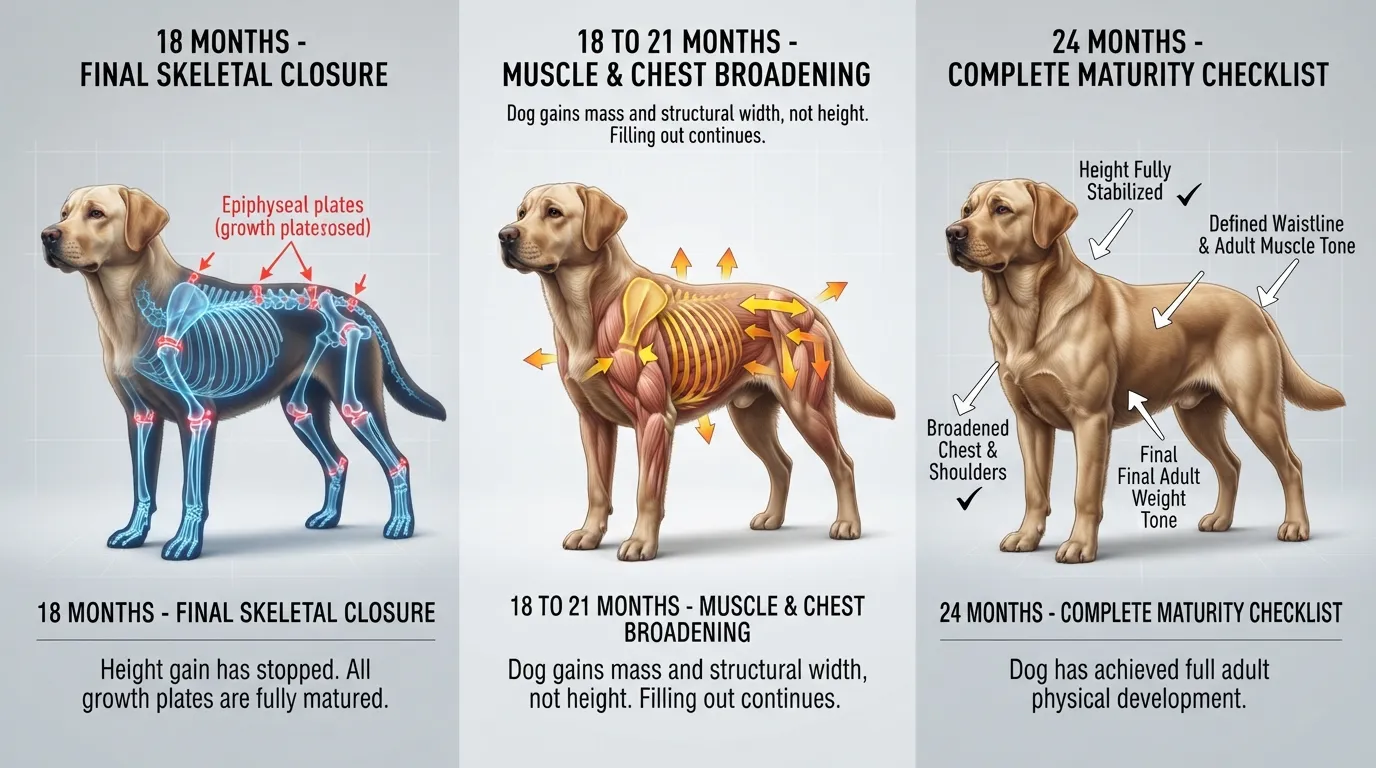
By the time your Golden Retriever hits the 18 to 24-month mark, their long bone growth plates have officially closed. This means your dog has reached their absolute final adult height—typically 23–24 inches for males and 21.5–22.5 inches for females.
If you notice your 18-month-old suddenly looks broader without actually getting any taller, don’t worry. This final stretch is all about “filling out” rather than growing up.
Here is what happens during this final physical milestone:
Complete Bone Density: Skeleton development finishes, giving your dog their solid, sturdy frame.
Chest and Shoulder Expansion: The ribcage deepens and the shoulders broaden, removing that awkward, gangly puppy look.
Final Body Proportions: The head, legs, and torso reach their permanent balanced ratio.
Around 20 months, many Golden Retrievers experience a noticeable shift in their build. They transition from that lean, leggy teenage phase into the classic, deep-chested retriever silhouette. Their coat also reaches its full thickness and feathering during this stage, completing their adult transformation.
Male vs Female Golden Retriever — Key Growth Differences
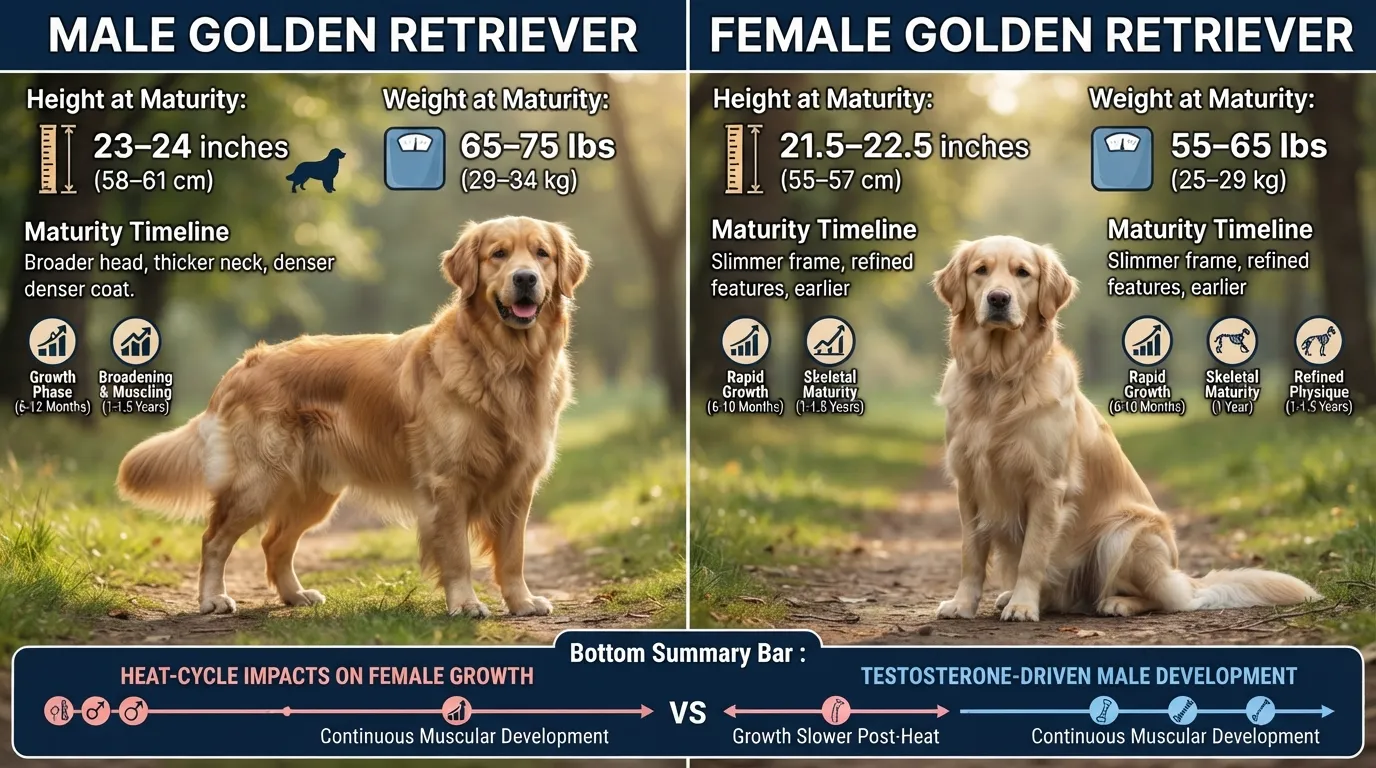
Male and female Golden Retrievers develop on slightly different schedules, particularly when it comes to filling out and reaching their final physical appearance. While both sexes hit their adult height around the same time, males usually take noticeably longer to gain their adult muscle mass and deep chest.
Females reach maturity faster: Females generally reach their full size and coat density between 16 and 18 months. By this point, their framework is complete and their overall look stays fairly consistent.
Males take up to two years: While a male Golden usually hits his final height by 12 to 13 months, his chest continues to widen and his muscular build develops until he is around 24 months old.
If you notice a 14-month-old male looking a bit lanky or awkward compared to a female of the same age, that is completely normal. He is simply in that adolescent phase where his frame is tall, but his muscles haven’t caught up yet.
Keep in mind that lineage also plays a role in their appearance. Field-line Goldens remain leaner and lighter-boned than show-line Goldens regardless of sex, but their underlying growth timelines remain identical.
Golden Retriever Growth Chart Weight & Height — lbs/kg + inch/cm
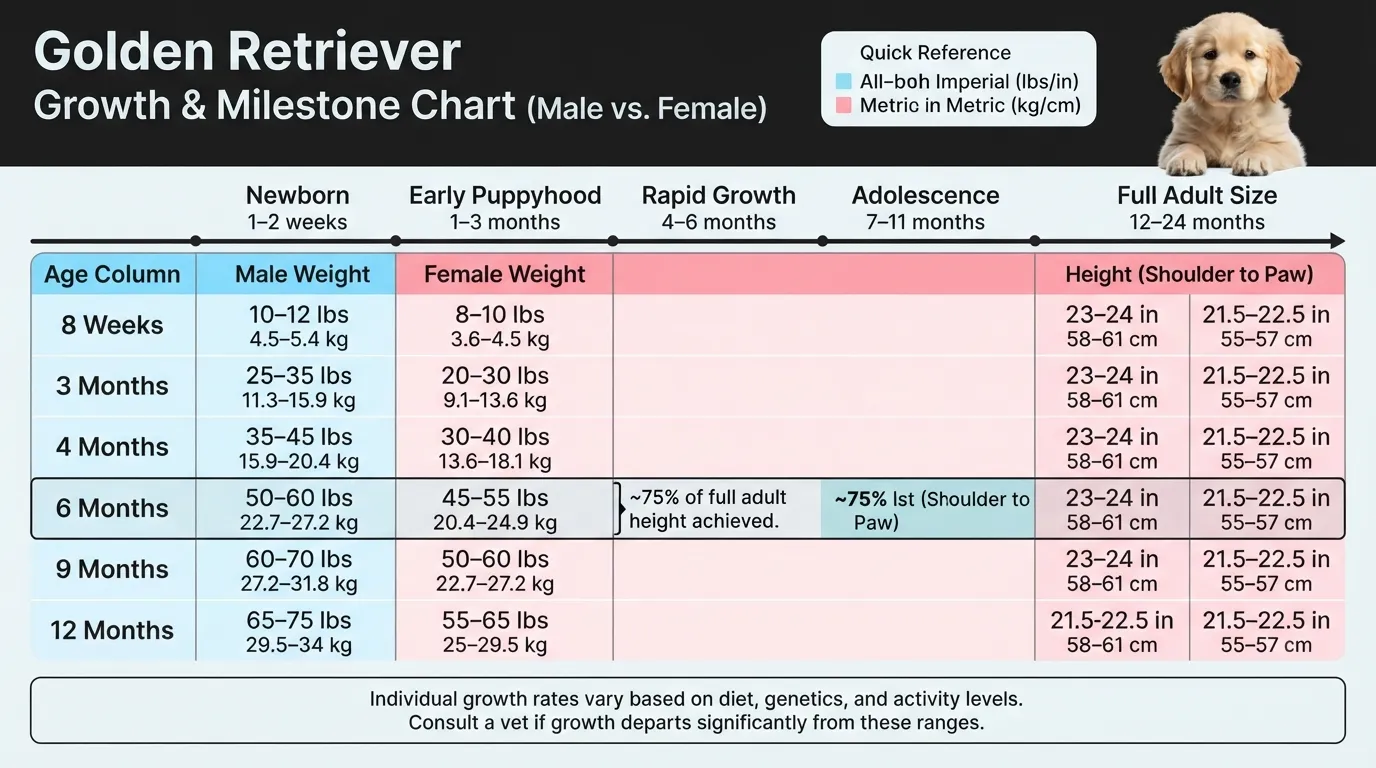
Golden Retriever puppies fast grow karte hain, lekin male aur female dogs ki growth trajectory mein thoda farq hota hai. Har puppy ek jaisa grow nahi karta — genetics, diet, aur overall health plays a huge role. Below month-by-month breakdown di gayi hai taake aap track kar sakein ki aapka puppy sahi path par hai ya nahi.
Male Golden Retriever Growth Chart
Male Golden Retrievers females ke mukabla thode heavy aur taller hote hain. Unka frame pehle 6 months mein bohot tezi se stretch hota hai.
| Age | Weight (lbs) | Weight (kg) | Height (inches) | Height (cm) |
|---|---|---|---|---|
| 2 Months | 10 – 15 lbs | 4.5 – 6.8 kg | 9 – 11 in | 23 – 28 cm |
| 3 Months | 20 – 26 lbs | 9.0 – 11.8 kg | 12 – 14 in | 30 – 35 cm |
| 4 Months | 30 – 35 lbs | 13.6 – 15.9 kg | 15 – 17 in | 38 – 43 cm |
| 5 Months | 40 – 45 lbs | 18.1 – 20.4 kg | 18 – 20 in | 45 – 51 cm |
| 6 Months | 50 – 55 lbs | 22.7 – 25.0 kg | 21 – 22 in | 53 – 56 cm |
| 9 Months | 60 – 68 lbs | 27.2 – 30.8 kg | 22 – 23 in | 56 – 58 cm |
| 12 Months | 65 – 75 lbs | 29.5 – 34.0 kg | 23 – 24 in | 58 – 61 cm |
| Age | Weight |
|---|---|
| 2 Mo | 10–15 lbs (4.5–6.8 kg) |
| 3 Mo | 20–26 lbs (9.0–11.8 kg) |
| 4 Mo | 30–35 lbs (13.6–15.9 kg) |
| 5 Mo | 40–45 lbs (18.1–20.4 kg) |
| 6 Mo | 50–55 lbs (22.7–25.0 kg) |
| 9 Mo | 60–68 lbs (27.2–30.8 kg) |
| 12 Mo | 65–75 lbs (29.5–34.0 kg) |
| Age | Height |
|---|---|
| 2 Mo | 9–11 in (23–28 cm) |
| 3 Mo | 12–14 in (30–35 cm) |
| 4 Mo | 15–17 in (38–43 cm) |
| 5 Mo | 18–20 in (45–51 cm) |
| 6 Mo | 21–22 in (53–56 cm) |
| 9 Mo | 22–23 in (56–58 cm) |
| 12 Mo | 23–24 in (58–61 cm) |
Adult Size Standard — How Big Do Golden Retrievers Get
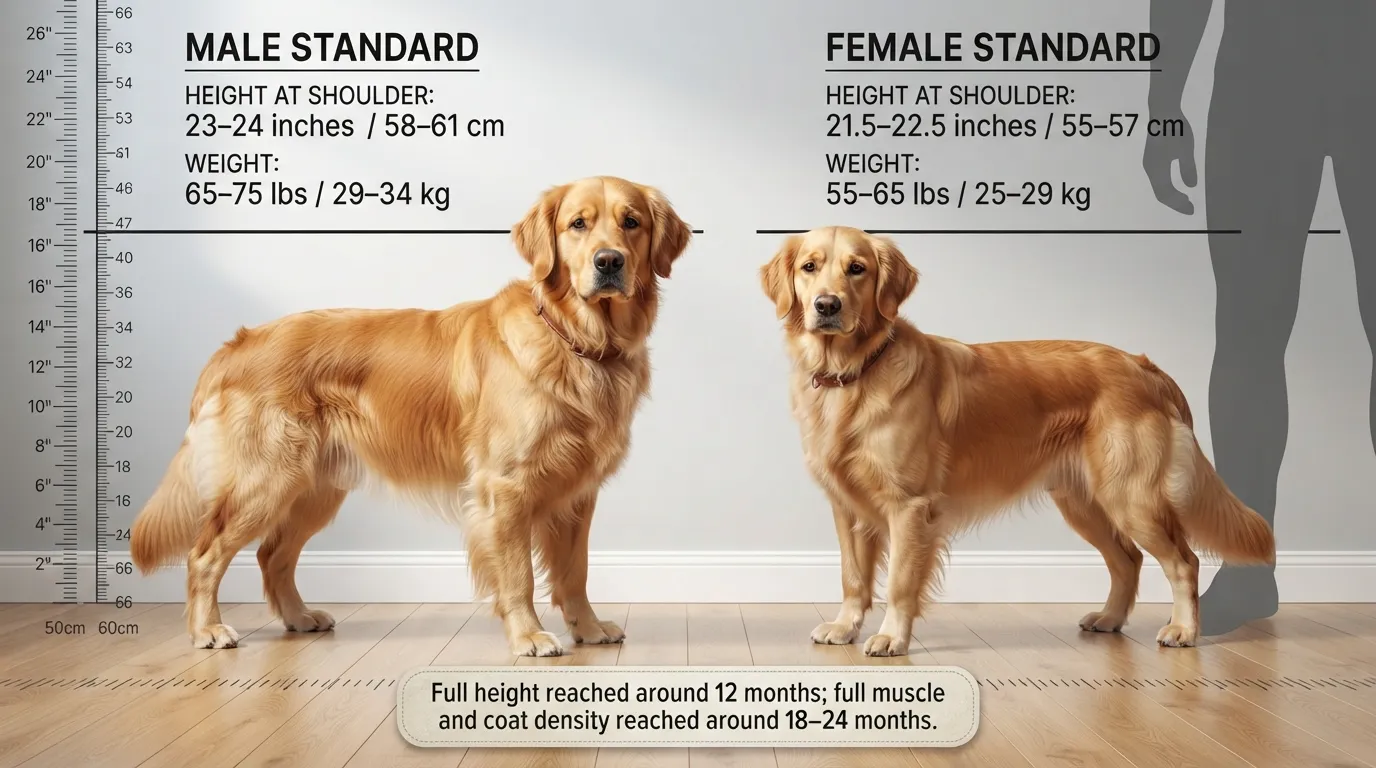
A fully grown Golden Retriever’s size depends heavily on its gender, with males naturally carrying a larger frame and more bone mass than females. According to official standards set by the American Kennel Club (AKC), here is what you can expect when your dog reaches full physical maturity:
Male Golden Retrievers: Height ranges from 23 to 24 inches at the shoulder, with a healthy adult weight between 65 and 75 pounds.
Female Golden Retrievers: Height ranges from 21.5 to 22.5 inches at the shoulder, with a healthy adult weight between 55 and 65 pounds.
Keep in mind that these numbers represent standard ranges for healthy working and show dogs. If your 14-month-old male weighs 62 pounds or your female sits closer to 68 pounds, it doesn’t automatically mean something is wrong. Frame size, genetics, and daily activity levels create natural variations.
The easiest way to tell if your dog is at a healthy adult weight is the rib test. You should easily feel their ribs under a light layer of skin without pressing hard, and they should have a visible tuck at the waist when viewed from above.
How to Tell If Your Golden Retriever Is Fully Grown
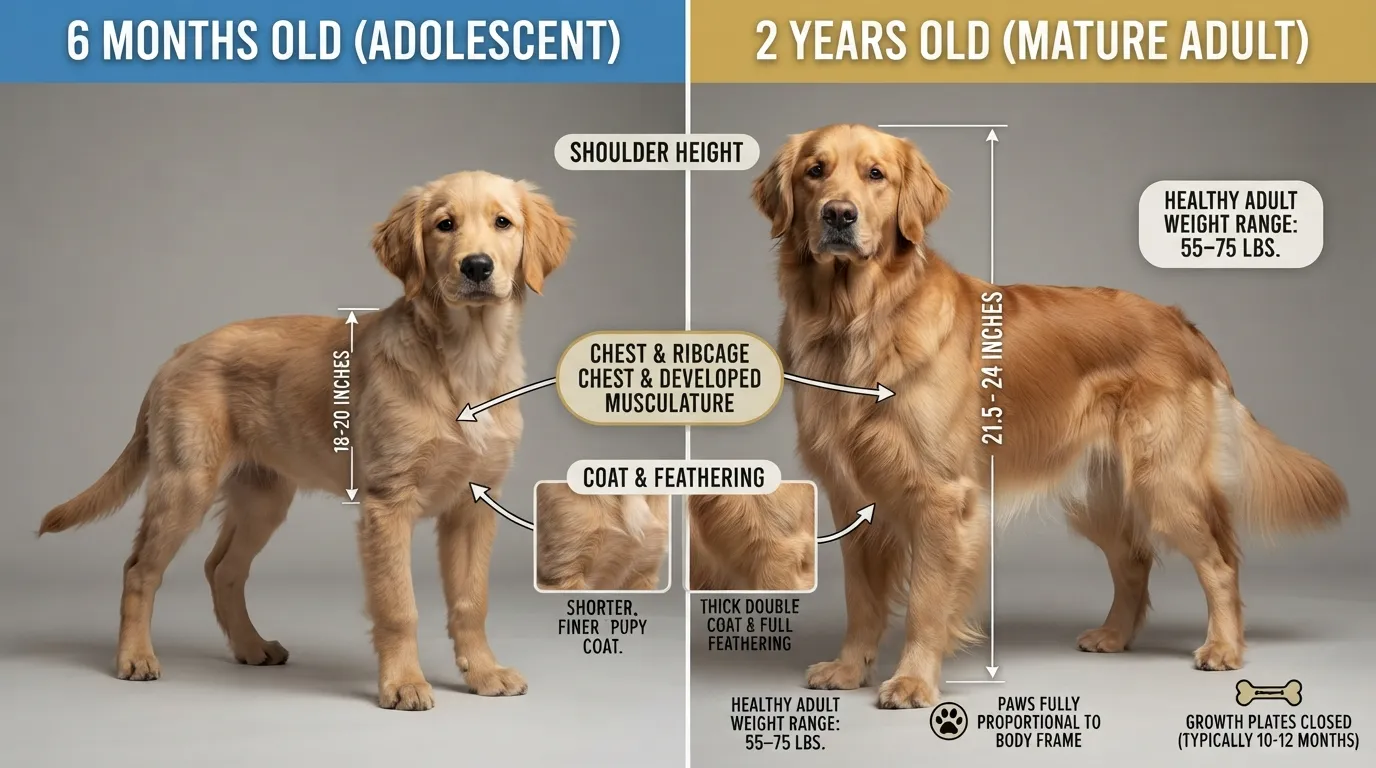
Determining whether your Golden Retriever has reached full physical maturity comes down to a few distinct physical and developmental markers. While every dog matures at a slightly individual pace, you can confirm your Golden is officially full-grown by watching for these clear signs:
Growth Plates Have Closed: The most definitive way to verify height maturity is through a routine veterinary X-ray. Growth plates—soft cartilage areas at the ends of long leg bones—harden into solid bone between 12 and 18 months of age, stopping further height increase.
Chest Has Filled Out: Young Goldens often pass through an awkward, “lanky” stage where their legs look too long for their body. Once physical growth finishes, their chest deepens and broadens, giving them a thick, well-proportioned front stance.
Ribs Are Feelable But Covered: Run your hands gently down your dog’s sides. In a fully mature, healthy Golden Retriever, you should be able to feel the ribs easily beneath a light layer of tissue without seeing them press sharply against the skin.
Weight Has Plateaued for 2–3 Months: Rapid weekly weight gains are standard during puppyhood. If your dog’s weight remains completely stable for two to three consecutive months on a steady adult diet, they have reached their final baseline size.
Complete Adult Double Coat: The thin, soft puppy fur transitions into a dense, water-repellent double coat featuring full feathering along the legs, tail, and neck chest area. The presence of this thick, coarse outer coat indicates their coat development is complete.
Why Your Golden Retriever Looks "Done" But Isn't
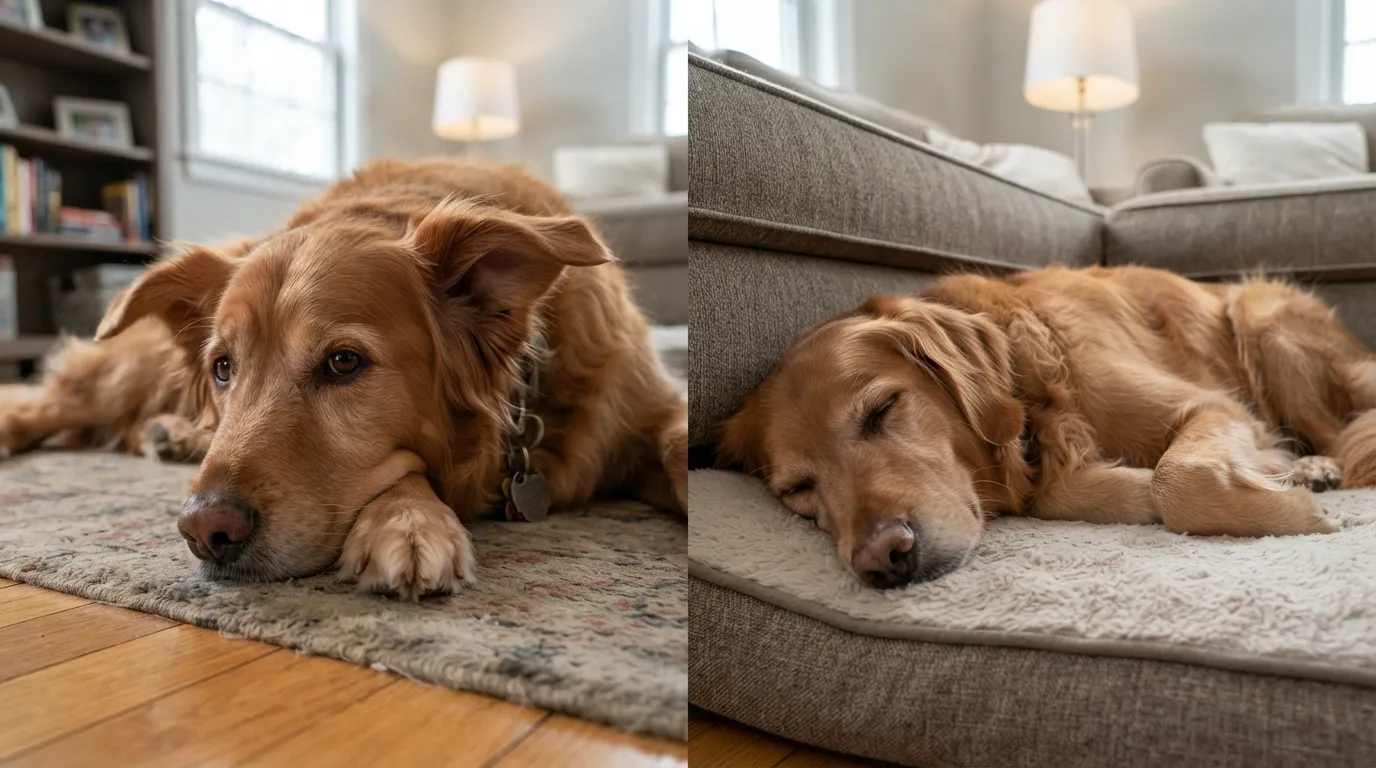
If your Golden Retriever has reached their full adult height, you might assume their growth journey is completely over. It’s a very common misconception. A 12-month-old Golden often stands as tall as they will ever get, but structurally, they are far from finished.
Physical maturity in Goldens happens in distinct phases rather than all at once:
Height vs. Frame: Skeletal height usually peaks between 10 and 12 months when the long bone growth plates close. However, muscle development, ribcage expansion, and chest widening continue well into their second year.
The Coat Timeline: That lush, signature double coat takes even longer to mature. While the puppy coat sheds around 6 months, the dense undercoat and adult feathering on the chest, legs, and tail often do not reach full thickness until 18 to 24 months.
If your 14-month-old Golden looks a bit lean or “lanky” with an awkward, sparse coat, do not panic. This leggy stage is completely normal while their body catches up to their frame.
Warning for Owners: A major mistake during this stage is assuming a lanky teenager is underweight and ramping up their daily food portions. Overfeeding a young Golden to “bulk them up” does not speed up muscle chest development—it simply adds excess fat, putting unnecessary stress on their developing hips and joints. Trust the natural timeline and keep their diet steady.
Growth Plates & Spay/Neuter Timing
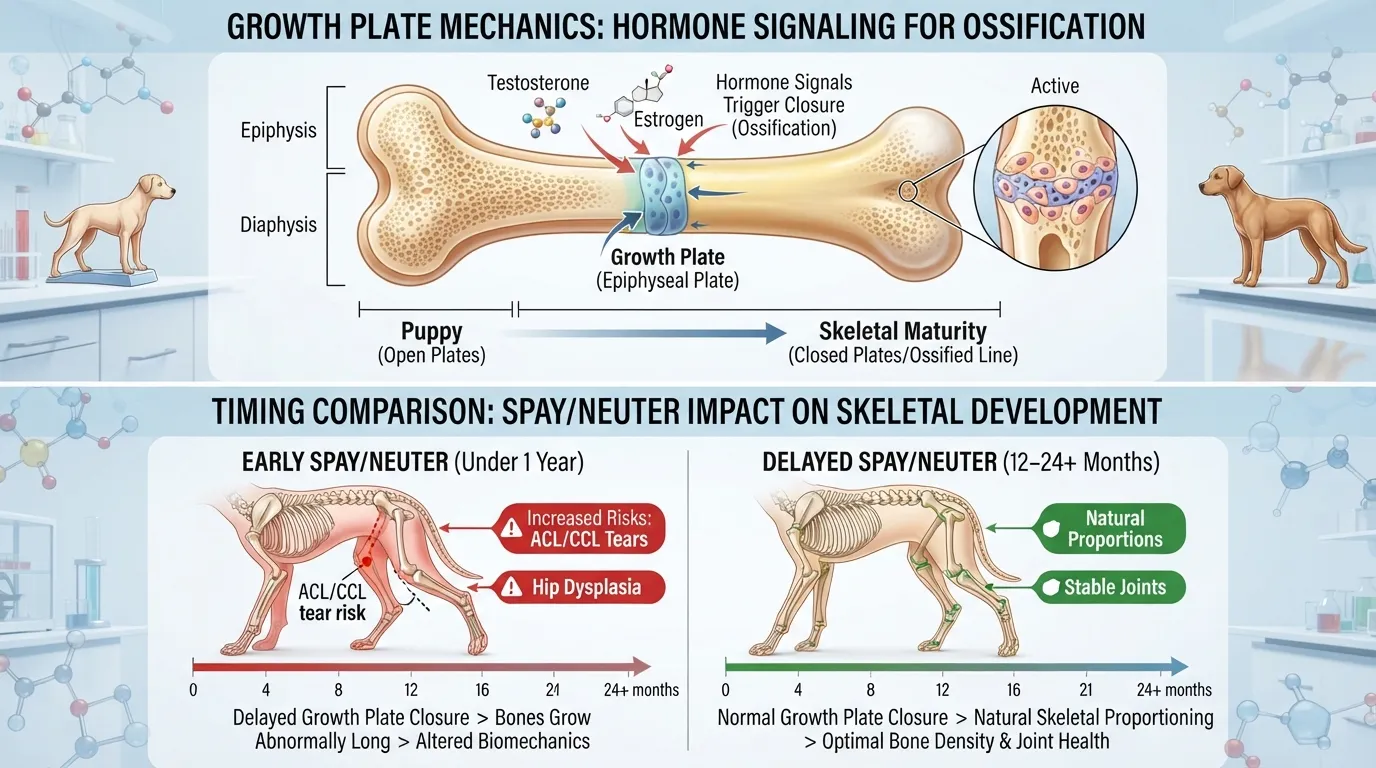
A Golden Retriever’s long bones grow from soft areas near the ends called growth plates (epiphyseal plates). These thin cartilage zones stay open while your pup is growing and gradually harden into solid bone, typically closing completely between 12 and 18 months of age.
Once these plates close, your Golden’s long bones stop growing in length, fixing their final frame height.
How Early Spay/Neuter Alters Height and Bone Structure
Desexing removes hormones like estrogen and testosterone, which signal growth plates to stop growing and close at the right time.
Spaying or neutering a Golden Retriever too early (before 12 months) alters this natural timing:
Delayed growth plate closure: Without adult hormone levels, the growth plates stay open longer than normal.
Taller, leggy frame: The leg bones keep lengthening past their genetic target size, making the dog slightly taller and narrower in the chest.
Altered joint angles: This extra leg growth shifts the dog’s natural weight distribution, which increases stress on ligaments and joint cartilage.
Real-World Observation: If you see a 14-month-old Golden Retriever with unusually long legs and a slim chest compared to its broader littermates, early neutering is often the primary reason for that lanky build.
Vet-Recommended Timing for Golden Retrievers
Veterinary health studies—including research from major veterinary institutions like Cornell University College of Veterinary Medicine—suggest waiting until your Golden Retriever reaches physical maturity before altering them.
For Males: Wait until at least 12 to 18 months. This gives their testosterone time to regulate bone closure, chest broadening, and muscle development.
For Females: Wait until after their first heat cycle, or until 12 to 15 months of age.
Delaying the procedure until the growth plates are fully closed helps maintain normal joint alignment and reduces long-term risks for conditions like hip dysplasia or cranial cruciate ligament (CCL) tears. Always coordinate with your veterinarian to pick the safest timeline based on your dog’s specific health, lifestyle, and bloodline.
Golden Retriever Size Variations
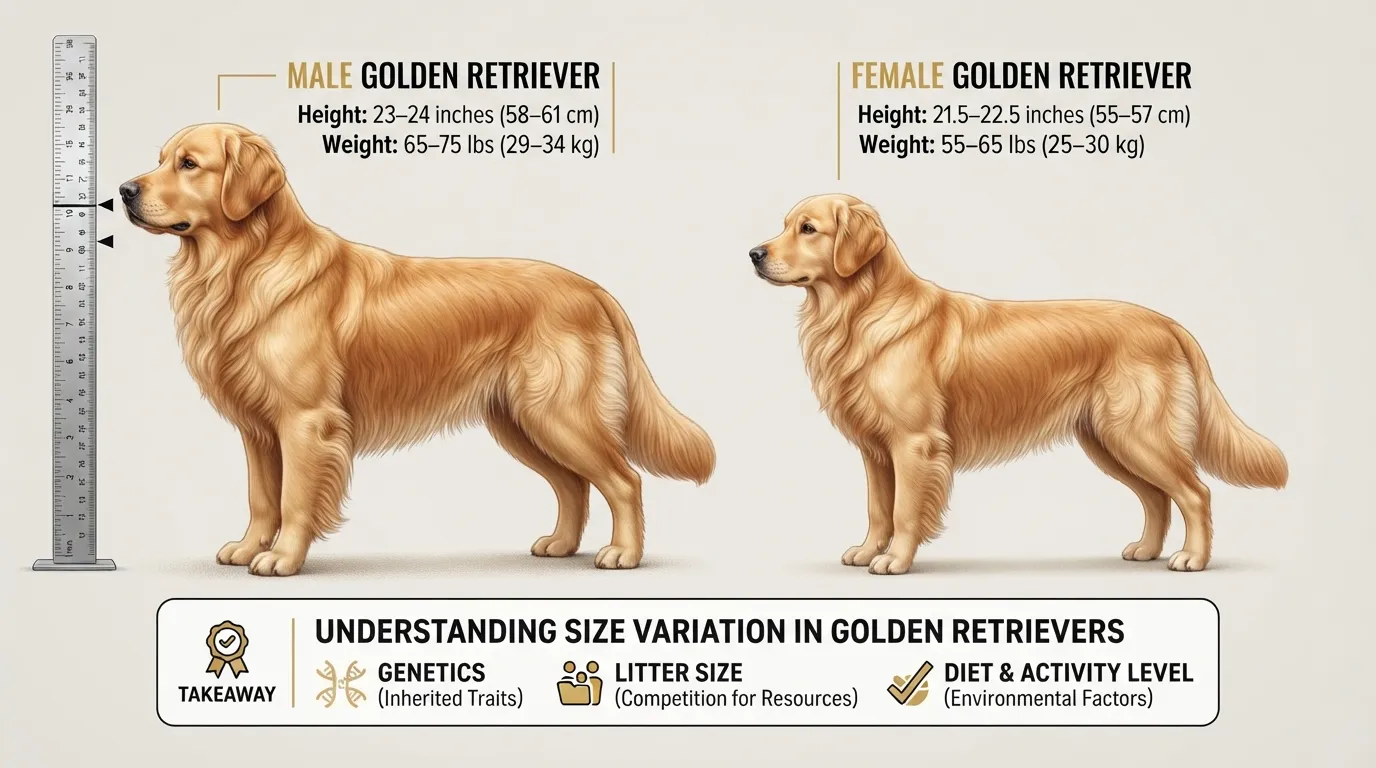
Golden Retrievers aren’t all cut from the same cloth when it comes to their final build. Genetics, breeding purpose, and bloodlines play a major role in how heavy or tall your dog ends up looking once fully mature. Understanding these variations helps set realistic expectations for your dog’s final frame.
Show-line vs Field-line
Show-line and field-line Golden Retrievers reach full maturity around the same time, but their adult structure looks completely different.
Show-Line (Conformation): Bred specifically to meet kennel club aesthetic standards. They carry a significantly heavier bone structure, broader skulls, deeper chests, and thicker coats. A mature show-line male often looks noticeably stockier and blockier, weighing toward the top of the standard breed weight spectrum (70–75 lbs).
Field-Line (Working): Bred for hunting, agility, and field work. They feature a much leaner, athletic, and high-clearance build with lighter boning. If your 14-month-old field Golden looks slimmer or less “fluffy” than the neighbor’s dog, that is entirely normal—their bodies are built for speed and endurance rather than heavy bulk.
English Cream Golden Retriever Size
Despite common marketing claims, “English Cream” Golden Retrievers are simply Golden Retrievers with a lighter coat color originating from European kennel standards.
Genetically, their physical size aligns directly with standard European show-lines. They are slightly stockier with a slightly wider head than American line dogs, but their overall height and weight ranges stay standard. Males typically reach 23–24 inches at the shoulder, while females stand at 21.5–22.5 inches. Don’t expect an English Cream to grow significantly larger or smaller just because of its cream-colored coat.
Feeding & Exercise During the Growth Phase
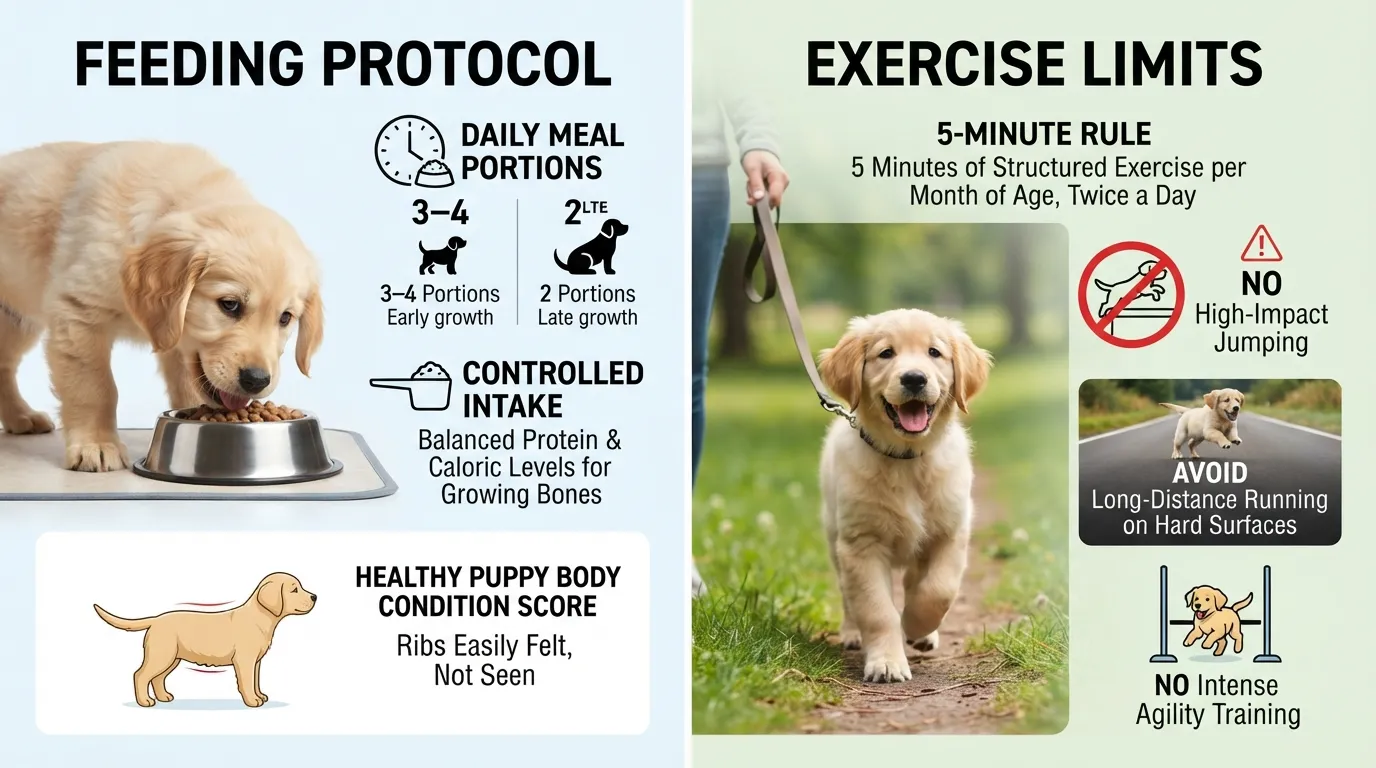
A Golden Retriever’s skeleton grows at a remarkable speed. To support this growth without damaging their developing joints, you need to align their daily calorie intake and exercise habits with their age.
Large-Breed Puppy Food Guidelines
Golden Retriever puppies shouldn’t eat standard puppy food. Regular puppy formulas often contain too much calcium and high calorie density, which can trigger rapid, unchecked growth spurts.
Controlled Growth Rate: Large-breed formulas balance calcium and phosphorus levels (ideally around 1.1% calcium to 0.9% phosphorus) to keep bone development steady rather than hyper-accelerated.
Joint Protection: High-quality options include glucosamine and omega-3 fatty acids (DHA) early on to support cartilage health.
Caloric Balance: These foods prevent excess weight gain, keeping unnecessary pressure off fragile growth plates.
If your 6-month-old Golden seems lean or gangly, resist the urge to overfeed them. Keeping a growing pup on the leaner side drastically lowers their risk of developing hip dysplasia later in life.
When to Switch to Adult Food
Most Golden Retrievers are ready to transition from large-breed puppy food to an adult formula around 12 to 14 months of age.
By 12 months, your dog’s height growth slows down significantly, and their nutrient requirements change. Switching too early deprives them of essential growth nutrients, while staying on puppy food past 15 months leads to quick weight gain.
Transition gradually over 7 to 10 days by mixing increasing amounts of adult food with their puppy food:
Days 1–3: 25% adult food, 75% puppy food
Days 4–6: 50% adult food, 50% puppy food
Days 7–9: 75% adult food, 25% puppy food
Day 10: 100% adult food
Safe Exercise Rule by Age
Growing joints and open growth plates are vulnerable to repetitive stress injuries. A safe, reliable baseline for exercising a young Golden is the “5-Minute Rule.”
The 5-Minute Rule: Provide 5 minutes of structured exercise per month of age, up to twice a day.
3 Months Old: 15 minutes max per session
6 Months Old: 30 minutes max per session
9 Months Old: 45 minutes max per session
Avoid high-impact activities—like long jogs on pavement, forced running, frisbee jumping, or steep stairs—until your Golden reaches 18 to 24 months. Their growth plates are fully closed by this time, meaning their skeleton can finally absorb heavier impacts without long-term joint damage. Stick to casual yard play and gentle walk-and-sniff outings during those early months.
Factors That Affect Growth Speed

Every Golden Retriever develops on its own timeline, and two pups from the same litter often reach adult size months apart. While most Goldens hit their full height around 12 months, several key biological and lifestyle variables determine how quickly your pup fills out.
Genetics and Parents’ Size: Genetics set the ultimate blueprint for your Golden’s final stature. Males typically inherit the larger frame of sire lines (often reaching 65–75 lbs), while females lean toward dam proportions (55–65 lbs). If both parents are on the smaller side of the breed standard, your pup will likely follow that slower, smaller trajectory.
Diet Quality and Caloric Intake: Proper nutrition dictates the pace of skeletal formation. Feeding a premium, large-breed puppy kibble ensures a balanced calcium-to-phosphorus ratio, promoting steady bone elongation. Rapid growth spurred by overfeeding creates structural stress—a 6-month-old Golden should look slightly lean, not heavy or round.
Spay and Neuter Timing: Sex hormones signal the growth plates in long bones to close. Pediatric spaying or neutering (done before 6 months) delays this closure, allowing the leg bones to keep growing longer than nature intended. This often results in a taller, rangier Golden with a narrower chest compared to one fixed after physical maturity (around 12–18 months).
Health Conditions and Weight Management: Health issues like severe intestinal parasites can stunt early development by stealing essential nutrients. Conversely, overfeeding to jumpstart growth heavily increases the risk of hip and elbow dysplasia. Excess body weight places unearned strain on soft, developing joint cartilage, leading to lifelong mobility issues.
Golden Retriever Growth Stages vs Human Age
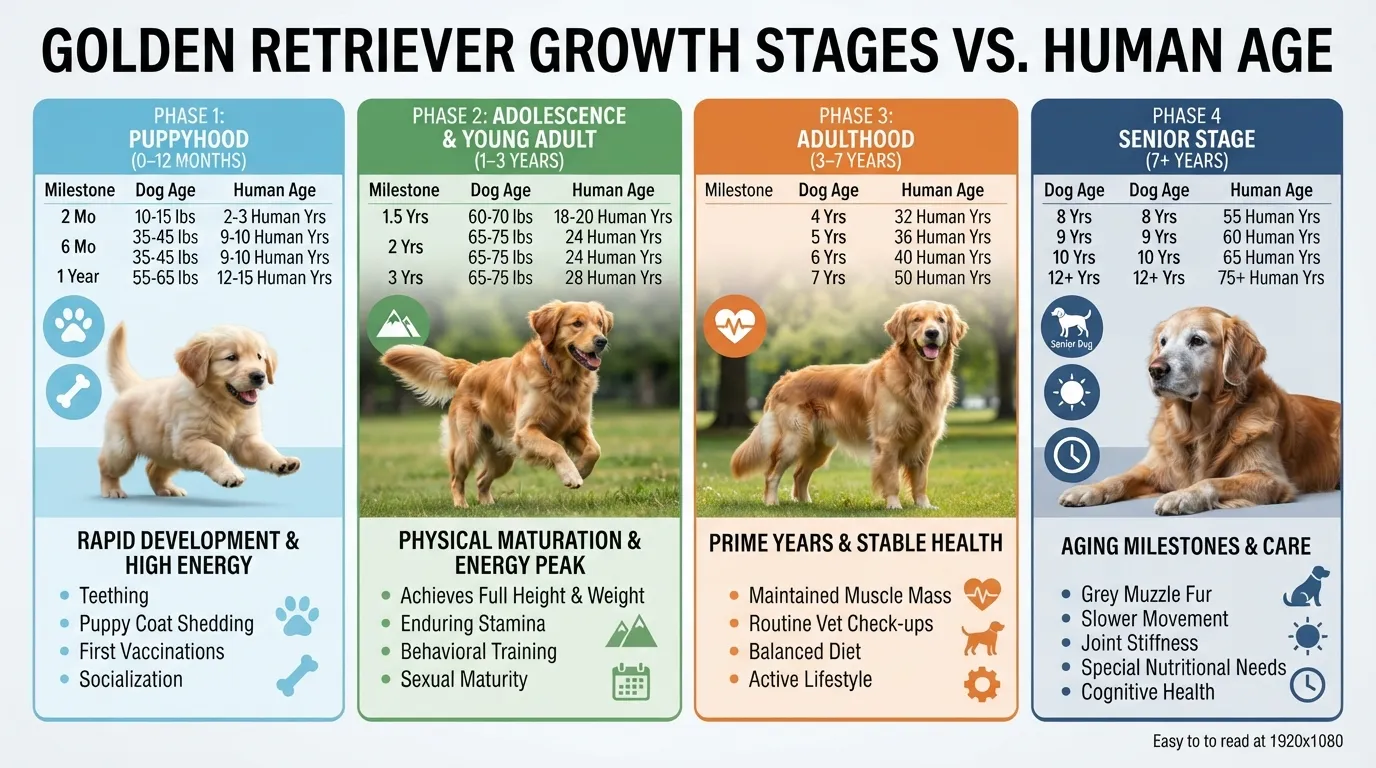
A 6-month-old Golden Retriever acts like a wild toddler, while a 15-month-old feels suspiciously like a moody teenager. Understanding how your dog’s physical and mental maturity maps to human years helps explain why a 1-year-old pup still chews your favorite shoes despite physically looking like a grown dog.
Here is how a Golden Retriever’s growth stages align with human life stages:
Puppy Stage (0–6 Months): Equivalent to a human toddler (1–5 years old). Growth during this phase is incredibly rapid. Your pup gains roughly 1.5 to 2 pounds every week, building the basic bone structure needed for adulthood.
Adolescent Stage (6–18 Months): Equivalent to a human teenager (12–18 years old). By 12 months, most Goldens reach 90–95% of their full adult height, but their brains are still catching up. Expect high energy, occasional boundary-testing, and a distinctly lanky appearance as their frame fills out.
Adult Stage (2 Years and Beyond): Equivalent to a human in their early-to-mid 20s. Bone growth plates fully fuse around 12–14 months, but chest muscles, neck width, and thick coat density continue developing until roughly 24 months.
Traditional wisdom says 1 dog year equals 7 human years, but large breeds like Golden Retrievers develop much faster in their first two years before their aging rate steadies.
My Golden's Growth Seems Too Slow or Too Fast — Should I Worry?
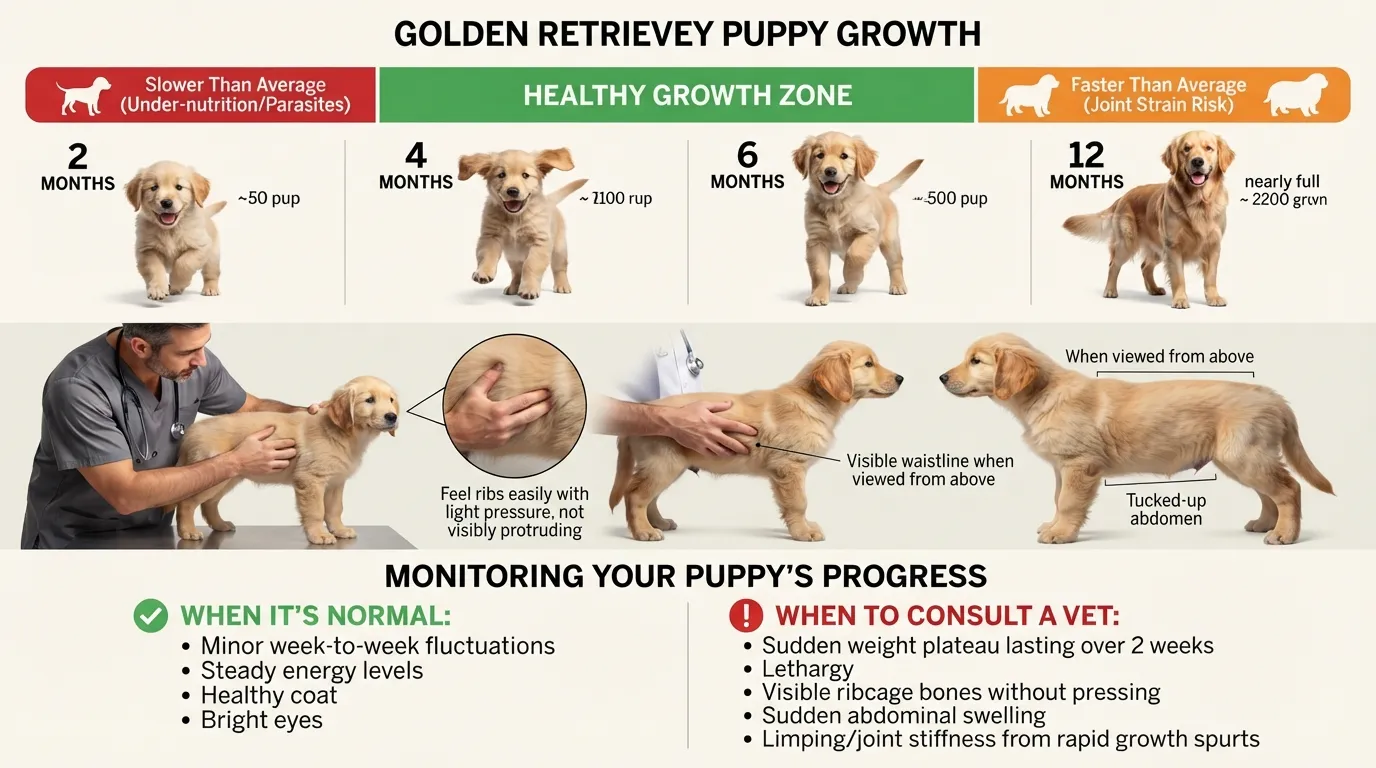
Most growth speed worries come down to one simple truth: Golden Retrievers rarely grow in a straight, predictable line. One month your puppy looks like a compact little bear, and the next, they have impossibly long legs and a thin frame.
Panic usually sets in when owners compare their pup to a neighbor’s Golden or an online photo. However, sudden lanky phases and temporary growth pauses are standard milestones in a Golden’s journey to full size.
Kab Ye Normal Hai
Your Golden Retriever’s body puts its energy into different places at different times. Up until around 6 to 8 months, height increases rapidly while muscle mass lags behind. This awkward “teenage” phase often makes a perfectly healthy puppy look surprisingly skinny or undersized.
Here is when you can relax:
The 8 to 10-month lanky phase: Your puppy looks tall, leggy, and thin despite eating well and acting energetic.
Minor weight plateaus: Growth slows down naturally around 9 to 12 months as bone height caps out before muscle filling begins.
Genetic variations: Working-line Goldens are naturally leaner and lighter than show-line Goldens. A 55-pound female at 12 months can be completely healthy if her parents were small.
High energy levels: If your Golden is playful, alert, and running around comfortably, a temporary slow patch in weight gain is rarely a concern.
A good rule of thumb: run your hands along their sides. You should easily feel their ribs under a thin layer of fat without seeing bones protruding sharply.
Kab Vet Consult Zaroori Hai
While uneven growth is typical, drastic deviations can point to underlying health issues like intestinal parasites, hormonal imbalances, or early joint stress. Accelerated growth is just as risky as stunted growth, as gaining weight too quickly puts intense pressure on developing joints and cartilage.
Schedule a veterinary visit if you spot these specific red flags:
Visible ribs and spine: The bones are clearly visible from a distance, or the waist tuck looks severely sunken.
Rapid over-fatness: You cannot feel the ribs at all, and your pup lacks a visible waistline when viewed from above (an indicator of accelerated growth that risks hip dysplasia).
Limping or stiffness: Your Golden struggles to get up, hesitates on stairs, or shows a noticeable limp after playing.
Persistent digestive issues: Chronic loose stools or frequent vomiting lasting more than 48 hours, which prevents proper nutrient absorption.
Complete growth standstill before 6 months: A puppy that stops gaining height or weight entirely during their primary early growth phase.
If you are ever unsure, bring your pup’s monthly weight record to your veterinarian. They can plot the numbers on a standardized canine growth curve to confirm whether your Golden is tracking safely along their natural genetic timeline.
Common Myths About Golden Retriever Growth
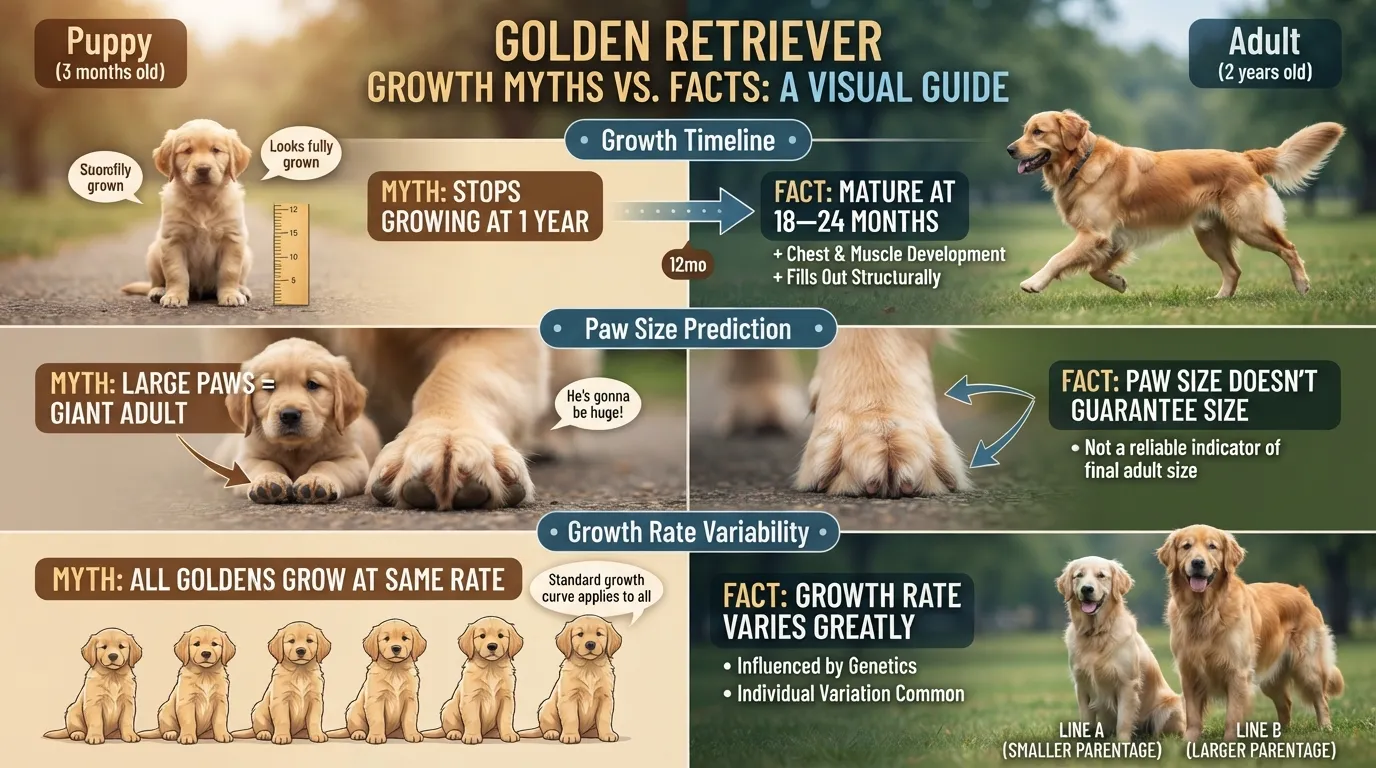
Misleading advice about dog growth circulates everywhere, especially in online forums and local dog parks. Understanding what is actually true saves you from unnecessary stress and wrong expectations about your puppy’s final size.
Myth 1: Giant Paws Guarantee a Massive Adult Dog
Many people look at a 4-month-old Golden Retriever with oversized, floppy paws and assume they are raising a future giant. While large paws mean a puppy still has plenty of growing left to do, they do not give an exact measurement of ultimate height or weight.
Puppies often grow asynchronously, meaning their feet and joints might hit a growth spurt weeks before the rest of their body catches up. Genetics, parent size, and overall bone structure dictate final dimensions far more than paw scale at a few months old. If your 5-month-old Golden looks like he is walking in oversized boots, he is simply in an awkward transitional phase.
Myth 2: A Broad Head Means a Bigger Overall Frame
Another frequent misconception is that a wider skull or prominent blocky head early on signals an overall massive adult dog. Golden Retriever heads develop on their own timeline, with males naturally developing broader skulls than females due to testosterone as they reach sexual maturity around 12 to 18 months.
Head shape reflects sex traits and lineage—such as Show vs. Field lines—rather than total body mass. A field-line Golden can have a slightly sleeker head while weighing a solid 70 pounds, whereas a show-line dog might feature a distinct blocky skull without being taller or heavier overall.
Myth 3: Stopping Height Growth Means Your Golden is Done Growing
Assuming a Golden Retriever is fully grown just because their vertical height levels off around 12 months is one of the most common mistakes owners make. Height growth plates usually close between 10 and 12 months, but skeletal height is only the first phase of complete physical development.
Between 12 and 24 months, Goldens go through a “filling out” phase where they gain lean muscle mass, widen through the chest, and develop their full coat density. If your 14-month-old looks unusually lanky or slender despite hitting their full height, do not worry or overfeed them—they are simply building adult muscle and chest depth at a natural pace.
Physical vs Behavioral Maturity — When Do Goldens Calm Down?
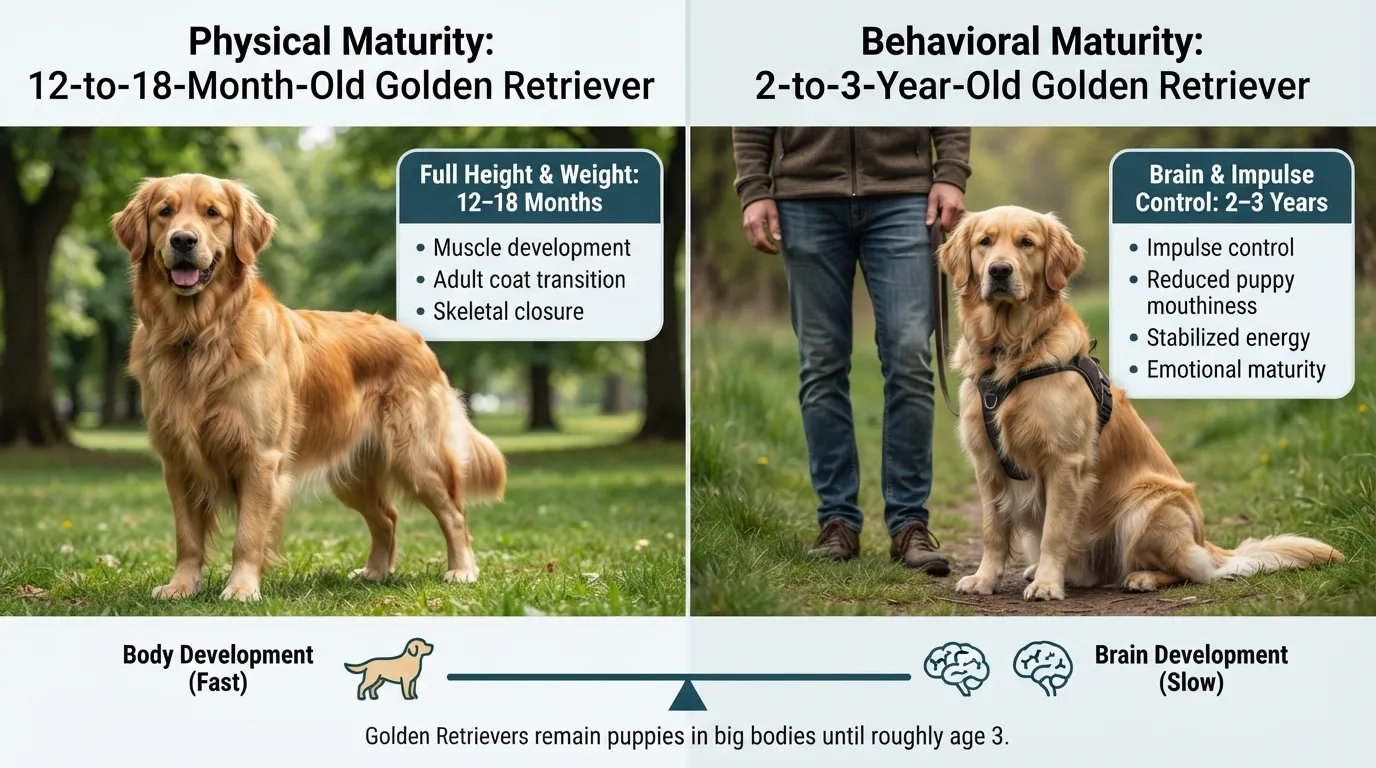
Your Golden Retriever will hit their full physical height and adult weight between 12 and 24 months, but their brain takes a bit longer to catch up. Mental and behavioral maturity usually arrives between 2 to 3 years of age. Until then, you essentially have a 70-pound puppy with limitless energy and an endless desire to fetch.
The transition from hyperactive pup to calmer adult happens gradually rather than overnight. Around the 18 to 24-month mark, most owners notice a subtle shift. Your dog will still get excited when guests walk through the door, but they will bounce off the furniture for five minutes instead of forty-five.
Here is what changes as your Golden Retriever mentally matures:
Lower baseline energy: They stop treating every single waking second as play time and learn how to settle down independently.
Better impulse control: Counter surfing, excessive mouthing, and jumping on people drop off significantly with consistent training.
Longer attention span: Focus during training sessions improves, making complex commands easier to teach.
If your 10-month-old Golden is zooming through the living room or shredding cardboard boxes, take a deep breath. They aren’t broken, and they aren’t going to be this high-strung forever. Daily mental stimulation—like puzzle toys, scent work, or structured heel walking—helps drain that remaining puppy energy far better than physical exercise alone while you wait for that brain maturity to lock in.
Frequently Asked Questions
| Question | Answer |
|---|---|
| At what age is a Golden Retriever fully grown? | Golden Retrievers typically reach full height by 12 months and fill out to their adult weight and frame between 18 and 24 months. |
| Do Golden Retrievers grow after 1 year? | Yes. While they reach most of their height by 1 year, they continue to gain muscle mass and broaden in the chest until around 2 years of age. |
| When do Golden Retrievers stop growing in height? | Most Golden Retrievers stop growing in height between 9 to 12 months old, after which their bone growth plates close. |
| How big will my Golden Retriever get? | Adult males usually reach 65–75 lbs (29–34 kg) and 23–24 inches tall. Adult females generally reach 55–65 lbs (25–29 kg) and 21.5–22.5 inches tall. |
| Why does my Golden Retriever still look skinny at 1 year? | It is normal for 1-year-olds to go through an "lanky" adolescent phase while their frame catches up to their height before filling out in muscle and coat density. |
| Is 2 years old considered fully grown for a Golden Retriever? | Yes, at 2 years old, a Golden Retriever is considered fully grown both physically (height, weight, coat density) and mentally mature. |
| Do male Golden Retrievers get bigger than females? | Yes, male Golden Retrievers are typically 10–15 lbs heavier and 1–2 inches taller than females on average. |
Comments