
What Is 11 Human Years in Dog Years?
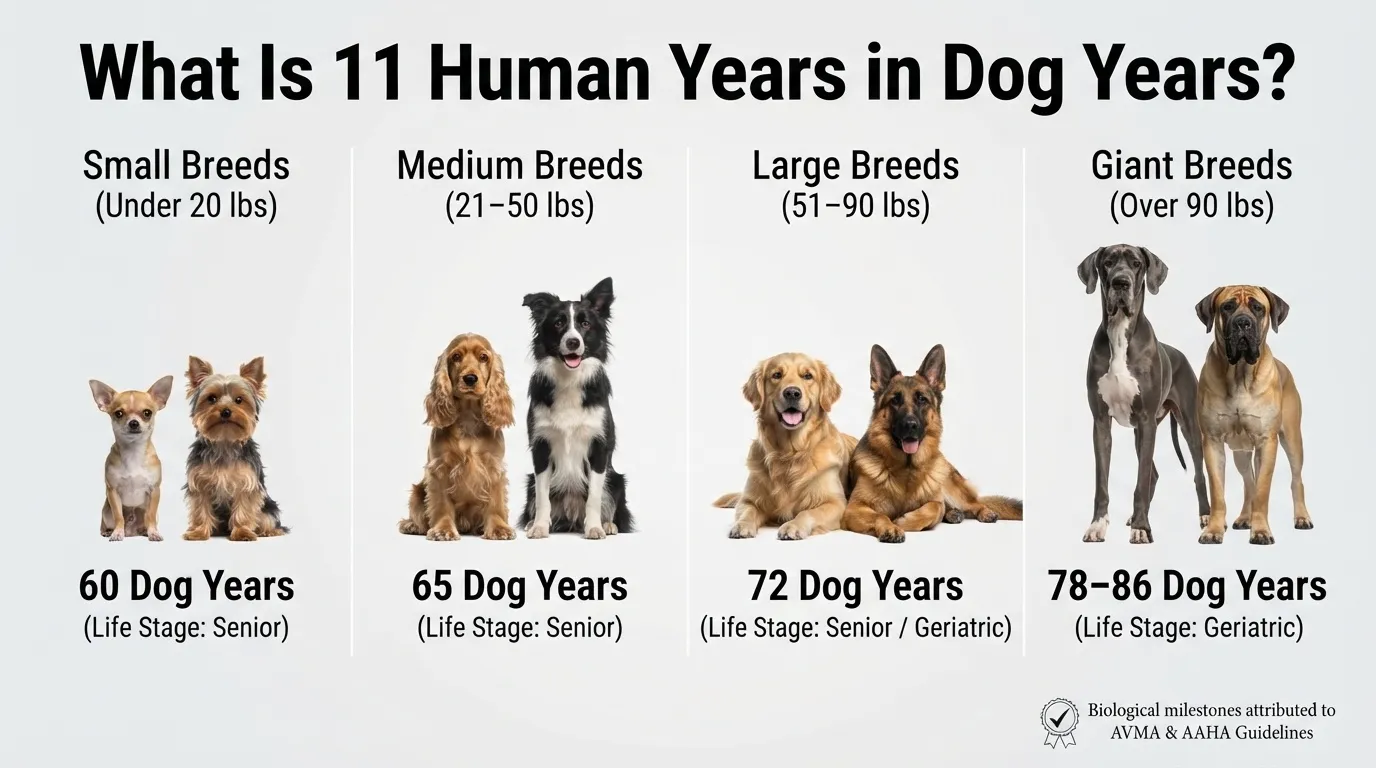
If you’re wondering what 11 human years in dog years means, the answer depends on a dog’s size and breed. An 11-year-old dog is generally a senior, but their equivalent age can vary significantly between small, medium, large, and giant breeds.
The old “multiply by 7” rule does not accurately reflect how dogs age. Dogs mature rapidly during their first two years, then their aging rate varies by size. Use the chart below to see the approximate dog-year equivalent of 11 human years for different size groups.
Quick Answer
An 11-year-old dog is approximately 60 to 86 dog years, depending on size:
| Dog Size | Approx. Dog Age | Life Stage |
|---|---|---|
| Small | ~60 years | Senior |
| Medium | ~65 years | Senior |
| Large | ~72 years | Senior/Geriatric |
| Giant | ~78–86 years | Geriatric |
Important: These are approximate biological-age comparisons, not exact mathematical conversions. Breed, genetics, health, and lifestyle can all affect how quickly an individual dog ages.
What Does "Human Years" Mean in Dog Age Context?
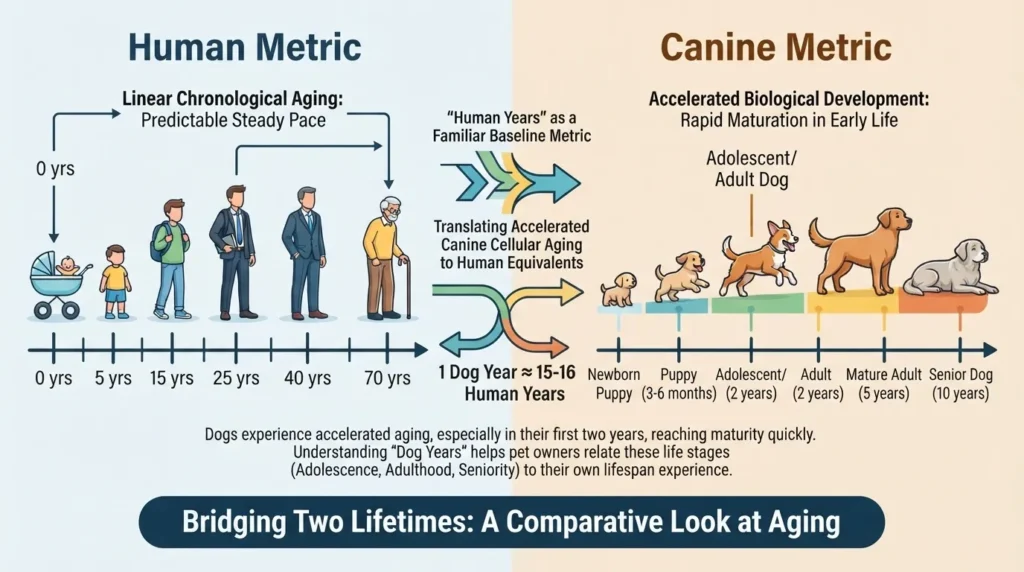
When we talk about “human years” in the context of our pets, we are simply referring to actual calendar years—the 365 days it takes for the Earth to orbit the sun. If you brought your puppy home exactly 12 months ago, they have been alive for one human year.
However, confusion arises because a dog’s biological clock ticks much faster than ours. Saying a dog is 17 years old in calendar years tells us how long they have lived, but it doesn’t accurately reflect their stage of physical development or cellular aging.
To bridge this gap, we use the term “dog years” to represent the human equivalent of a dog’s physical age. This metric allows us to compare a canine’s life stage directly to human milestones. For example, knowing what is 17 dog years in human years helps us understand that a 17-year-old dog in human years has survived well past the equivalent of a human centenarian, requiring specialized geriatric care.
Quick Answer — 11 Human Years in Dog Years
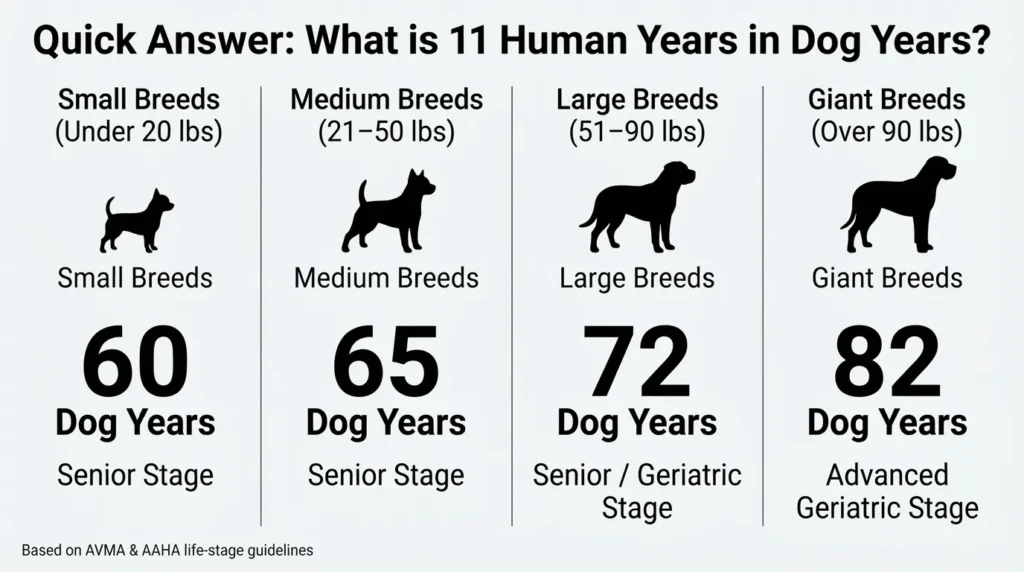
An 11-year-old dog is roughly equivalent to 60 to 86 human years old. The exact number depends heavily on your dog’s size and weight category, as smaller breeds age much slower than giant breeds.
While these numbers provide a solid baseline, it is important to remember that canine biological aging is an estimate rather than a rigid, exact science. Every dog is an individual; diet, genetics, lifestyle, and overall healthcare history will ultimately influence how old your dog acts and feels.
Understanding what 11 human years in dog years dog age calculator means helps you tailor your daily routine to your dog’s changing biological needs. It gives you a practical framework for scheduling more frequent senior vet checks, adjusting their nutritional intake, and planning proactive lifestyle changes to protect their aging joints.
How to Use Our Free Dog Age Calculator
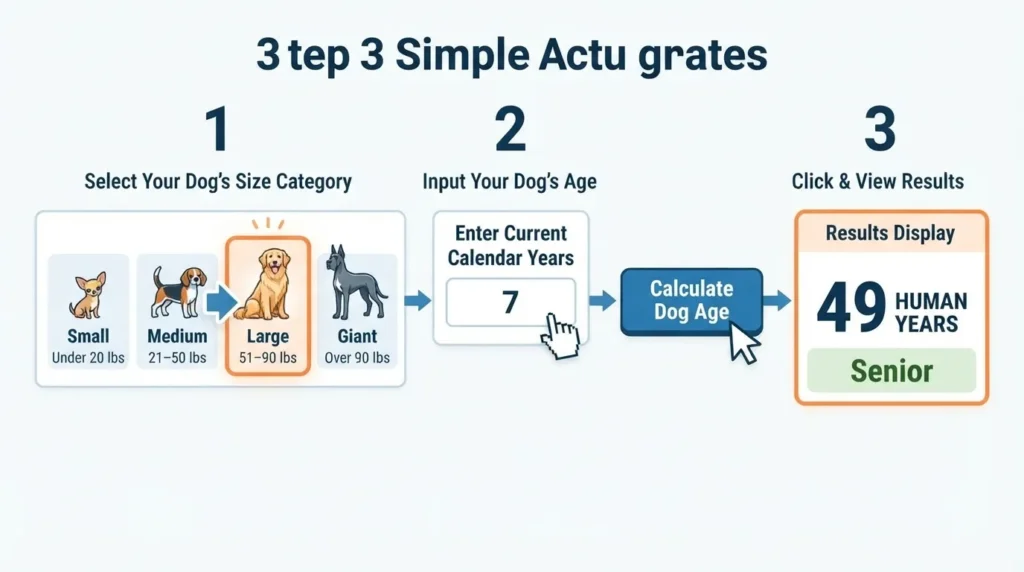
Finding your dog’s true biological age takes just a few clicks. Our calculator does all the heavy lifting behind the scenes, combining AVMA age progression guidelines with size-specific growth data to give you an accurate human-to-dog year conversion instantly.
Here is exactly how to get your results:
Select your dog’s breed or weight class: Because a 15-pound Chihuahua ages much slower than a 110-pound Mastiff, choosing the correct size category ensures the math aligns with your dog’s actual biology.
Enter their current age: Simply type in the number of years your dog has been by your side.
View the instant calculation: The tool will immediately reveal your dog’s equivalent age in human years alongside their current official AAHA life stage.
Calculating Age for Puppies or Months-Old Dogs
If you are trying to figure out the exact age of a puppy or a dog whose birthday doesn’t land on a perfect whole number, you can still use the tool easily. Simply convert the extra months into a decimal format before entering the number into the age field.
For example, if your dog is 1 year and 6 months old, you will enter 1.5 into the calculator. If they are 4 years and 3 months old, type in 4.25. This small adjustment ensures the calculation accounts for the rapid development that occurs during a dog’s younger months.
How Is 11 Human Years Converted Into Dog Years?
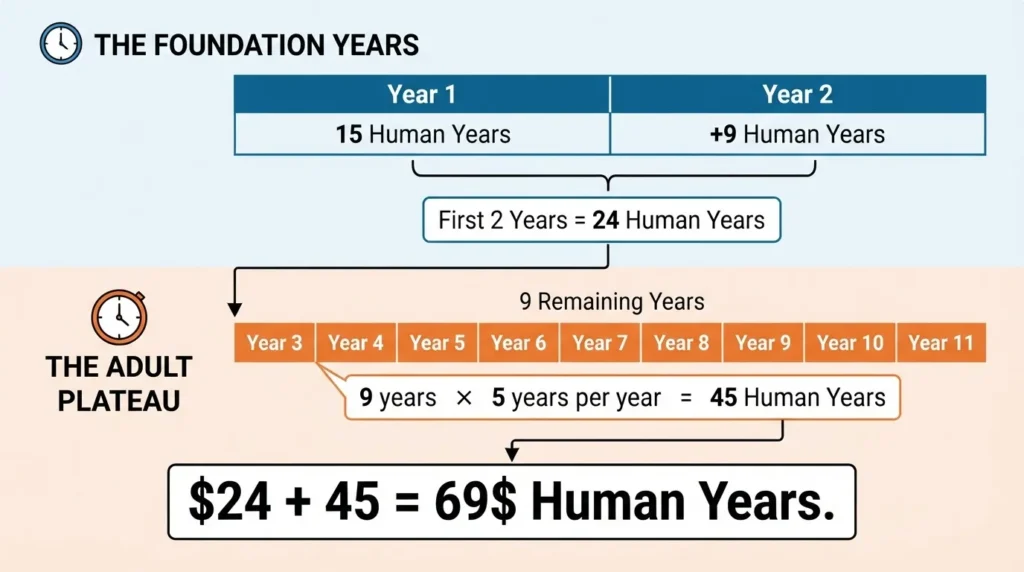
Calculating your dog’s true age means moving past old assumptions and looking at real biological milestones. Dogs develop rapidly in their first two years of life, meaning their aging process doesn’t scale on a straight line. To find out what 11 human years means for your dog, veterinary medicine uses a tiered approach based on growth phases rather than simple multiplication.
The Old “7-Year Rule” Myth (Why It’s Inaccurate)
For decades, the standard advice was simply to multiply a dog’s age by seven to find their equivalent human age. While this old rule of thumb was easy to remember, it is completely inaccurate.
If the seven-year rule were true, a one-year-old dog would have the developmental maturity of a seven-year-old human child. In reality, a one-year-old dog is fully capable of reproducing and has the physical maturity closer to a human teenager. The traditional rule completely misses how rapidly dogs mature in their youth, and it oversimplifies how aging slows down later in life.
Modern AVMA-Based Formula
To solve this inaccuracy, the American Veterinary Medical Association (AVMA) established a much more precise guideline that reflects real canine development. This formula splits a dog’s life into three distinct developmental stages:
Year 1 = 15 human years: A dog’s first year covers the massive leap from infancy through childhood and into adolescence.
Year 2 = +9 human years: The second year slows down slightly, adding nine human years to bring a two-year-old dog to the maturity level of a 24-year-old adult.
Each following year = +5 human years: Once a dog reaches adulthood, their physical aging stabilizes, accumulating roughly five human years for every calendar year that passes (adjusted slightly for heavier breeds).
Reverse Calculation Method Explained
To find what 11 human years in dog years looks like using this modern veterinary standard, we break the math down step-by-step. We start with the baseline of the first two years and then add the steady progression of the adult years.
Isolate the first two years: The first two years account for 24 human years of development (15 years for the first year plus 9 years for the second).
Calculate the remaining years: Subtract those first two years from the total 11 years, which leaves 9 remaining human years.
Multiply the remaining years: Multiply those 9 remaining years by the adult aging rate of 5, which equals 45 dog years.
Add the totals together: Combine both development periods (24 years plus 45 years) to get your final answer.
Following this method, a standard 17-year-old dog in human years has actually lived through a biological lifespan equivalent to 69 dog years. This shows why an 11-year-old pup is considered a distinguished senior who deserves a little extra comfort and care.
11 Human Years in Dog Years — Full Conversion Chart by Age & Breed Size
While knowing your dog’s current age is helpful, seeing the broader trajectory of their aging process helps you anticipate their changing needs. Instead of looking at a massive, repetitive chart, it is much easier to see how an 11-year-old dog compares to the milestone years around them.
Because weight plays such a massive role in how a dog’s body ages, 11 human years translates into a completely different developmental phase depending on the size of your pup:
Small Breeds (Under 20 lbs): Hit 60 dog years at age 11. They are senior citizens but often stay highly active for several more years.
Medium Breeds (21–50 lbs): Reach 65 dog years at age 11. They are firmly in their senior stage and might start showing early signs of slowing down.
Large Breeds (51–90 lbs): Cross into 72 dog years at age 11. At this point, they are moving from senior to geriatric care.
Giant Breeds (Over 90 lbs): Jump to 82 dog years at age 11. Because their life expectancy is shorter, they reach an advanced geriatric stage much sooner.
Note: These age conversions are approximate estimates based on generalized canine weight
ranges. Individual aging can vary depending on genetics, lifestyle, and overall metabolic health
What Does This Age Mean for Your Dog's Life Stage?
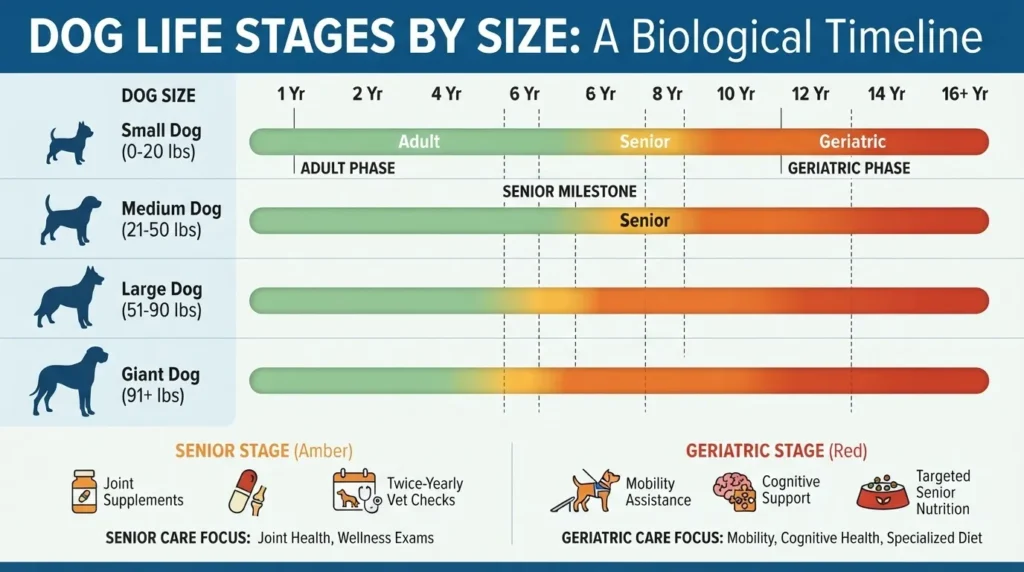
Reaching 11 human years means your dog has firmly moved past adulthood and is living as a true senior citizen. According to the American Animal Hospital Association (AAHA) canine life stage guidelines, dogs cross the senior threshold when they hit the last 25% of their breed’s estimated lifespan. For most dogs, this transition happens right around their late single-digit or early double-digit years.
A Relatable Comparison to Human Aging
To put this milestone into perspective, an 11-year-old dog has completely left behind the high-energy bursts of puppyhood, the testing boundaries of adolescence, and the peak physical fitness of young adulthood. Instead, their life stage is highly comparable to a human in their mid-60s to mid-70s.
Just like a retirement-aged human, your senior pup is entering a phase of life focused on pacing themselves, preserving joint comfort, and enjoying a much slower, predictable daily routine.
Is Your Dog Showing These Senior Signs?
Every dog experiences senior citizenship differently, but certain physical and behavioral shifts become common right around the 11-year mark. Use this self-check list to see how your dog is adapting to this life stage:
Changes in Sleep Patterns: Your dog might sleep much longer during the day or experience restless nights as their natural internal clock shifts.
Slower Transitions: You may notice them hesitating before climbing onto the couch, taking the stairs more slowly, or taking longer to get up after a nap.
Sensory Decline: They might not notice you walking into the room right away or could start startling easily, which often indicates early clouding of the eyes or mild age-related hearing loss.
Shifted Interaction Styles: Some senior dogs become much more attached and clingy to their owners for comfort, while others prefer quiet solitude away from noisy household activity.
Frequently Asked Questions
At 11 human years old, all dogs have officially crossed the threshold into their senior years. Small and medium dogs are firmly in the senior bracket, while large and giant breeds at this milestone are considered geriatric, meaning they require more focused age-related health monitoring.
Yes, a groundbreaking epigenetic clock study by researchers at the University of California, San Diego (UCSD) introduced a formula based on DNA methylation. Instead of fixed milestones, this science shows that canine aging is incredibly fast in the first few years and slows down dramatically later, placing a typical dog at a distinct biological maturity stage by their eleventh year.
Large dogs grow from puppies into massive adults at an accelerated pace, which researchers believe causes their cells to divide quickly and experience higher oxidative stress. This rapid early growth causes their biological clock to tick faster, pushing large dogs much deeper into senior citizenships by the time they hit 11 human years compared to slower-aging small dogs.
The calculations are highly accurate estimates based on modern life-stage models from the AVMA and AAHA. However, individual factors like genetics, diet, weight management, and routine veterinary care can cause a specific 11-year-old dog to be biologically younger or older than the average numbers show.
No, 11 human years looks very different depending on the size of the breed. While a small breed dog reaching 11 human years is roughly equivalent to a 60-year-old human senior, a giant breed dog at that same milestone has accelerated to an advanced geriatric stage of over 80 dog years.
🐾 Other Age Guides

Gulfam Haider Mehdi
Founder & Developer
I built Dogagescalculator.com to give dog owners honest, science-backed answers instead of the outdated "×7" myth. Every figure here is checked against AKC, AVMA, and published veterinary research.
More about the author & this site →📌 Featured Guides
what is 2 dog years in human years
→
dog breed chinese shar-pei
→
what is 4 dog years in human years
→
How Long Do Boston Terriers Live
→
mutt dog breed
→
70 in dog years
→
what is the lifespan of a basset hound
→
how long can a puppy hold their pee
→
Difference Between a Lhasa Apso and a Shih Tzu
→
How to Tell How Old a Bird Is
→
Comments