
What Is 20 Dog Years in Human Years?
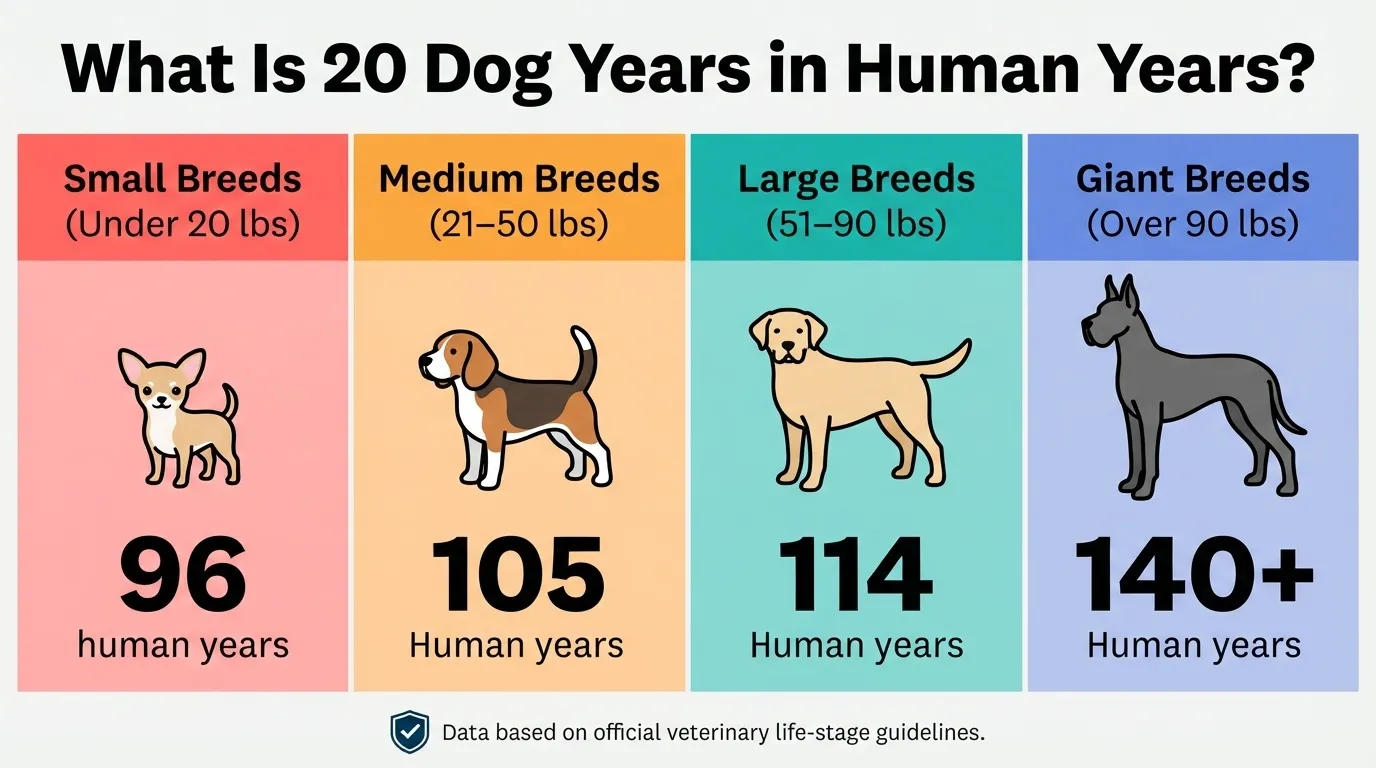
If you’re wondering what is 20 dog years in human years, a 20-year-old dog is exceptionally old. Depending on the dog’s size, breed, and overall health, its human-age equivalent can be roughly 96 to 120+ years.
A 20-year-old dog has far exceeded the typical lifespan of most dogs, making this a remarkable milestone. However, there is no single human-age number that applies to every dog. Smaller breeds generally live longer and tend to age more slowly in later life, while larger and giant breeds often experience age-related changes earlier.
The old “multiply by seven” rule would make a 20-year-old dog equivalent to 140 human years, but this simple calculation does not accurately reflect how dogs age. Modern approaches consider a dog’s age, adult size, breed, and life stage when estimating its human-age equivalent.
For a more personalized estimate, use our dog age calculator to see how your dog’s age compares with human years.
What Is 17 Dog Years in Human Years?
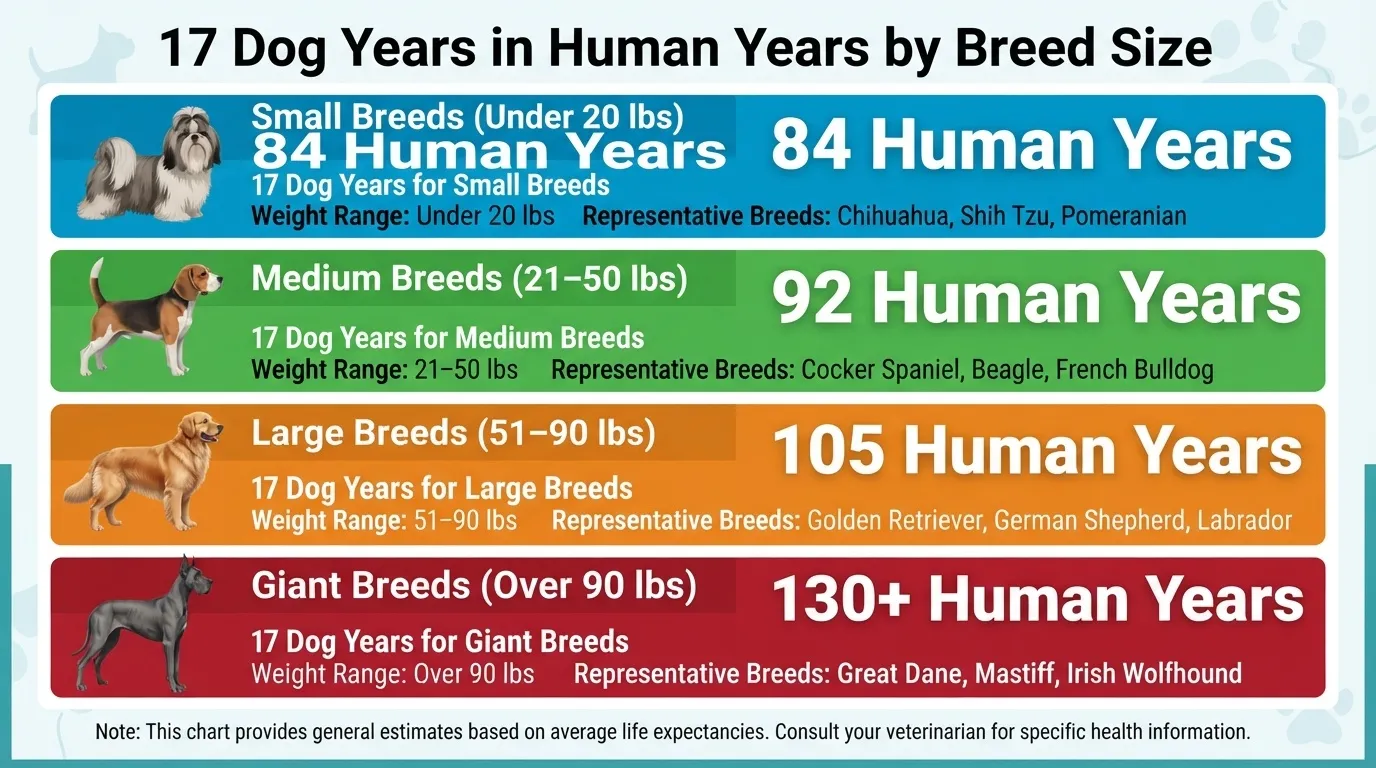
A 17-year-old dog is roughly 84 to 115+ in human years, depending entirely on their size and breed. Small dogs at 17 are roughly equivalent to an 84-year-old human, medium dogs are around 87 to 90, and large or giant breeds—which rarely reach this milestone—are well over 100 to 115 human years.
How Is Dog Age Calculated in Human Years?
The Scientific Epigenetic Formula
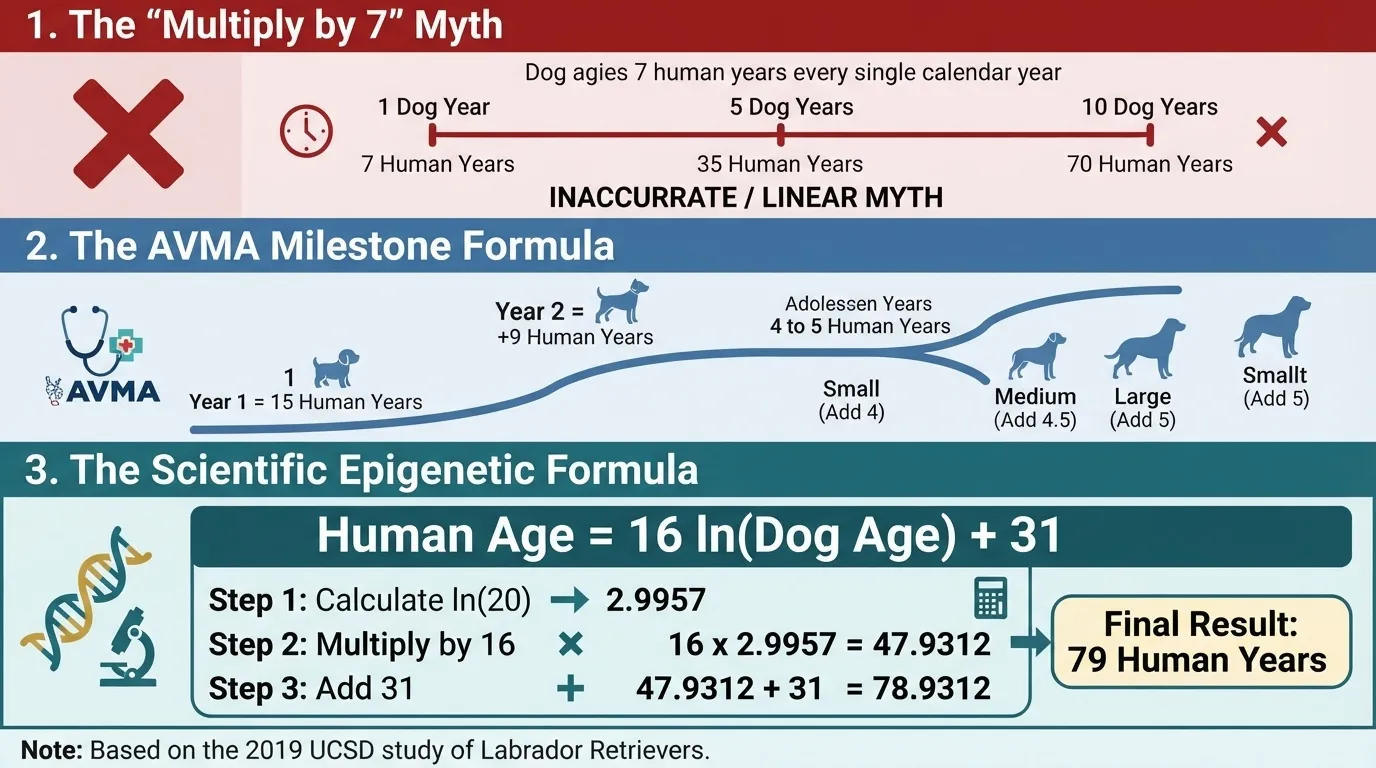
In 2019, researchers at the University of California, San Diego (UCSD) introduced a highly advanced method based on genetics. By studying DNA markers that track biological aging, the scientists created a new formula to map canine aging directly to human years.
If you want to bypass the complex math, here is exactly how a 20-year-old dog breaks down into human years using this scientific method:
| Step | What to Calculate | The Result |
| Step 1 | Find the biological baseline for age 20 | 2.996 |
| Step 2 | Multiply that baseline by 16 | 47.93 |
| Step 3 | Add 31 to get the final human age | 78.93 (Rounded to 79 years old) |
A Note on the Science: While this genetic formula provides a fascinating look at cellular aging, the UCSD study focused exclusively on Labrador Retrievers. Because small dogs generally live longer than large breeds, this specific calculation can overestimate the human equivalent age for smaller, long-lived dogs.
How Is Dog Age Calculated in Human Years?
The “Multiply by 7” Myth
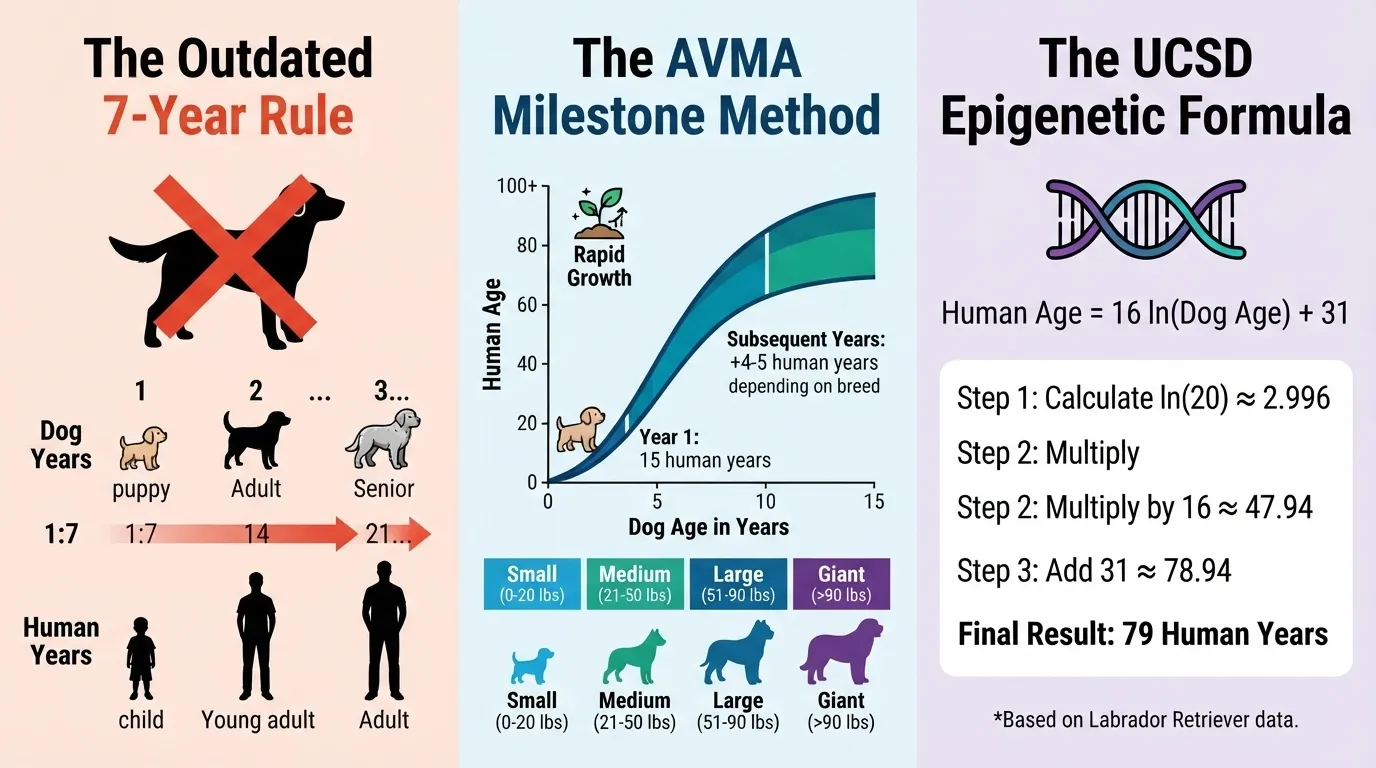
For decades, the go-to rule of thumb was simple: multiply your dog’s age by seven to get their human equivalent. While convenient, this old formula is completely inaccurate because it assumes dogs age at a perfectly linear rate throughout their entire lives. In reality, a puppy matures far faster in their first two years than a human does, and the aging process slows down significantly as they get older.
The AVMA Formula
To capture this uneven aging curve, the American Veterinary Medical Association (AVMA) outlines a much more realistic framework based on canine developmental milestones. Instead of a steady multiplier, the calculation shifts as your dog grows:
Year 1: The first year of a dog’s life counts for roughly 15 human years, reflecting the rapid leap from puppyhood to adolescence.
Year 2: The second year adds about 9 human years, bringing a two-year-old dog to the human equivalent of a 24-year-old young adult.
Year 3 and Beyond: Each additional year adds roughly 4 to 5 human years, though this pacing depends heavily on your dog’s specific size and breed.
The Scientific Epigenetic Formula
In 2019, researchers at the University of California, San Diego (UCSD) introduced a highly advanced method based on genetics. By studying DNA methylation—chemical markers that track biological aging—the scientists created a logarithmic formula to map canine aging directly to human aging.
While calculating what is 17 dog years in human years or assessing an older 17-year-old dog in human years relies on these modern biological baselines, the math behind a 20-year-old dog shows exactly how this genetic timeline works without the confusing equations:
| Step | How to Calculate | The Result (For a 20-Year-Old Dog) |
| Step 1 | Find the biological baseline (Natural Log) | 2.996 |
| Step 2 | Multiply that baseline by 16 | 47.93 |
| Step 3 | Add 31 to get the final human age | 78.93 (Rounded to 79 years old) |
A Note on the Science: While this genetic formula provides a fascinating look at cellular aging, the UCSD study focused exclusively on Labrador Retrievers. Because small dogs generally live longer than large breeds, this specific calculation can overestimate the human equivalent age for smaller, long-lived dogs.
What Life Stage Is a 20-Year-Old Dog In?
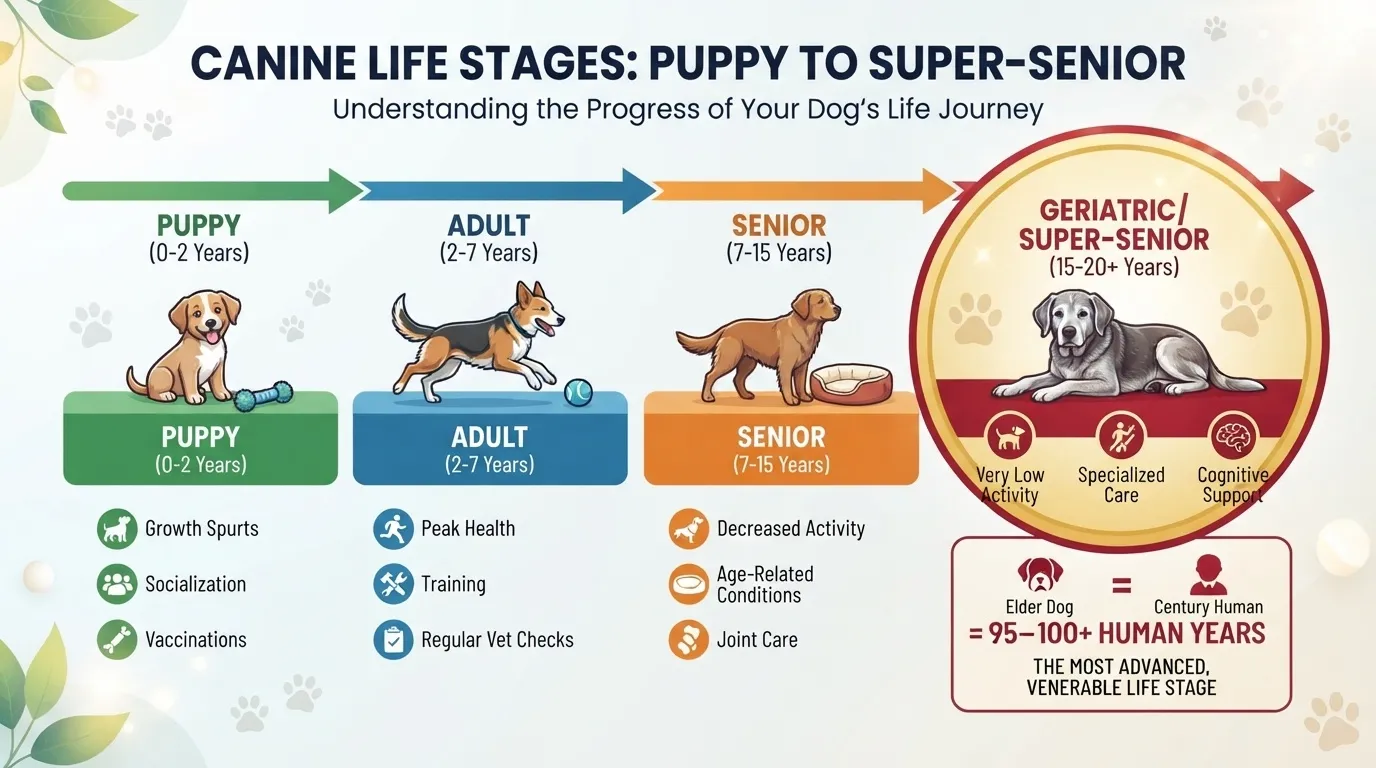
A 20-year-old dog has far surpassed the typical life expectancy for almost any breed, placing them deep within the geriatric stage of life. According to the AAHA Canine Life Stage Guidelines, dogs transition from senior to geriatric when they outlive the average lifespan of their specific breed by 25%. At this honorable age, your dog’s biological systems have slowed down significantly, requiring specialized daily management to keep them comfortable.
Common Signs of Advanced Aging
Living with a centenarian canine means you will notice distinct changes in their daily rhythms and physical capabilities. These are not necessarily signs of immediate failure, but rather the natural progression of advanced age:
Mobility Challenges: Severe stiffness, muscle wasting in the hindquarters, and difficulty rising from slick floors due to osteoarthritis.
Sensory Decline: Cloudy eyes from nuclear sclerosis or cataracts, alongside a significant loss of hearing that might make them startle easily.
Cognitive Shifts: Disorientation, wandering, pacing at night, or vocalizing without a clear reason, which often points to Canine Cognitive Dysfunction (CCD).
Practical Care Tips for Your Geriatric Dog
Caring for a 20-year-old companion focuses heavily on maintaining an excellent quality of life through environmental modifications and proactive health monitoring.
Tailored Nutrition: Switch to highly digestible, senior-specific diets featuring elevated omega-3 fatty acids for joint health and adjusted calorie profiles to combat weight loss or obesity.
Frequent Veterinary Assessments: Increase wellness visits to every 3 to 4 months so your vet can run regular blood work, monitor kidney function, and adjust pain management protocols promptly.
Home Modifications: Lay down non-slip rugs across high-traffic areas, use orthopedic memory foam beds to protect pressure points, and utilize specialized lifting harnesses to assist them during bathroom breaks.
For a comprehensive breakdown of milestone care, you can review the formal veterinary recommendations outlined in the AAHA Canine Life Stage Guidelines.
Can a Dog Really Live to 20 Years?
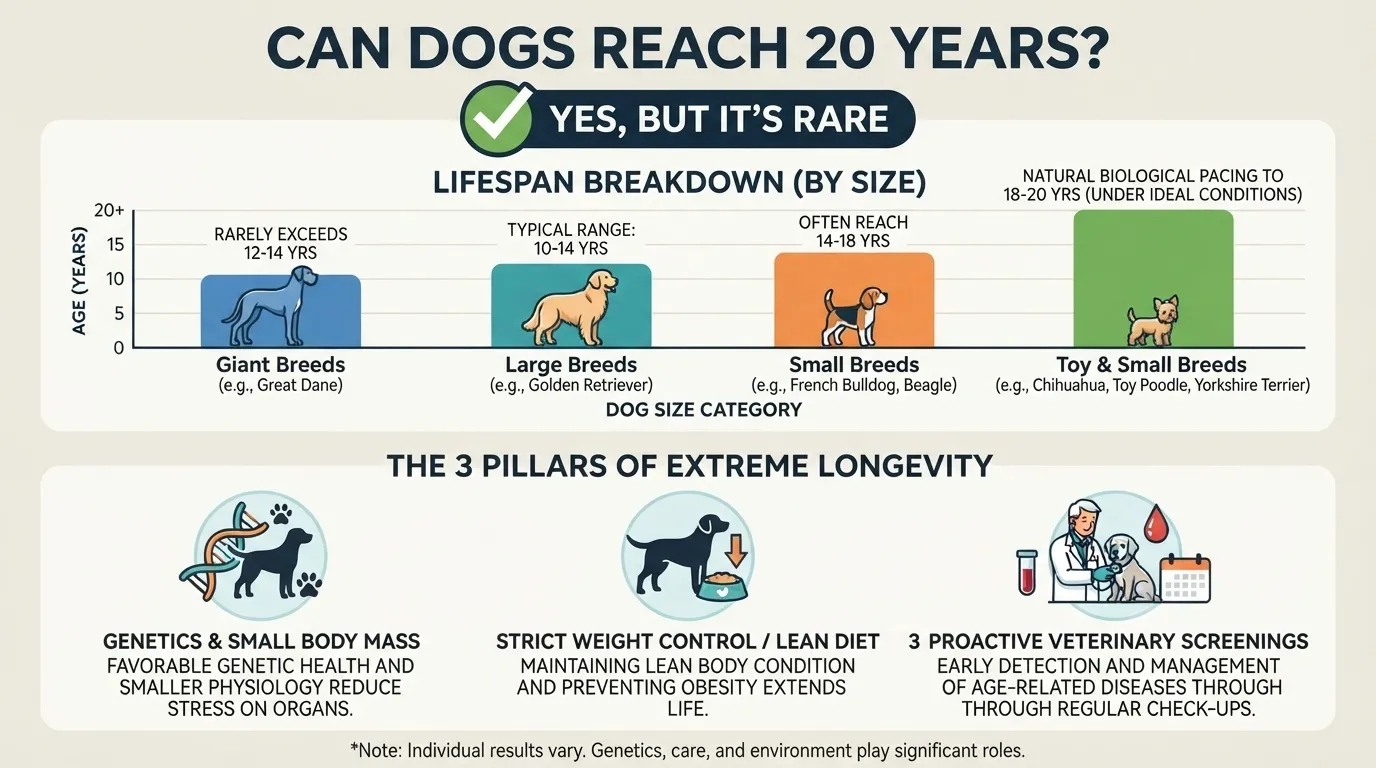
While reaching 20 dog years is an incredible milestone, it is absolutely possible. Very few dogs reach this advanced age—it is roughly equivalent to a human living past 100—but veterinary advancements and proactive pet care are making extreme canine longevity more common.
Breeds Most Likely to Reach 20 Years
Size is the single most critical factor in determining whether a dog can reach two decades of life. Toy and small breeds possess a distinct biological advantage, as they age at a much slower rate than large and giant breeds after reaching adulthood.
If you are looking at dogs that successfully cross into this rare age bracket, they almost always belong to specific small-stature groups:
Chihuahuas and Toy Poodles: Renowned for their exceptional lifespans, these breeds frequently reach 15 to 18 years, with resilient individuals pushing right past 20.
Dachshunds and Shih Tzus: These small, sturdy companions are biologically wired for slower cellular aging, making them top contenders for extreme longevity.
Yorkshire Terriers and Maltese: With consistent dental care and weight management, these toy companions routinely defy standard canine lifespan averages.
Critical Factors for Extreme Canine Longevity
A dog doesn’t reach the milestone of a 17-year-old dog in human years or beyond by accident. It requires a perfect alignment of genetic luck, specialized lifestyle management, and attentive veterinary care throughout their life stages.
| Longevity Pillar | Impact on Lifespan |
|---|---|
| Genetic Lottery | Innate resistance to congenital heart defects, early-onset cancers, and major organ failures. |
| Lean Body Weight | Keeping a dog lean prevents metabolic stress. AAHA guidelines show that lean dogs live up to two years longer than overweight dogs. |
| Advanced Senior Care | Bi-annual vet visits, comprehensive senior blood panels, and early management of arthritis or kidney changes. |
| Proactive Dental Hygiene | Periodontal disease introduces harmful bacteria directly into a senior dog’s bloodstream, accelerating heart and kidney decline. |
The Limits of Canine Longevity Records
When looking at what is possible for a 17-year-old dog, the absolute ceiling of canine lifespan is even higher. According to official historical records, the oldest verified dog in history was an Australian Cattle Dog named Bluey, who lived to an astonishing 29 years and 5 months.
While recent claims of dogs living into their early 30s frequently make internet headlines, veterinary scientists and official record-keeping bodies treat these unverified cases with high skepticism due to a lack of reliable, traceable birth documentation. Focusing on realistic senior health care remains the best way to help your own dog break age barriers safely.
How Our Dog Age Calculator Works
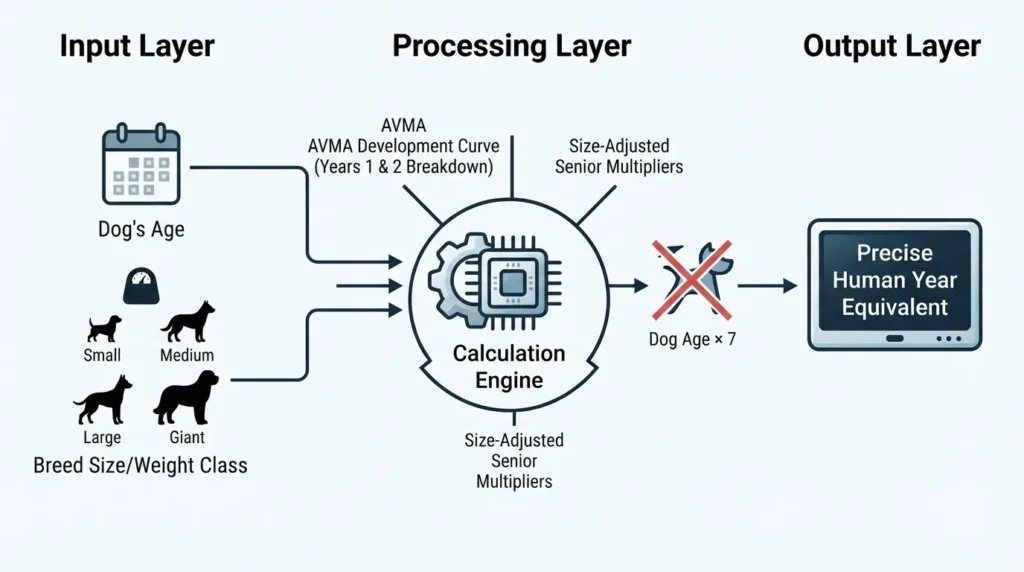
We designed our tool to eliminate the guesswork and provide a highly accurate calculation based on current veterinary science. Unlike static charts that treat all dogs the same, our calculator Dog Age Calculator customizes the result by pairing your dog’s specific breed size with verified life-stage metrics. It integrates both the trusted development milestones from the American Veterinary Medical Association (AVMA) and advanced cellular data from recent epigenetic research.
By calculating the unique aging curve of your pet, you get a realistic view of what 17 dog years truly looks like for their body. If you want to know exactly how your dog’s age translates to human milestones without dealing with any complex math, try our free calculator below. Simply choose your dog’s size, enter their age, and get an instant, science-backed result.
Frequently Asked Questions
No. The "multiply by 7" rule is a persistent myth that simplifies canine aging way too much. It wrongly assumes dogs age at a steady, linear rate their entire life. In reality, a puppy matures dramatically fast in its first two years before its biological clock settles down into a slower pace.
The exact conversion depends heavily on your dog's adult weight class, as larger dogs age faster than small ones. Here is how those milestones break down in human years:
10 Dog Years: This equals roughly 56 human years for small breeds, 60 years for medium dogs, 66 years for large breeds, and a senior 78 years for giant breeds.
15 Dog Years: At this stage, a small dog is about 76 human years old, a medium dog is 83, a large dog reaches 93, and a giant breed jumps to an incredible 115 human years.
Understanding these milestones helps you appreciate the journey when calculating what is 17 dog years in human years, as a 17-year-old dog in human years has officially outlived the average life expectancy for nearly any breed size.
Yes, clinical data indicates that spayed and neutered dogs generally live longer than intact dogs. This lifespan extension is primarily linked to a reduced risk of certain cancers, life-threatening uterine infections (pyometra), and trauma from roaming behaviors, rather than a direct alteration of their cellular aging clock.
Yes, clinical data indicates that spayed and neutered dogs generally live longer than intact dogs. This lifespan extension is primarily linked to a reduced risk of certain cancers, life-threatening uterine infections (pyometra), and trauma from roaming behaviors, rather than a direct alteration of their cellular aging clock.
According to AAHA canine life stage guidelines, a dog generally hits senior status when they reach the last 25% of their breed's expected lifespan. For giant breeds like Great Danes, this transitional senior phase can begin as early as 5 or 6 years old, while small Chihuahuas might not be considered seniors until they hit 10 or 11.
A single dog year is not equal to a single set number, but for an adult dog's first year of life, it equates to roughly 15 human years. This massive jump reflects how quickly a canine develops from a tiny puppy into a fully grown teenager during that initial twelve-month stretch.
🐾 Other Age Guides

Gulfam Haider Mehdi
Founder & Developer
I built Dogagescalculator.com to give dog owners honest, science-backed answers instead of the outdated "×7" myth. Every figure here is checked against AKC, AVMA, and published veterinary research.
More about the author & this site →📌 Featured Guides
What Is 13 Dog Years in Human Years
→
how old should a german shepherd be to breed
→
18 human years to dog years
→
what is the lifespan of an english bulldog
→
what is the lifespan of a basset hound
→
36 dog years to human years
→
oldest french bulldog
→
Nova Scotia Duck Tolling Retriever vs Golden Retriever
→
What Is the Lifespan of a French Bulldog?
→
What Is 11 Dog Years in Human Years
→
Comments